Сегодняшний день в Азии был, мягко говоря, не вдохновляющий, так как валютные рынки стали жертвой узких диапазонов и отсутствия каких либо важных данных или новостей. В основном, трейдеры сидели сложа руки и ждали сигналов от предстоящих данных, включая протокол заседания Банка Англии по монетарной политике в Великобритании, и потом чуть позже, индекс потребительских цен США и данные количества разрешений на строительство новых домов из Нью-Йорка. Full text »
[...]London Session - November 18, 2009 5:56 AM
0 commentsGains in EUR/USD accelerated in European hours before EUR buyers emerged at 1.4960. Softer stocks in Japan kept the lid on the risk trade in Asian hours but a better tone in European equities indices has coincided with a softer USD against the EUR, AUD and the NZD. Sterling has been subjected to a choppy morning. The pound initially plunged on the back of the release of the Nov MPC minutes. However, the unit has subsequently recovered. The softer USD has spurred gold to a high of USD1148.10 /troy ounce this morning. Full text »
[...]Asia Session - November 18, 2009 1:44 AM
0 commentsToday was not an exciting day in Asia by any stretch of the imagination as currency markets were victim of tight ranges and a lack of any meaningful data or news. Traders mostly sat on their hands and waited for signals from upcoming data including the Bank of England’s monetary policy minutes out of the UK, and a little further down the road, the US CPI and Building Permits data out of New York. Full text »
[...]New York Session - November 17, 2009 4:48 PM
0 commentsPoor economic data out of the US coupled with more jawboning in favor of the US dollar elicited a lackluster day for equities and resurgence in the buck. Stock markets closed up a smidge as a late day rally helped erase sharp losses early in the session. EUR/USD remained extremely well correlated with the risk trade and the pair squeezed down from a NY session open by 1.4880/90 towards the 1.4870 zone at last look. The recovery in stocks helped the pair come off the lows just above the crucial 1.4800 support level. Full text »
[...]U.S. Dollar Moves Higher in Currency Trading
0 commentsModest rally helps greenback in forex trading
The U.S. dollar is moving higher in currency trading on the FX market today. The euro is faltering in forex trading, and the greenback is gaining the upper hand — at least for now.
Yesterday, the story was different. Ben Bernanke tried to buoy up the dollar with rhetoric, but largely failed as the greenback tanked in forex trading, heading to 15-month lows.
Today, though, things are looking a little different. With equity markets pulling back and commodities losing ground, the U.S. dollar is finding support. However, this support may not last long, as it is expected that fundamentals will once again assert themselves as economic recovery progresses.
[...]Euro Heads Lower in Forex Trading
0 commentsEuro drops below 1.4900
The euro is heading lower in forex trading on the currency market today. After seeing a rally yesterday, the euro is pulling back as the U.S. dollar takes the upper hand.
Part of the reason is likely due to some profit taking. Another issue is the fact that equity markets are falling right now, and the euro generally derives support from strong stocks. And, of course, the pace of economic recovery remains in doubt.
FX Street offers a look at the technical side of the euro in forex trading:
[...]Ian Coleman, Analyst at Turtle Futures, comments: “We have hit some resistance at 1.4920 (was resistance now support). I am expecting a break here then looking to take off half the trade at 1.4893 (which is the daily trend line). If we break there it should be impulsively and take us down to 1.4696, my third wave target, pretty quickly.”
London Session - November 17, 2009 6:09 AM
0 commentsEUR/USD has drifted lower from its 1.5000 overnight high aided by comments from the ECB’s Trichet and a weaker tone in stock markets. The move back to USD1.500 wiped out any evidence of the fact that Fed Chairman Bernanke broke with convention yesterday to make mention of the USD. Bernanke’s acknowledgement of the headwinds that face the economy will continue to warrant low rates for an extended period effectively snuffed out any support for the USD. Full text »
[...]Asia Session - November 17, 2009 1:50 AM
0 commentsThe US Dollar was able to take a step back from lows but was still precariously close to them in a day that saw light flows and little action. The US Federal Reserve spent most of the NY day emphasizing the fact that rates in the US will remain low for an extended period of time, talk that would do nothing to buoy the sinking dollar. Further comments by Fed Chairman Bernanke that looked to reinforce the central bank’s “Strong dollar policy” fell mostly by the wayside. Full text »
[...]New York Session - November 16, 2009 4:45 PM
0 commentsBetter economic data and a rather status-quo Bernanke helped risk assets extend gains in NY trading, sending the US dollar commensurately lower. Headline retail sales blew away expectations, rising 1.4% in October on a pop in auto sales. Moreover, the “control” retail sales number (ex gasoline, auto dealers and building materials) was actually up a decent +0.5% on the month and this follows +0.4% in September and +0.5% in August. This really limited the downside for risky assets all day. Equities liked the details of the report even more than the headline and were up about 1.5% by the time the dust settled. Full text »
[...]U.K. Pound Moves Higher in Forex Trading
0 commentsSterling gains agains greenback in currency trading
The U.K. pound is moving higher in forex trading on the currency market today as risk appetite makes an appearance. High beta currencies are moving higher as equities around the world rally. Indeed, the sterling is seeing some benefit against the greenback in currency trading due to the gains by equities, including the fact that U.S. stock futures point to a higher open.
Retail sales in October showed improvement, led by auto sales, which are no longer receiving help from Cash for Clunkers. The U.S. dollar is down across the board, with a drop even against the Japanese yen, which is getting support on the strength of GDP growth.
For now, sterling is likely to remain well bid in currency trading. However, troubles in the British economy are far from over, and that could make a difference for the U.K. pound in forex trading going forward.
[...]Interview with Edward Hugh: The Dollar’s Demise is Vastly Overstated
0 commentsToday, we bring you an interview with Edward Hugh, a macro economist, who specializes in growth and productivity theory, demographic processes and their impact on macro performance, and the underlying dynamics of migration flows. Edward is based in Barcelona, and is currently engaged in research into the impact of aging, longevity, fertility and migration on economic growth. He is a regular contributor to a number of economics blogs, including India Economy Blog, A Fistful of Euros, Global Economy Matters and Demography Matters. [The interview will be presented in two parts, with the first part printed below].
Forex Blog: I’d like to begin by asking if there is any significance to the title of your blog (”Fistful of Euros”), or rather, is it only intended to be playful?
Obviously the title is a reference to the Segio Leone film, but you could read other connotations into it if you want. I would say the idea was basically playful with a serious intent. Personally I agree with Ben Bernanke that the Euro is a “great experiment”, and you could see the blog, and the debates which surround it as one tiny part of that experiment. As they say in Spanish, the future’s not ours to see, que sera, sera. Certainly that “fistful of euros” has now been put firmly on the table, and as we are about to discuss, the consequences are far from clear.
Forex Blog: You wrote a recent post outlining the US Dollar carry trade, and how you believe that the Dollar’s decline is cyclical/temporary rather than structural/permanent. Can you elaborate on this idea? Do you think it’s possible that the fervor with which investors have sold off the Dollar suggests that it could be a little of both?
Well, first of all, there is more than one thing happening here, so I would definitely agree from the outset, there are both cyclical and structural elements in play. Structurally, the architecture of Bretton Woods II is creaking round the edges, and in the longer run we are looking at a relative decline in the dollar, but as Keynes reminded us, in the long run we are all dead, while as I noted in the Afoe post, news of the early demise of the dollar is surely vastly overstated.
Put another way, while Bretton Woods II has surely seen its best days, till we have some idea what can replace it it is hard to see a major structural adjustment in the dollar. Europe’s economies are not strong enough for the Euro to simply step into the hole left by the dollar, the Chinese, as we know, are reluctant to see the dollar slide too far due to the losses they would take on dollar denominated instruments, while the Russians seem to constantly talk the USD down, while at the same time borrowing in that very same currency – so read this as you will. Personally, I cannot envisage a long term and durable alternative to the current set-up that doesn’t involve the Rupee and the Real, but these currencies are surely not ready for this kind of role at this point.
So we will stagger on.
On the cyclical side, what I am arguing is that for the time being the US has stepped in where Japan used to be, as one side of your carry pair of choice, since base money has been pumped up massively while there is little demand from consumers for further indebtedness, so the broader monetary aggregates haven’t risen in tandem, leaving large pools of liquidity which can simply leak out of the back door. That is, it may well be one of the perverse consequences of the Fed monetary easing policy that it finances consumption elsewhere – in Norway, or Australia, or South Africa, or Brazil, or India – but not directly inside the US.
This is something we saw happening during the last Japanese experiment in quantitative easing (from 2002 - 2006) and that it has the consequence, as it did for the Yen from 2005 to 2007, that the USD will have a trading parity which it would be hard to understand if this were not the case. I am also suggesting that this situation will unwind as and when the Federal Reserve start to seriously talk about withdrawing the emergency measures (both in terms of interest rates and the various forms of quantitative easing), but that this unwinding is unlikely to be extraordinarily violent, since the Japanese Yen can simply step in to plug the gap, as I am sure the Bank of Japan will not be able to raise interest rates anytime soon given the depth of the deflation problem they have. Indeed, investors will once more be able to borrow in Yen to invest in USD instruments, to the benefit of Japanese exports and the detriment of the US current account deficit, which is why I think we are in a finely balanced situation, with clear limits to movements in one direction or another.
Forex Blog: In the same post, you suggested that the Fed will be the first to raise interest rates. Why do you believe this is the case? How will this affect the Dollar carry trade?
Well, I would want to qualify this a little, becuase things are not that simple. In fact, as Claus Vistesen argues in this post, the ECB has rather “locked itself in” communicationally, and by talking up the eurozone economies they now have markets expecting clear exit road maps and even pricing in interest rate rises from the third quarter of next year. But if we look at the underlying weaknesses in some of the Eurozone economies – evidently Spain, but Italy is hardly likely to have a strong robust recovery, and the German economy needs exports and hence customers to really return to growth – it is hard to see monetary tightening being applied with any kind of vigour at the ECB, so they may move up somewhat – say to 2% – and then stop for some time.
I was also suggesting that in the short run they may do this to assist in the process of unwinding the global imbalances, since allowing the Fed to lead the world out of the monetary easing cycle would almost certainly provoke a rebound in USD, and problems for correcting the US current account deficit.
Really none of the developed economies (not even Norway) seem to be looking at the sort of really strong “V” shaped rebound some investors were anticipating, and it is more a question of who is weaker among of the weak. But if we look a little further ahead, at potential growth and inflation dynamics, then it is clear that the deflationary headwinds are stronger in Europe, while headline GDP growth may well turn out to be stronger in the US, and both these factors suggest that the Fed will at sometime be tightening faster than the ECB, in a repetition of what we saw from 2002 to 2005.
Forex Blog: You have pointed out that fiscal problems are not unique to the US. While the UK and Japan are certainly in the same fiscal boat, there seem to be plenty of examples of economies that aren’t, or at least not to the same extent, such as the EU. Do you think, then, that the long-term prospects for the Euro (especially as a global reserve currency) are necessarily brighter than for the Dollar?
[...]Well, actually I wouldn’t say the UK and Japan are in the same fiscal boat. Let me explain. The UK evidently has severe short term problems (as does the US) with its sovereign debt, due to the high cost of resolving the lossses produced by the current crisis. But Japan has still not resolved debt problems which were produced in the crisis of the late 1990s, and indeed both gross and net debt to GDP simply continue to rise there. So I would say – as long as they can weather the present storm – the outlook for US, UK and French sovereign debt is rather more positive than it is for Japan. Indeed in the longer term it is hard to see how Japan can resolve its problems without some kind of sovereign default. This is the problem with deflation, as nominal GDP goes down, debt to GDP simply rises and rises.
But the principal reason I am rather more positive on UK, US and French sovereign debt in the mid term is simply the underlying demographic dynamic. These countries have a lot more young people (proportionately) than the Germany’s, Japan’s and Italy’s of this world, and hence their elderly dependency ratios (which are the important thing when we come to talk about structural deficits into the future) will rise more slowly.
It is also important to realise that the EU – at this point at least – is not a single country in the way the US is, and indeed there is strong resistence among European citizens to the idea that it should be. So it is impossible to talk about the EU as if it were one country. That being said, the lastest forecast from the EU Commission suggests that average sovereign debt to GDP will breach the 100% threshold across the entire EU by 2014, so I would hardly call the situation promising. Basically some cases are much worse than others. In the East there are countries like Latvia and Hungary which are currently implementing IMF-lead structural transformation programmes, ut it is far from clear that these programmes will work, and sovereign debt to GDP has been rising sharply in both cases. In the South a similar problem exists, with Greek gross sovereign debt to GDP now expected by the Commission to hit 135% by 2011, and Italian debt set to increase significantly over the 110% mark. At the same time the future of government debt in Spain and Portugal is becoming increasingly uncertain. I would also point to the strong gamble Angela Merkel is making in Germany, and indeed ECB President Jean Claude Trichet singled the German case out during the last post rate-decision-meeting press conference for special mention in this regard. The future of German sovereign debt is far from clear, and markets certainly have not taken in this underlying reality.
So basically, and I think I have already explained my thinking on this in earlier questions, we have a structural difficulty, since I am sure the way out of Bretton Woods II will not be found by simply substituting the Euro for the USD. Europe is aging far more rapidly than the US, and the dependency ratio problems are consequently significantly greater.
Emerging Markets Bubble Continues to Inflate, but for How Long?
0 commentsYesterday, emerging markets (proxied by the MSCI Emerging Markets Index) recorded their biggest fall since July, ending a week of solid gains. Still, this one-day slide of 1.4% pales in comparison to the nearly 100% gain that the index has achieved since bottoming last March. In other words, while investors might be starting to pull back, the direction of asset prices is still upward.
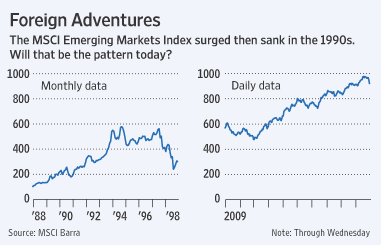
As for what’s causing this across-the-board appreciation, that was the subject of my previous post (Inverse Correlation between Dollar and Everything Else…Still), in which I merely stated the obvious; that the Fed’s year-long program of negative real interest rates and quantitative easing (i.e. wholesale money printing) has unleashed a flood of cash into global capital markets. Since we’re not just talking about the Dollar, here, it makes sense to point out that the Fed’s easy money policies have been copied by Central Banks in most other industrialized countries, including the UK, Canada, Switzerland, Sweden, and to a lesser extent, the EU.
As for why emerging market assets and currencies seem to be outpacing appreciation in other asset classes, that’s also not difficult to explain. First of all, by some measures, emerging market stocks have hardly outperformed other assets. Oil, for example, has risen by 131% in less than a year, to say nothing of other commodities. Still, by other measures, growth has been remarkable. Most emerging market stock indexes and currencies have fully erased (or come close to erasing) the losses recorded during the peak of the credit crisis. Bonds, meanwhile, have gone one step further. Yields are collapsing, and prices have exploded – by 25% in the last year, sending the JP Morgan Emerging Market Bond Index to a new record.
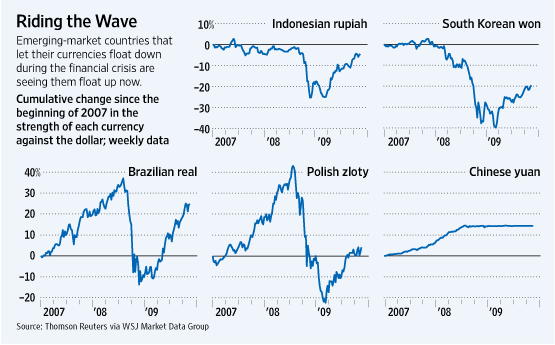
Is it safe to call this a bubble? Intuition would suggest so; given that all assets are rising across the board, without regard to particular fundamentals, it would seem that only a herd/bubble mentality could offer an explanation. Some analysts, in fact, have given up completely on fundamental analysis, instead using fund inflows (i.e. investor demand) to predict whether some emerging market assets will continue rising. As Nouriel Roubini (the NYU economist that famously predicted the credit crisis) summarizes: “Traders are borrowing at negative 20 per cent rates to invest on a highly leveraged basis on a mass of risky global assets that are rising in price due to excess liquidity and a massive carry trade.” P/E ratios are nearly twice as high in some emerging markets, compared to stocks in the S&P 500.
On the other side of the equation are the bulls and the efficient market theorists.”By historical price-to-earnings ratios — the ratio of stock prices to per-share profits — these levels can be justified, if the economic recovery continues. With massive layoffs, business costs have been cut sharply. “The hope is that when consumers and companies start spending, the added sales will drop quickly to the bottom line [profits].” Other proponents argue that the rise in asset prices is exactly what the Fed wants, since it implies that the markets are once again characterized by stability and liquidity.
Regardless of whether growth materializes, however, that doesn’t change the fact that the free ride can’t and won’t last forever. At some point, Central Banks will be forced to raise interest rates and start withdrawing Trillions of Dollars from global capital market. This will cause the Dollar to rise, and investors to rapidly unwind their carry trade positions. Warns Roubini, “A stampede will occur as closing long leveraged risky asset positions across all asset classes funded by dollar shorts triggers a co-ordinated collapse of all those risky assets – equities, commodities, emerging market asset classes and credit instruments.”
If the tech-bubble and real-estate bubble taught us anything, it is that there is no free lunch in the markets. It is not possible for all investors in all assets classes to simultaneously win. At least, in the long-term. In the short-term, meanwhile – it pains me to say this – let the party continue. My only warning is this: when the music stops, don’t be the one caught with your pants down…
[...]Cowabunga System Daily Update: Thursday, 11/05/09
0 commentsIf this is your first time visiting this blog, read this first!
Main Trend

Current Trend
The trend stayed up the entire day.
Today I only looked for long trades.
News events to watch for today :
- 4:30am EST- UK Manufacturing Production; Industrial Production
- 7:00am EST- Bank of England Interest Rate Decision
- 8:30am EST- US Non-Farm Productivity
Today's Surf
12:00am EST- There was a moving average crossover for a long trade. RSI was greater than 50, stochastics were trending up, but MACD was already negative. This cancelled out the signal and I did not enter.
3:15am EST- There was a moving average crossover for a long trade. RSI was greater than 50, stochastics were trending up, but MACD was already negative. This cancelled out the signal and I did not enter.
6:30am EST- No entry before news
10:30am EST- There was a moving average crossover for a long trade. RSI was greater than 50, stochastics were trending up and MACD was negative and gaining value. This was a valid entry
The entry was at the close of the candle at 1.6608 with a stop at the most recent low at 1.6535. Since I was 42 pips away from the nearest 50 or 00 level, I decided to put my initial target at 1.6650.
Entry: Long at 1.6608 Stop: 1.6535 Target: 1.6650
1:00pm EST- My target was not hit by this time. Since it was late in the day, I went ahead and cut my losses and exited out at 1.6580.

Trade Result: -28 pips (NOT INCLUDING SPREAD) R-Multiple: -0.38
News events to watch for tomorrow:
- 4:30am EST- UK PPI Input m/m
- 8:30am EST- US Non-Farm Employment Change
For a complete list of news events check out our Forex Economic Calendar.
Questions? Read the Cowabunga FAQ.
Want to discuss the Cowabunga System? Visit our Forex Forums.
Daily Economic Roundup - November 11, 2009
0 commentsWhat's on the Economic Horizon
Volatile GBP Ahead: Labor Market Statistics and Inflation Report on Tap
NZD: Retail Sales Due Late Tonight
US Veterans Day Holiday: Light Volatility Ahead?
United States
Ho hum, quiet trading for most of the majors yesterday. Save for the USDCAD and GBPUSD, the rest of the pairs were range-bound since the US economic schedule was relatively light. Still, the USD was able to lock in humble gains as investors took some profits off the table. More...
Euro zone
Relatively quiet Monday on the European front yesterday, as traders kept EUR pairs in check yesterday. The EURUSD bounced between a tight range of about 70 pips for most of the day. Could yesterday's consolidation lead to a breakout today? More...
Japan
The lack of any fundamental catalyst kept yen pairs in trading in tight ranges yesterday. Japan's economic calendar is once again empty of any important release today so expect the yen's price action to be largely dependent on risk sentiment. More...
United Kingdom
The pound took an early hit yesterday when Fitch commented on the possibility of a downgrade in UK's "AAA" sovereign rating. The GBP/USD was trading just a few pips below 1.6800 prior the comment and dropped to a low of 1.6602 before creeping up slowly to 1.6700 as the day went by. More...
Canada
The CAD moved sideways for the most part of yesterday before making a late push to close higher than the USD. The USDCAD pair fell to a low of 1.0488 but closed at 1.0500. More...
Australia
The Aussie flirted again with its yearly high in yesterday's trading. The AUDUSD, however, fell short and closed at 0.9302. In any case, it is possible for the pair to set a new yearly high since its longer term uptrend is still very much intact. More...
New Zealand
There was some hesitance to bring the Kiwi higher yesterday, as traders left the NZDUSD stuck in the mud. Kiwi trading was tight, which left the pair to close at 0.7418, just a few pips from its opening for the day. More...
Switzerland
The USDCHF was stuck in a 50-pip range as it bounced up and down from support at 1.0060 and resistance at 1.0110. The US economic schedule was relatively light yesterday while Switzerland's was free from any reports. More... [...]G20: The Silent Treatment
0 commentsOnce again, most finance moguls and central bank officials from the G20 kingdoms pledged their allegiance to their stimulus programs, claiming that it was still too early to implement exit strategies. According to the G20 summit, the recent economic recovery depends largely on easing policies and that high unemployment could undermine growth. Keeping their stimulus programs in place would provide support for the economy until it can stand on its own.
We've been hearing these same old words from the G20 leaders since their September meetings in London and Pittsburgh. Back then, it seemed prudent for them to continue implementing their easing policies in order to spur economic recovery. Now that we've seen plenty of signs of economic growth, aren't they getting tired of the usual sit-and-wait strategy? Did anything new come up this time?
There was one particular event (or rather, non-event) that set this November summit apart from the preceding meetings. Instead of discussing their concerns on the dying dollar, the G20 nations decided to avoid the issue completely. Quite odd, considering that some of the participants of the summit have shown a lot of unease on how the dollar is recently trading in the foreign exchange market.
Take for instance Canada. The BoC has been saying time and time again on how the persistent strength of the Canadian dollar would put a strain on their exports and would eventually stunt growth. ECB President Jean-Claude Trichet also said before that a strong dollar is extremely important now that the global economy is starting to recover. On the other side of the world, the RBNZ, although not part of the G20, has been echoing the same concerns as the BoC.
Hmmmm... pretty interesting don't ya think? Just when major economies all over the world start distressing about the dollar's value, they suddenly go mute when the opportunity to talk about the issue TOGETHER comes along...
Traders saw this lack of currency talks as a deliberate exclusion from their meeting's agenda, employing some sort of passive action - a silent treatment. Perhaps they just want the invisible hand to work its magic? Are the G20 nations letting the markets do their own thing while they lean on the side of caution?
The G20's commitment to keep stimulus programs in place, particularly by US Treasury hotshot Timothy Geithner, also contributed to the broad-based dollar selling. The Dollar Index slipped back to its 2009 lows, losing about 1% of its value.
The global capitals markets, including treasuries, commodities, and the "anti-dollar" currencies all staged strong rallies against the greenback. Almost all majors went soaring! Gold flew to a new historical high at $1,111.70/ounce before closing at $1,101.40/ounce. Oil also soared above $80/barrel before settling at $79.43/barrel. The Fiber (EURUSD) rose back to the 1.50 handle once again. The Aussie even gapped up before revisiting its yearly high around 0.93. The Kiwi, similar to the Aussie, bypassed some pips to close around 0.74. The Swissy, on the other hand, stepped a day-range closer to parity.
What could be in store for future meetings? Their next agenda might depend on what news and dominate sentiment in coming the months. If data supports that the economies are indeed improving, would we finally hear about the gang's potential exit strategies? Chances are, however, that the G20 nations would continue to sit on their hands until they grow numb. In the past few months, we've seen officials from different central banks express "cautious-optimism". Are those nervous smiles that I see?
Word on the street is that they will be focusing on the climate financing issue, as the 'richer' economies (like the G7) want emerging nations like Brazil, India and China to pay more towards future costs associated with climate change. With this in mind, I don't think we'll be hearing any talks about currency levels or the weakness of the dollar. We might just be in for another non-currency-event the next time the G20 party rolls around...
Daily Chart Art - November 11, 2009
0 commentsAUDUSD: 1-Hour

Good morning forex friends! Let's start today by looking at the AUDUSD's 1-hour chart. As you can see, the pair fell back to its 50% Fibonacci retracement level after climbing to 0.9324. It can revisit yesterday's high at 0.9324 if the uptrend support holds, and possibly move even higher if it breaks above the said level. However, if the pair breaks below the rising trendline drawn on the chart, sellers could push the Aussie back to retest the minor support at 0.9260.
EURUSD: 1-Hour

Next is the EURUSD on the 1-hour chart. After breaking free from the 1.4900 resistance, the pair continued to head north where it flirted with the 1.5000 handle once again. Presently, the pair is trading just below the mentioned price level, but it still has an upward bias since the uptrend line is still unbroken. If buyers continue to push the pair north, we may see a break of this year's high. On the other hand, just like the AUDUSD, if it does break below the rising trendline, we could see a retest of yesterday's low, minor support around 1.4950.
USDCAD: 1-hour

The CAD was one of the strong performers yesterday as the USDCAD dipped to a low of 1.0485. However, the selling pressure seems to be exhausted now that the stochastics are in the oversold area. Bullish divergence, with the price showing lower lows and the oscillator drawing higher lows, also hints that the pair could move higher. Drawing a Fibonacci tool on the latest swing move shows that the 38.2% retracement level is nearly in line with previous support just a few pips above the psychological 1.0600 handle. If that area fails to serve as resistance, the pair could climb but encounter another resistance level at the 61.8% Fibonacci level, which is aligned with previous minor resistance at 1.0668.
The Yen vs. the Dollar - Double Entendre?
0 commentsUS Treasury Secretary Timothy Geitner was in Japan talking with Japanese reporters today, where he stated "I believe deeply that it's very important to the United States, to the economic health of the United States, that we maintain a strong dollar."
Meanwhile the question that remains is whether the Bank of Japan intervene if the USD/JPY breaks below 88.00 as they have in the past. The bank is silent on this subject at the moment.
Which brings us to this week's truth-telling Fibs.
On October 7th, price reached a low at the end of a long-term downtrend at 88.03 By October 27th price had bounced up hitting a high of 92.33
As you can see on the chart, price looks as though it may be hitting a double-bottom with strong resistance at the 61.8 retracement level at 89.76
If price continues up from here, a very long-term target would be 94.98. Closer resistance levels to watch include 90.18, 90.69, 91.31 and 92.33, which would bring us back to the previous high.
If price finally does break this support level, the USD/JPY could go back to the 88.03 level, potentially pausing at additional support along the way at 88.95 - at which point we would find out what the Bank of Japan intends to do.

Forcing Trades
0 commentsI was watching the Lakers play the other night on the tube. While I'm a big fan of Kobe Bryant, I was getting frustrated at him during the game because he seemed to, at least in my opinion, force too many shots. His teammate would pass him the ball, four defenders would run over and smother him, essentially giving him a .01% chance of scoring, but did he decide to pass the ball to an open man?
Eight times out of ten, that would be a negative. He loves to be in his "I'll score and not look for anyone else" mode. Kobe believes he always has a shot whether it's one guy defending him or five, whether he's dislocated his right shoulder, or broke his left foot. He will still shoot the ball and think he can still make it.
The scary thing is he probably could. I wouldn't bet against him. He's the greatest.
But that's not the point.
The point is because he forces so many shots when he could easily pass the ball to a teammate who is open for a shot that has a higher probability of going in, the Lakers lose.
You will get a similar outcome if you force your trades. I've learned the hard way not to execute trades just because I'm bored and there's nothing to do. The market doesn't always have a trade available so sometimes the best thing to do is the same thing Kobe should do...pass it up!
As a trader, what you should do is absolutely NOTHING! Be patient. The best action at times is no action at all.
What happens when Kobe forces a shot? He usually causes a turnover where the opposing teams rebounds the missed shot and scores on the other end. What does Kobe do after this happens? He gets the ball and tries to force another shot.
It's the same when trading. What happens when you force a trade? You lose and you force again and then lose again.
The key to becoming a successful trader is knowing when to stop yourself. You must know how and when to stop trading and stay out of the market. It's tough to stop but it's crucial to stop and walk away when the trades aren't going your way. You don't want a couple losing trades to turn into a losing streak like the Lakers seem to regularly be in.
If you can't stop trading, you will eventually stop...when your account runs out of money.
Unfortunately, it's not as simple a solution for Kobe. I doubt he'll quit forcing shots. It's a good thing they have Andrew Bynum, Lamar Odom and Pao Gasol to grab offensive rebounds.
Who is the greatest basketball player ever?
Share ThisPolldaddy.com [...]
USDCAD - Close Open Orders
0 commentsClose Open Orders: 2009-11-04 13:42
Welps...it looks like USDCAD was ready to breakout, but to the downside! Positive ISM data from the US brought back the risk bulls out, taking traders away from greenback and moving back to the Loonie. The pair broke well below the rising trendline and finally found support at 1.0600. Needless to say, it's time to close my open orders, especially ahead of the upcoming FOMC event.
Closed Open Orders. No trade.
Alrighty, nothing to do now but wait for the FOMC meeting before making any moves. Stay tuned and be safe in these wild and crazy markets!
Trade Idea: 2009-11-03 04:22

Good morning Forex friends! For this week, I am watching USDCAD for a potential breakout on a classic chart pattern setup. Are currencies ready to move with all the major data coming out this week?
First, the technicals. I have the one hour chart up and we can see an ascending triangle forming. This shows buyers growing in strength, jumping back in on every dip, but sellers have been able to hold buyers off around 1.0800 - 1.0850. Sooner or later, sellers wouldn't be able to hold back the buyers and a reakout may occur. Will we see a breakout? Not sure, but the current market sentiment may give us a clue.
This past week, we have seen a return to risk aversion sentiment across the global markets on continuing economic weakness concerns. This has traders selling "riskier" assets (like commodities, equities, and "high-yielding" currencies), and flocking back towards "safe haven" assets like the Greenback. Are traders right in that we will see further weakness? There's so much data out there pointing to one way or another that it is difficult to weed out what really matters.
For me, I'm basing my bias on this one thought - if the economy is getting better, why do governments need to extend stimulus programs like unemployment benefits, home buyer credits, and quantitative easing measures? Makes no sense. While I think governments have been a little slow in the recent past to recognize potentially dire situations, I would have to agree with what their actions are saying - the economy is weak and cannot survive without its help. I think risk aversion behaviors in the markets are likely to continue in the short to medium term, and I'm willing to take a calculated risk on it.
Last factor to take note of is this week's major economic events. Most notable include the FOMC interest rate decision and the US and Canadian employment reports. I'm not going to try to forecast numbers, but I will say that they have the potential to facilitate a breakout move, depending on the final reads and market reactions. Check out our Forex calendar for specific data and times of these releases.
So, I am taking a long trade in USDCAD based on my technical analysis and fundamental outlook. I will buy above the resistance area, just above last week's high point. My stop will be 150 pips (daily average true range and below the rising trendline) and I will target the area of last resistance between 1.1000 to 1.1100. Here is what I am going to do:
Long USDCAD at 1.0875, stop at 1.0725, pt1 at 1.1000, pt2 at 1.1100
Remember to never risk more than 1% of a trading account on any single trade. Adjust position sizes accordingly.
An interesting week ahead of us with the potential for some really nice trades! Thanks for checking out my blog and stay tuned for updates and adjustments!
BabyPips.com USDCAD Forums
BabyPips.com Forex Chatroom
Will USDCAD break above or below the ascending triangle?
Share ThisPolldaddy.com [...]
Back To The Classics: USDCHF
0 comments
The first day of the week got pretty hectic for me because, well, people needed their coffee to wipe out their Monday blues! I got home late last night and, after freshening up, I decided to read up on what happened in the forex world...
It seems that dollar weakness dominated on Monday, after reports indicated that G20 nations want to keep stimulus and interest rates at current levels. I don't think this is too good for the dollar... Just yesterday, we saw the greenback get dumped! Also, with more and more people speculating that US interest rates will stay low until 2010, then fewer people would want to invest in the USD, right?
Anyway, when I looked at the charts, I noticed a nice setup on the USDCHF 1-hour chart. The pair just broke below support at 1.0130 and tumbled down. The 50% Fibonacci retracement level of the latest swing move is nearly in line with the broken support level. This level also coincides with the previous week low. Given this, I suspect a lot of sellers are just waiting to short the pair at a much better price, especially since the pair is forming a bearish divergence.
The pair moves, on average, 100 pips per day so I will place my stop at 1.0185. I believe that, assuming the trade gets triggered, the pair only has 50 pips to climb before the buying pressure gets exhausted. In addition, 1.0185 is also beyond the 61.8% Fibonacci retracement level.
Here's what I will do:
Short at 1.0125, profit target at 1.0050, stop at 1.0185.
As usual, I will adjust my position size to make sure I risk only 1% of my account. I also plan to close the trade before the European session ends.
I hope my trade gets triggered this time. Wish me luck! I'll keep y'all posted! [...]Interest in Forex Grows with Fear
0 commentsThere’s a correlation between fear of worsening economic conditions and the interest in forex trading. This can be seen in figures disclosed by big forex portals and also in my internal statistics.
Forex trading is at many times an alternative to stock markets. Many forex brokers tease potential customers by pointing out that their stock portfolios are plunging. Forex still didn’t reach out to the masses, but it did draw more money and more interest following the crisis.
Francesc Riverola, CEO of the popular forex portal FXStreet, recently published a post which showed that October saw the highest traffic since March.
Ben Bernanke stunned the markets in March, by announcing the trillion dollar printing program. Since then, the dollar fell and stock markets rallied. Interest in forex fell, according to FXStreet.
And when was the new peak? In another post, Riverola shows that it was on the last week of October. This was the best week of traffic on FXStreet This specific week saw panic return to the markets. Riverola’s transparency is impressing.
Fears of a double-dip recession, Roubini’s scary prophecies and sent the markets down and the dollar up. At the end of that week, I was wondering if the tables are turning.
Here at Forex Crunch, I also had a peak week on the last week of October, significantly better than previous weeks. Monday, October 26th saw a peak of 7,000 page views.
Also in a much smaller site like mine, the fear was felt in the interest in forex trading. Thanks to all my readers!
Looking at my favorite portal, Forex Factory, you can see that the highest number of concurrent users was last Friday, when US unemployment rate rose above 10% – quite gloomy.
I believe that other forex blogs and portals are also seeing the same equation: bad economic situation = good times for forex.
Thanks to Michael Greenberg that pointed out Francesc Riverola’s blog. Read more about the situation of forex portals in Michael’s blog.
[...]Forex Daily Outlook – November 11th 2009
0 commentsIt’s Remembrance Day in many countries in the Western hemisphere, so forex trading will be rather light today. In Britain, there’s no holiday, and there are major employment events. Let’s see what’s on the menu today:
Both the US and Canada are on holiday, but this doesn’t mean that USD/CAD won’t shake, after breaking the support line yesterday.
An influx of data arrives from China. The most important figure is Industrial Production. The growth rate is expected to rise from 13.9% to 15.3%, showing that the Asian giant is in full strength. Also note Trade Balance, which is expected to show a higher surplus.
Good figures from China are good for the Aussie. For more on the Australian dollar, read the weekly AUD/USD forecast.
New: An outlook video from my partners:

Big day in Britain
Britain’s Claimant Count Change is the earliest and most important employment figure. The rise in unemployed people softened last month, helping the Pound. It’s expected to remain stable at around 20.2K. And there’s more in the UK…
At the same time, 9:30 GMT, the Unemployment Rate is released. This related to the previous month – September. Despite the late release, this figure, which surprised twice, has a great influence on cable as well. It’s expected to edge up from 7.9% to 8%.
Later in Britain, the Bank of England will release the quarterly BOE Inflation Report. It’s expected to show that Britain is on the verge of deflation, with slowing price rises. Mervyn King, governor of the BoE, will hold a press conference immediately after the release of the report. He will state policy related to inflation (or deflation), something that will rock the Pound.
For more on the British Pound, check out the weekly GBP/USD forecast.
In Europe, despite the holiday, a speech from Axel Weber, head of the German Budesbank is expected. He’s one of the strongest people at the European Central Bank.
For more on the Euro, I suggest reading Casey Stubbs’ recent EUR/USD technical analysis and my EUR/USD weekly forecast.
Near the end of the day, New Zealand will release a major figure: retail sales. They’re expected to rise by 0.5%, about half of last month’s rise. Core retail sales are predicted to rise by 0.4%, much less than 1.2% that was recorded last month.
That’s it for today. Happy forex trading!
[...]USD/CAD breaking minor support – the move is fragile
0 commentsThe Canadian dollar built up strength from a few factors and managed to break a minor support line. It’s now back to the levels that it was before the greenback comeback, but has bumps on the way.
USD/CAD now trades at 1.0520, after touching the round number of 1.0500. Since the beginning of the week, it made a move of over 200 pips downwards, and there are various reasons.
The drop began yesterday with the general dollar weakness. The G20 ministers are allowing the dollar to fall. This took USD/CAD down to 1.06, the support line mentioned in the weekly USD/CAD forecast.
Canadian housing starts, which disappointed many times in recent months managed to meet expectations and rise to 157K. The publication sent USD/CAD below the 1.06 support line, but it stalled at around 1.0540.
In today’s New York session, a fresh new wave of dollar weakness sent USD/CAD to 1.05, but it bounced and went higher again.
The Canadian economy is recovering slowly, similar to the American one. The recent negative monthly GDP hurt the Canadian dollar that had many reasons to rise. This wasn’t the only problem. Mark Carney, head of the BOC, released a as a dovish rate decision.
The latest disappointment in Canada was quite big: the Canadian job market lost over 40,000 jobs, more than the gains in the previous months.
The Canadian economy is recovering quite slowly, and the recent move downwards is mostly attributed to the weakness of the US dollar, rather than the strength of the Canadian one.
USD/CAD must close the week under the 1.06 line in order to convince traders that the Canadian dollar is strong, aiming for parity.
[...]Forex Daily Outlook – November 10th 2009
0 commentsLots of economic indicators are published today, with the German ZEW Economic Sentiment standing out. Let’s see what’s up for dollar continue the plunge?
British figures start the day: BRC Retail Sales Monitor serves as the “mini retail sales” release. It rose by 2.8% last month, and is expected to keep on growing. The RICS House Price BalanTce shows that more areas are reporting a rising in price. The positive number of 22% is expected to be followed by 29% this time.
Later in Britain, Trade Balance is predicted to remain stable, at a deficit of around 6.2 billion. The CB Leading Index, which is based on data that has already been released, is expected to rise again, despite the recent fall in GDP.
GBP/USD broke the resistance line and is making a sharp move north. For more on the British Pound, read the GBP/USD Forecast.
New: A daily outlook from my partners:

In Japan, the Economy Watchers Sentiment is predicted to rise cautiously to 43.9 points. Near the end of the day, Core Machinery Orders are expected to jump by 3.7%.
Australia’s NAB Business Confidence will be released, and it’s expected to resume rising, after dropping last month. The Aussie is doing well.On the other side of the day, Westpac Consumer Sentiment is expected to continue rising, following last month’s 1.7% rise.
For more on the Australian dollar, read the AUD/USD Forecast.
In Europe, German Final CPI is expected to confirm the early read of a 0.1% – too low for thinking about a rate hike. Following yesterday’s nice rise in the German industrial production, France is also expected to show a rise – but only 0.9%.
The bigger event in Europe is the release of the German ZEW Economic Sentiment. This highly regarded indicator is predicted to fall from 56 to 55.2 points, showing that the recovery in Europe’s largest economy is still slow. The all-European figure is expected to rise to 58.9 points.
For more on the Euro, read the EUR/USD Forecast.
In the US, the falling dollar still doesn’t receive any significant indicators this week, but there a few notable speeches: FOMC members Dennis Lockhart, Janet Yellen and Daniel Tarullo will be speaking today.
Towards the end of the day, kiwi traders will receive the RBNZ Financial Stability Report which is a good indicator the whole economy. NZD/USD made a huge leap in yesterday, and owes some of these gains to the local dairy company of Fonterra, which increased its payout to farmers.
[...]Forex Daily Outlook – November 9th
0 commentsThe week begins with renewed risk appetite. The dollar loses ground across the board on optimism from China. Let’s review the events that will impact forex trading in the wake of the new week:
In Australia, Home Loans rose significantly more than expected – by 5.1%. On the other hand, ANZ Job Advertisements disappointed by falling by 1.7% after two months of gains.
AUD/USD looked at the bright side, and rose to 0.9250, under the resistance line. For more on the Aussie’s week + technical analysis, read the AUD/USD Forecast.
In Europe, German Trade Balance is expected to show a higher surplus, rising from 10.6 billion to 11.8 billion Euros. The all-European Sentix Investor Confidence is expected to edge up, but still remain in the negative zone – 11.2 points.
New: A daily outlook from my partners:
The more important release in Europe is the German Industrial Production. It’s predicted to post a second month of growth and rise by 1.2%. The publication at 11:00 GMT will move the Euro. EUR/USD is currently at 1.4937, higher than last week’s highs.
For more on the Euro’s week + technical analysis of EUR/USD, read the EUR/USD Forecast. I also suggest looking into Casey Stubbs’ latest EUR/USD analysis.
In Canada, Housing Starts are an important release for the Canadian dollar. They’re expected to rise up to 157K, after a slow cautious upwards move in previous months. Also the loonie enjoys the greenback’s weakness, with USD/CAD under 1.07.
For more on the Canadian dollar’s week, and a technical analysis for USD/CAD, check out the USD/CAD Forecast.
That’s if for today. The next days are more interesting, especially from Britain. Check out the GBP/USD Forecast for the events in Britain and a GBP/USD technical analysis [...]British Pound Outlook – November 9-13 2009
0 commentsAfter enjoying a rather positive rate decision, big tests await the Pound – employment figures. Will the Pound enjoy them as well? Or will the ongoing British recession be reflected in these numbers as well? Here’s an outlook for the main events in Britain, and updated technical analysis for GBP/USD:
GBP/USD chart with support and resistance lines marked on it:

The previous rate statement already contained hidden hints about expanding the QE program. Last week’s decision brought an expansion, but at smaller scale – 25 billion, and this helped the Pound. Bad Non-Farm Payrolls in the US didn’t stop the Pound. All eyes are on this week’s Claimant Count Change, and there are other events. Let’s review them:
- BRC Retail Sales Monitor: The British Retail Consortium publishes this report, which is an unofficial alternative to the official releases, beating it by more than a week. Last month’s report showed a rise of 2.8%, after a drop in the previous month. It’s expected to edge up this time. Published on Tuesday at midnight GMT.
- RICS House Price Balance: This indicator by RICS shows the percentage of British areas reporting a rise (or fall) in prices. After many months of a negative figure, this indicator was positive in the past two months, beating expectations 7 times in a row. 22% last month is expected to be followed by 29% this time. Published on Tuesday at midnight GMT, together with the previous figure.
- Trade Balance: British trade balance is traditionally negative – meaning there’s a deficit. This deficit has slightly squeezed in recent months, edging down to 6.2 billion pounds. It’s predicted to edge down some more, to 6.1 billion. A smaller deficit will help the Pound. Published on Tuesday at 9:30 GMT.
- CB Leading Index: This composite index is based on figures that have already been released, but can still surprise in its overview of the British economy. It showed growth in the past 5 months, rising 0.9% last time. It’s predicted to continue rising. Published on Tuesday at 10:00 GMT.
- Claimant Count Change: This is the most important employment release in Britain, and related to the previous month – October in this case. The number of people claiming unemployment benefits has risen constantly from April 2008. Last month showed a rise of 20.8K people, significantly less than expected, and the lowest in 14 months. It’s expected to stay stable, and move to 20.2K. The Pound will shake in any case. Published on Wednesday at 9:30 GMT.
- Unemployment Rate: This employment figure, released with the Claimant Count Change, relates to the month before the previous one – September in this case. Despite being a late release, this figure is highly quoted by the media, and impacts the Pound. In the past two months, the unemployment rate “refused” to rise to 8%, beating economists’ expectations and standing on 7.9%. Predictions are for a rise to 8%. Again.
- BOE Inflation Report: The Bank of England publishes this important quarterly report on Wednesday at 10:30 GMT. Prices are slowing down in Britain in recent months, together with the economy. The BoE might miss the 1-3% inflation target. This report goes beyond inflation and dives into the whole economic situation and monetary policy. Britain is still in recession. Mervyn King, governor of the BoE, will follow this report with a press conference to explain the report and answer questions.
GBP/USD Technical Analysis
After weathering the dollar’s strength in the previous week, the Pound made a nice rise this week. It initially fell down to 1.6260, but recovered quickly, riding on the positive rate decision, to close the week at 1.6610.
I’ve updated some of the support and resistance lines from last week’s GBP/USD outlook. Looking up, a strong Pound will meet the 1.67 line, which served as a strong resistance line in many occasions this year.
Further above, 1.7042 was the peak during August, and will serve as a resistance line if the Pound rallies.
Looking down, 1.6110 is the first significant support line, serving as a resistance line before the Pound made its comeback, and serving as support beforehand. Below that, 1.5720 is a major support line, holding the Pound’s downfall a few weeks ago, and also earlier this year.
Despite the Pound’s recent strength, and also the relatively positive rate decision, the British economy is still in trouble. My bearish sentiment holds on.
Only very strong employment figures, such as a fall in the Claimant Count Change could convince me that something is getting better in Britain.
[...]EUR/USD Outlook – November 9-13 2009
0 commentsAfter a good week, the Euro expects a week full with indicators, with GDP numbers kept for Friday. The Euro is slowly climbing again, but it still seems out of fuel. Here’s an outlook for the events in the Euroland and an updated technical analysis for EUR/USD.
Arabic version of the EUR/USD Forecast.
EUR/USD forex chart with support and resistance lines marked on it:. Click to enlarge:

Germany and France are already out of recession, but the continent as a whole still isn’t there. Will the Euro zone get out of recession in Q3? These releases are on Friday, and there’s lots more before that. Let’s review the events:
- German Trade Balance: Europe’s largest economy enjoys a surplus in its trade balance. This surplus is on the rise, but fell last month down to 10.6 billion. It’s expected to return back up to 12 billion, showing the steady growth of the German economy. Published on Monday at 7:00 GMT.
- Sentix Investor Confidence: 2800 experts are surveyed about their current sentiment towards the European economies. This index is negative, meaning a pessimistic sentiment for almost a year and a half. In recent months it has improved, reaching -12.6 points. It’s predicted to edge up to -10.8 points. Published on Monday at 9:30 GMT.
- German Industrial Production: Returning to Germany, it’s industrial production is published earlier than other countries. This indicator went up and down in recent months, posting a neat 1.7% rise last time. This month, the rise is expected to continue – by 1.4%. Published on Monday at 11:00 GMT.
- German Final CPI: Deflation is a serious problem in Europe. Germany’s Consumer Price Index is around zero in recent months, falling by 0.4% last month and rising by 0.1% this time, according to the preliminary release. This 0.1% rise is expected to be confirmed on Tuesday at 7:00 GMT.
- French Industrial Production: Europe’s second largest economy has an industrial production that is more stable. It posted growth in the past 4 months, with a surprising 1.8% last time. Half of this growth is expected this time – 0.9%. Published on Tuesday at 7:45.
- German ZEW Economic Sentiment: This release is very important for the Euro. 350 senior investors and analysts are surveyed for their sentiment. This indicator fell to 56 points last time, taking it two months backwards. The disappointment hurt the Euro. Expectations have been modified, and another fall is predicted this time – to 55 points. EUR/USD will shake during the release, on Tuesday at 10:00 GMT. Note that the same indicator will be published for the whole continent, but it’s less accurate. The all-European figure is predicted to rise from 56.9 to 58.9 points.
- Axel Weber talks: The president of Germany’s central bank, Axel Weber, is an influential member of Jean-Claude Trichet’s ECB. His words might indicate future policy. He’ll make two public appearances this week: on Wednesday at 17:00 GMT, and on Friday (following the GDP numbers) at 13:15 GMT. His speech on Friday is more important.
- ECB Monthly Bulletin: This report gives us an insight to the numbers that the ECB members were checking out before making their recent decision, which wasn’t very exciting. Published on Thursday at 9:00 GMT.
- Industrial Production: At the time of the all-European release, industrial production numbers have already been published in Germany and France. As we see in the GDP, there’s a significant difference between the large and strong economies to all the rest. The all-European figure is predicted to rise by 0.6%, following a nice 0.9% last time.
- Jean-Claude Trichet talks: The president of the ECB, JEan-Claude Trichet will speak on Thursday at 19:00 GMT. In speech addressing the future beyond the lost year of 2009, he might hint about the timing of a rate hike, something that probably won’t happen in the near future.
- German Prelim GDP: The main course of the week is served on Friday at 7:00 GMT. After a year of recession, Germany got out of it in the second quarter of 2009 – posting growth of 0.3%. The resilient German economy is predicted to show a faster pace of growth in Q3 – 0.8%, according to the initial release. EUR/USD will shake.
- French Prelim GDP: Europe’s second largest economy is also out of recession, posting the same growth rate as Germany. Here, third quarter growth is expected to be less than Germany – 0.6%. Published on Friday at 7:50 GMT.
- Flash GDP: As aforementioned, the whole Euro-zone hasn’t see the end of recession. The Euro-zone’s economy squeezed by 0.2% in Q2. Optimism rules here as well, and a growth rate of 0.6% is predicted. This preliminary release is due on Friday at 10:00 GMT.
EUR/USD Technical Analysis
The Euro had a bad start to the week, failing to enjoy good figures and break the resistance line. It then fell below previous levels, bottoming at 1.4626. It made a strong comeback, rising as high as 1.4917, before closing at 1.4846.
The resistance line of 1.4842, that was mentioned in last week’s EUR/USD outlook was eaten from all directions, and doesn’t appear in the graph.
Looking up, I marked 1.4917 as the immediate minor resistance line. It was this week’s peak, and also back in August last year.
Higher above, this year’s high of 1.5060 is the next resistance line. Even higher, 1.5144 was a support line when the Euro was going up and now serves as a resistance line.
Looking down, I’m keeping 1.4683 and taking the dip as temporary. It’s a minor support line. Further below, 1.4444 was a huge resistance line in recent months, and continues to be a major support line.
For more technical insight, I suggest reading Casey Stubbs’ most recent EUR/USD analysis. Another great read is Mohammed Isah’s EUR/USD strategic analysis. Also check out a The Geek Who Knows, with an interesting EUR/USD technical analysis of his own.
I remain neutral on EUR/USD. The fear of an ongoing crisis in the world, as seen in the bad employment numbers from the US, make the steady European recovery not enough to push the currency much higher.
[...]Australian Dollar Outlook – November 9-13 2009
0 commentsAfter another rate hike, the Aussie finishes the week higher, looking forward to a week of many indicators, including the all-important employment figures. Here’s an outlook for 9 important events for the Aussie, and an updated technical analysis for AUD/USD.
AUD/USD chart with support and resistance lines marked:

Australia’s interest rate is very high, and is going higher, but this was already anticipated by the markets, which initially sent AUD/USD lower. The strength of the Aussie was seen at the end of the week, when it continued rising despite the scary employment figures from the US. Now, it’s Australia’s turn to publish employment figures, that will impact it directly. And there are more events…Let’s see them:
- Home Loans: The number of loans for homes is directly linked with the housing sector, where most home buyers take a mortgage. The housing sector impacts the whole economy. In the past two months, home loans fell in Australia and lagged behind other economic indicators. This time, a return to growth is expected, with a rise to 3.1%. Published on Monday at 00:30 GMT.
- ANZ Job Advertisements: At the same time as the Home Loans release, another important indicator is published. The number of jobs that are advertised in Australian newspapers are an indicator of employment. After many months of downfall, the past two month have seen nice growth, above 4%. Growth is expected this time as well. This early release comes well before the official employment figures on Thursday.
- Philip Lowe talks: RBA Assistant Governor Phillip Lowe is an influential member of Glenn Stevens’ RBA. In a recent speech about Asia’s role in the Australian economy, Lowe said that his country is well placed to benefit from Asia. Will he be hawkish this time as well? Answers on Monday at 3:30 GMT.
- NAB Business Confidence: The National Australia Bank releases this indicator on Tuesday at 00:30 GMT. Their survey of about 350 businesses has been positive in the past 4 months, rising up o 18 before dropping to 14 points this month. It’s expected to resume growing this time.
- Chinese Industrial Production: A lot of indicators are released from China on Wednesday, with industrial production being the most important one, published at 2:00 GMT. After growing by 13.9% (annualized), expectations are very high this time, with a jump to 15.3%. Australia depends on trade with China, and this publication will instantly move the Aussie.
- Westpac Consumer Sentiment: This survey comes from another major bank, the Westtpac Banking Corporation, and it survey 1200 consumers. Australian consumers have shown confidence in their economy during most of the year, with rising numbers. Last month’s relatively mild rise of 1.6% is expected to be followed by a similar rise this time. Published on Tuesday at 23:30 GMT.
- MI Inflation Expectations: The Melbourne Institute hasn’t changed their inflation expectations in the past three months – an annual price rise of 3.5%. Higher inflation expectations are needed for the RBA to move faster on the interest rate. Published on Thursday at midnight GMT.
- Employment Change: The net change of jobs in Australia has been a see-saw in the last months, switching from positive to negative. Last month saw a huge positive surprise with a rise of 40.6K jobs, beating expectations of a drop. This doesn’t convince economists, which are pessimistic again, and expect a fall of 10K. A surprise sure is possible. Published on Thursday at 00:30 GMT.
- Unemployment Rate: The twin figure of the employment change, published at the same time is the unemployment rate. This figure also surprised economists in the past months. This included a drop from 5.8% to 5.7% last month – the second drop this year. Expectations are for a return to 5.8% this time. A better result will boost the Aussie.
AUD/USD Technical Analysis
The Australian dollar began the week with a break of the 0.8950 support line, a break which proved false. It later made a nice rise and rose steadily rose up to 0.9188.
As in last week’s AUD/USD outlook, I continue to mark the 0.8950 as the initial and important support line. The Aussie bounced off this line a few weeks ago on the way up. Below that, 0.85 was the previous resistance line, and now serves as a support line.
Looking up, I’ve added 0.9280 as the first resistance line. It served as a support line the during last year. A little higher, this YTD high of 0.9327 is the next resistance line.
A stronger resistance line is at 0.95 – this was a major resistance line in 2008, and is also a round number. A collapse of the dollar will stop there.
My trend remains the same: I’m bullish on the Aussie. The Australian economy continues to enjoy Asia’a growth and also a very high interest rate.
[...]Canadian Dollar Outlook – November 9-13 2009
0 commentsThe loonie had a good week, until the Canadian employment figures were released. These bad numbers sent USD/CAD back up. Here’s an outlook for the upcoming week, and an updated technical analysis for USD/CAD.
USD/CAD chart with support and resistance lines:

The bad employment figures not only disappointed the markets, but also erased all of last month’s job gains that boosted the Canadian dollar. Let’s review the events this week:
- Housing Starts: Canadian Housing Starts have risen in the past months, and stabilized at 150K. The housing sector was slow to recover, and the hesitant rise shows it. This time, Housing Starts are predicted to rise up to 157K. Published on Monday at 13:!5 GMT.
- NHPI: The second housing figure for the week is published on Thursday at 13:30. After many months of downfall, the New Housing Price Index has been positive in recent months, rising 0.1% last month. This housing indicator is also important for the loonie. It’s expected to rise by 0.2% this time.
- Trade Balance: 5 months of consecutive trade deficit will probably be followed by a sixth one. The fall in the prices of commodities has hurt the Canadian exports, and the deficit has deepened to 2 billion C$. It’s expected to ease this time, and show a deficit of 1.5 billion. Publishe on Friday at 13:30 GMT, together with the American Trade Balance. This double feature event makes the release time very sensitive for USD/CAD.
USD/CAD Technical Analysis
The Canadian dollar started the week with some nice strength: USD/CAD fell as low as 1.0594, flirting with the support line. The disappointing job figures in Canada on Friday erased the gains, and USD/CAD ended the week at 1.0750, a relatively small drop.
I’ve updated some of the support and resistance lines from last week’s USD/CAD outlook. Looking down, this week’s low area of 1.06 is the first support line. It was also a support line in September.
Further below, 1.02 is this year’s bottom for USD/CAD and serves now a strong support line. Further below, parity, 1:1 is a huge support line. This level was last seen last summer.
Looking up, a strengthening greenback will find resistance at 1.0850, the peak of the last weeks. Further above, 1.1130 is a major resistance line, that wasn’t reached since July, and was tested many times.
Following last week’s change, I remain neutral on the pair. The negative change in the Canadian dollar’s direction was done also by the falling GDP. Now it was confirmed by this week’s bad employment figures.
[...]Free Training Video From Technical Analysis Guru John Murphy
0 commentsI'm just writing a quick blog post today to tell you about a special free offer that may be of interest to you. It's basically a 90 minute video/seminar (that you can watch online) from legendary technical analysis expert John Murphy.
If you haven't heard of John Murphy before, he's not only a trader with over 30 years experience, but he's also an award-winning author who's written several books on various aspects of technical analysis. Indeed he's regarded by many people in the industry as being the father of modern-day technical analysis.
So this free video is an excellent opportunity to pick up some invaluable trading tips from one of the very best technical analysis experts. Plus if that wasn't enough, you can also access three additional training videos including 'Market Wizard Insights' from Jack Schwager.
Click here to access these free training videos.
[...]How To Trade RSI And MACD Divergence
0 commentsDivergence is undoubtedly one of the most effective trading patterns because it basically tells you when a trend is starting to run out of momentum. Therefore when it looks like a reversal is about to happen, you can have a great deal more confidence entering a trade at the start of this new trend.
These divergence patterns occur on every different time frame and they are fairly easy to spot. You can use a variety of different technical indicators to help you, but I personally think the RSI and MACD indicators are two of the best ones you can use for spotting these divergence patterns.
What you are basically looking for is for the price to be going up (and ideally making new highs), but for the RSI and MACD indicators to be failing to make new highs. The fact that these indicators are failing to make new highs tells you that the upward trend is running out of steam, and could be about to reverse.
Similarly if you are looking to go long in a downward trending market, you want the price to be making new lows, whilst the RSI and MACD indicators are both failing to make new lows.
I probably haven't explained that very well so let me give you two recent examples from the daily GBP/USD chart.

In the first example, indicated by points 1 and 2 you can see that when the price headed up towards 1.6750 (at point 2), both the RSI and MACD were lower than they were at point 1. Therefore although this wasn't a perfect divergence pattern because the price didn't actually make new highs, it was still an excellent trading signal to go short when the MACD crossed downwards (indicated by the red arrow).
The second example, indicated by points 3 and 4, was more of a classic divergence pattern because the price made a new low at point 4 but the RSI and MACD were actually higher at this point than they were at point 3. So this was another indication that this trend was running out of momentum, and indeed you can see that when the MACD crossed upwards (indicated by the green arrow), there was a very nice reversal to the upside.
So as I say, these divergence patterns happen on every different time frame and can be extremely profitable. However in my experience it's generally best to use them on the longer time frames so you avoid getting a lot of false signals.
[...]
Subscribe to:
Posts (Atom)