Weekly Trading Update

0 comments

Well I have very little to report this week because I didn't trade a single position using my main 4 hour trading method. There were two good set-ups on the GBP/USD and EUR/USD pairs but both of these upwards EMA crossovers occurred on Easter Monday when I was still on holiday.

I was tempted to go against the daily trend and take a short position on the GBP/USD yesterday morning once it failed to stay above 1.50 and the EMAs had crossed downwards again, but I decided not to in the end.

Anyway there should hopefully be some decent trading opportunities next week as I'm expecting the EUR/USD to bounce back upwards at some point, and I think the GBP/USD may be gearing up for another assault on the 1.50 level now that it's fallen back somewhat. I certainly hope so because this week has been incredibly boring.

(If you would like to find out more about my 4 hour trading strategy, you can read all about it by filling in the short form above and subscribing to my newsletter).

[...]

The EUR/GBP Pair - An Easy Pair To Trade?

0 comments

The EUR/GBP pair is often overlooked by many forex traders because it isn't the most volatile of currency pairs. Indeed it has one of the smallest daily ranges out of all the major currency pairs - usually around 80-100 points.

However I think if you are new to forex trading and want to experiment with an intraday system, then the EUR/GBP is an excellent pair to trade. The reason why is because of the very fact that it moves so slowly. You can take your time entering and exiting your positions, even if you trade the shorter time frames such as the 5 minute charts, for instance.

Another reason why it's a good pair to trade is because it conforms extremely well to technical analysis. You only have to plot the RSI (14) on the 5 minute chart, along with Murrey Math lines, to see how well it bounces off of the overbought and oversold levels, so it's ideal for scalping say 10-15 points, particularly in the evening/overnight session when the pair is largely range-bound.

Finally, the EUR/GBP generally has very tight spreads, so overall if you are just starting out and wish to trade a relatively slow-moving, but predictable currency pair, then the EUR/GBP is an ideal choice. Once you become more experienced you can always move on to the EUR/USD or GBP/USD pairs, for instance, which are far more volatile and have greater daily ranges.

[...]

Interview with Karl Denninger: “This is not a time to be in the markets”

0 comments

As part of a new series, the Forex Blog will begin interviewing other financial columnists/bloggers. The following represents an interview with Karl Denninger of The Market Ticker.

Read the rest of this entry »

[...]

Is the Bear Market Rally Temporary?

0 comments

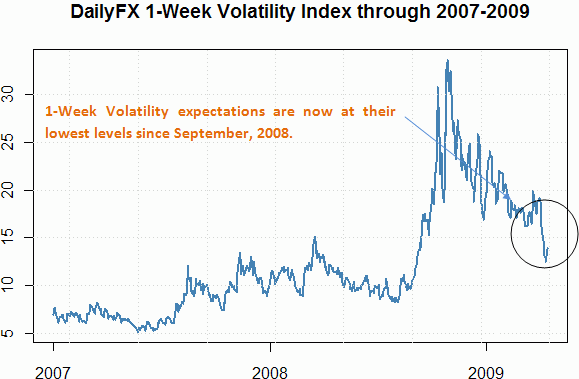
The stock market rally that has unfolded over the last month is nothing short of incredible; stocks have now risen 25% since bottoming on March 9. Unsurprisingly, the rally has been deeply intertwined with an ebb in volatility. “The VIX, which measures options trading sentiment on the S&P 500 Index has crashed from a high of 80.86 to 38.85 ahead of Thursday’s trading, a 52% decline.” [Chart below courtesy of DailyFX]

Forex Volatility Declines

This decline in volatility can be witnessed in all corners of the financial markets, including forex. “The lack of volatility in currency markets has been especially mysterious considering the relationship between the dollar and risk adversity since the onset of the credit crisis almost 20 months ago.” The Dollar has been locked in a comparatively tight range, with one analyst even using the word “listless” to describe its recent performance. With the exception of the Japanese Yen- which is declining for economic reasons- most currencies are gradually stabilizing.

Does this lull represent the end of the storm or the metaphorical eye of the hurricane? Naturally, the answer depends on who you ask. Personally, I am inclined to believe that it is only temporary. The last year has already witnessed two “false starts,” and it wouldn’t surprise me if this time around proved to be yet another one in hindsight.

Whether or not the economic picture is “less bad” than before, it remains grim. “The system is bursting with overcapacity. Demand is falling faster than any time since the 1930s. Inventories will have to be trimmed and budgets cut to muddle through the downtimes. Foreign trade has slowed to a crawl, auto sales are down by 40 percent or more, and unemployment is rising at 650,000 per month.” Two economists, meanwhile, have published a widely-circulated piece which uses juxtaposed graphs as a basis for comparing the current downturn to the Great Depression. Of course, this comparison has become hackneyed, but from a purely statistical standpoint, it’s hard to dispute.

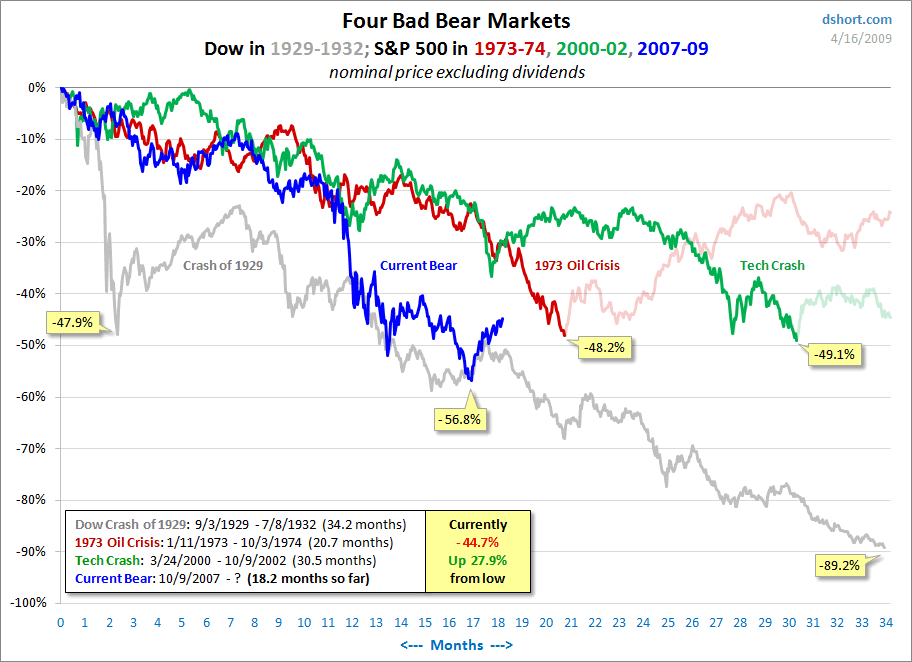
four-bears-largeThe difficulty with forecasting the current recession is that its causes are structural rather than cyclical. Argues one analyst: “It is unwise and foolish to treat this bear market like any other in the post-WW II period because it is totally unique; the scope and depth of the ongoing destruction of consumer and business credit, bank balance sheet compression and insolvency, consumer retrenchment and soaring unemployment should not be underestimated.” As a result, many economic models are out of date. “Economic forecasters have underestimated how bad it is because they have over-estimated the strength of the real economy and failed to take into account the extent of its dependence upon a buildup of debt that relied on asset price bubbles.”

Not only will future growth have to be built on actual wealth (rather than debt), but the mountain of debt that fueled the most recent economic expansion will also have to be resolved. The most recent IMF estimates imply that “Toxic debts racked up by banks and insurers could spiral to $4 trillion.” Until all of this bad debt can be identified and sorted, economic recovery will remain illusory.

[...]

China is Still Not a Currency Manipulator

0 comments

There was tremendous speculation surrounding today’s release of the US Treasury’s semi-annual report to Congress on exchange rates. Considering that Treasury Secretary Geithner accused China unequivocally of currency manipulation during his confirmation hearing in January, it would seem that an official condemnation was inevitable.

Alas, the report once again exonerated China: “In the current Report, Treasury did not find that any major trading partner had manipulated its exchange rate for the purposes of preventing effective balance of payments adjustment or to gain unfair competitive advantage.” The press release accompanying the report made a point of justifying the decision to exclude China: “First, China has taken steps to enhance exchange rate flexibility….Second, the Chinese currency appreciated by 16.6 percent in real effective terms between the end of June 2008 and the end of February 2009….Even so, Treasury remains of the view that the renminbi is undervalued.”

There was certainly a political calculus that went into the decision. There has been a great deal of talk recently regarding China’s growing unease over its US investments, and its consequent willingness to contribute to funding the upcoming US budget deficits. Asks one analyst rhetorically, “If the Obama administration encourages the Chinese government to keep rolling their dollars into US Treasury bonds, then how can the Chinese do this without stabilizing the exchange rates?”

There is also mounting economic evidence that China is no longer manipulating the Yuan, at least not to the same extent as before. China’s foreign exchange reserves, which it must accumulate as part of its efforts to depress its currency, are growing at the slowest pace in nearly a decade. In the first quarter of 2009, its reserves grew by only $7 Billion, compared to an increase of $150 Billion in the first quarter of 2008. This can be explained as follows: “China’s first-quarter trade surplus shrank 45 percent from the previous three months and foreign direct investment tumbled as the global recession choked off demand.” According to another economist, “Inflow through buying properties and speculation was a big part of foreign exchange increase in the past few years, and we are seeing a bit of unwinding as new money is not coming in.”

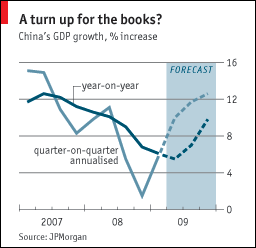
On the other hand, there are signs that China’s economic stimulus plan has begun to trickle down to the bedrock of the economy. The Chinese money supply expanded by a record 25.5% in March, as a result of a six-fold increase in lending. Today’s release of GDP figures revealed that “By March the economy was gaining more speed, with the year-on-year increase in industrial production rising to 8.3% from an average of 3.8% in the previous two months. Retail sales were 16% higher in real terms than a year ago, and fixed investment has soared by 30%.” In short, it looks like the increase in investment and government spending will at least partially offset the projected 10% decrease in 2009 exports. [Chart below via The Economist].

china GDP forecast

[...]

Concerns about Corporate Earnings Lift Dollar

0 comments

Last week marked the beginning of earnings season, as corporations release the results from the first quarter of 2009. The season got off to a strong start with financial heayweights Goldman Sachs and Wells Fargo both smashing analysts’ expectations with large profits. Over the next few weeks, most listed companies will report earnings, which could collectively set the pace for financial markets for the next couple months. “Markets will continue to watch the corporate earnings data very closely in the short term with company comments on prospects also very important for sentiment with any optimism liable to curb defensive dollar demand.”

The last few weeks have witnessed a general decline in risk aversion, as investors have selectively interpreted economic data to support the notion that the economy as bottomed out. Improvements in corporate earnings could reinforce this trend, especially if a majority of companies beat analysts’ expectations. In short, “Forecast-busting first quarter results from Goldman Sachs on Monday encouraged optimism that the worst may be over for financial firms, but investors stayed cautious given that there are many more results to concern.”

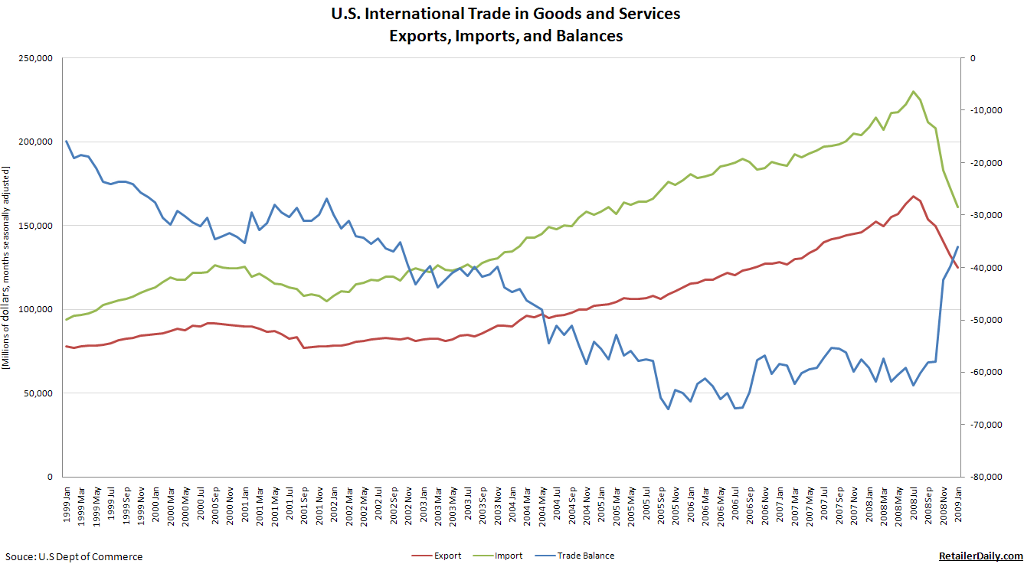
It will be interesting to see if and how the strong Dollar will affect corporate earnings. On the one hand,the expensive currency would be expected both to drive a decrease in exports as well as a decrease in earnings from companies that do significant business overseas, since such companies earnings appear relatively smaller in Dollar-terms when exchange rates are more favorable. On the other hand, the decrease in the US trade deficit (to a nine-year low), suggests that the strong Dollar is not exerting a negative impact. “Exports sprang back in February after six months of decline, increasing by 1.6 percent to 126.8 billion dollars and comprising mostly consumer goods, automotive vehicles, foods, feeds and beverages.”

us_trade_balance_february_2009Ironically, an improvement in corporate profitability would further drive risk-taking and would thus have the effect of weakening the Dollar. One would think that an improved economic outlook would strengthen the Dollar. In actuality, financial and psychological factors continue to predominate in financial markets, and investors are looking for an excuse to dump the Dollar in favor of higher-yielding alternatives.

Their is a danger in currency markets taking their cues from stocks, given that the bear-market rally that unfolded over the last month is one of the most dramatic in history. The herd mentality has caused investors to become complacent about risk and pile willy-nilly back into the markets. Writes one analyst, “The growing potential for economic disappointment due to further growth contraction as well as overly confident, economically myopic policy-makers leaves stocks set up for a major wave of selling.”

[...]

Emerging Market Currencies Receive Boost from IMF

0 comments

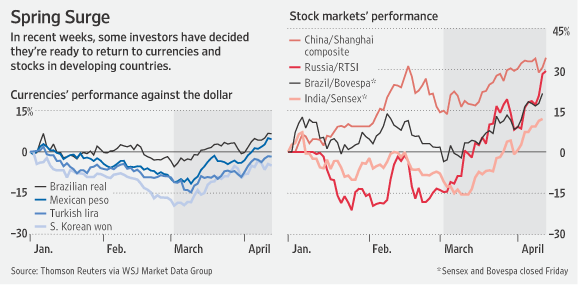
Only two months ago, the Wall Street Journal published an article under the headline “Slowdown hits Emerging Markets.” Buttressed with economic data and testimony from economists, the piece underscored the notion that “The global downdraft is hitting the world’s emerging economies with a speed and ferocity few imagined possible.” On Monday, the same newspaper published an article entitled “Emerging Markets Go on a Tear,” exploring how emerging markets have outperformed in 2009.

emerging-markets-surge

That these stories are built around opposing themes is not surprising, but given that they were published only two months apart, it seems impossible that they could both be meaningful. A deeper analysis, however, reveals some powerful insights, namely that investors seem to be flocking back to emerging markets despite poor fundamentals.

It’s difficult to pinpoint the start of the rally, but it accelerated in earnest in early March for no apparent reason other than investors arbitrarily decided to collectively increase risk-taking. This seems like a classic case of ‘making one’s own reality,’ given that the economic picture continues to deteriorate, and “positive” developments were limited to an increase in government intervention and stimulus plans. But, perception is everything in financial markets, and if investors collectively decide they want a rally, then a rally will indeed obtain.

In the case of emerging markets, the rally has certainly surpassed all expectations. “A Morgan Stanley index tracking emerging-market stocks is up 12% in dollar terms. By contrast, its index following stocks in developed markets outside the U.S. and Canada is down 9%.” Meanwhile, “The extra yield investors demand to own developing nation debt instead of U.S. Treasuries narrowed 10 basis points, or 0.1 percentage point, to 5.68 percentage points.

Emerging market currencies have also enjoyed a nice bounce, led by an across-the-board 7% gain in the Mexican Peso, Brazilian Real, and Russian Ruble over the last five weeks. Analysts at both Citigroup and Goldman Sachs are now encouraging clients to pile back into such currencies, evidently confident that the rally is sustainable: “Valuation has become very attractive in many cases, in particular in historically higher-yielding currencies.”

The concern, however, is that this rally is a product of financial and technical factors, and is not underlied by macroeconomic fundamentals. Exports and confidence have tumbled at a record pace, such that “J.P. Morgan forecasts at least 11 emerging economies — among them South Korea, Taiwan, Russia, Turkey, and Mexico — will shrink in 2009, with another 4 posting no growth.” Instead, investors are using low prices and a lull in bad news - rather than a change in economic tenor - as a basis for buying.

Of course, the bulls will selectively point to data which paint a different picture. “From monetary easing to joint fiscal policy to capital becoming less constrained at banks, the potential for a recovery in 2010 and 2011 seems more likely.” Some analysts have argued that they believe emerging markets have been, and will continued to be cushioned from the worst of the financial crisis due to their conservative financial sectors, but this argument strikes me as self-justification. Others point to the $500 Billion increase in capital that the IMF (via the G20) will potentially make available to developing countries. As I wrote in a recent post, however, much of the perceived increase is redundant and/or has not yet been guaranteed by rich countries.

Personally, I fall in the “cautiously pessimistic” camp, summarized as follows: “The economic picture is cloudy enough that a number of investors say it is worth adopting a more nimble approach in the short run.” In other words, a wait-and-see approach is probably more prudent than following the crowd, especially since it was the crowd that as originally responsible for the bubble.

[...]

Yen Continues to Drop Despite Government Stimulus Plan

0 comments

This week, the Yen continued its decline against the Dollar and Euro, dipping well below 100 Yen/Dollar en route to a six-month low. Most analysts attribute this trend to a pickup in risk aversion: “Some kind of optimism is returning to the market and that’s putting pressure on the yen,” explained one analyst succinctly.

An ongoing rally in stocks and commodities is reinforcing investor attitudes that the economic recession is under control, and is stimulating risk-taking. In other words, the same forces that contributed to the unwinding of the carry trade during the beginning of the credit crisis, are now working in reverse and causing investors to flee from the Yen en masse. “As long as stocks can retain their buoyancy… risk appetite and risk-based trades will be in vogue and investors will continue to add to and rebuild yen short positions.”

According to the most recent International Monetary Market report, “Short positions on the currency have been building up for three consecutive weeks, and are now at levels last seen in the late summer of 2008,” which means the Yen’s slide has basically become self-fulfilling. From a technical standpoint, “A move above 101.00 yen was technically significant as it was a 38.2 percent Fibonacci retracement of its decline from a peak in 2007 to its 13-year low in January.” Even domestic Japanese investors have signaled their bearishness by taking advantage of last week’s Yen upswing by making “aggressive purchases of foreign bonds.”

From a fundamental standpoint, the decline in the Yen makes sense, given the abysmal economic situation in Japan. In fact, the “Minutes from the Bank of Japan’s March meeting showed members of the central bank were leaning toward cutting the bank’s economic forecast in April, and that they believed the BOJ would need to continue to provide substantial liquidity to financial markets that they see as still under substantial stress.”

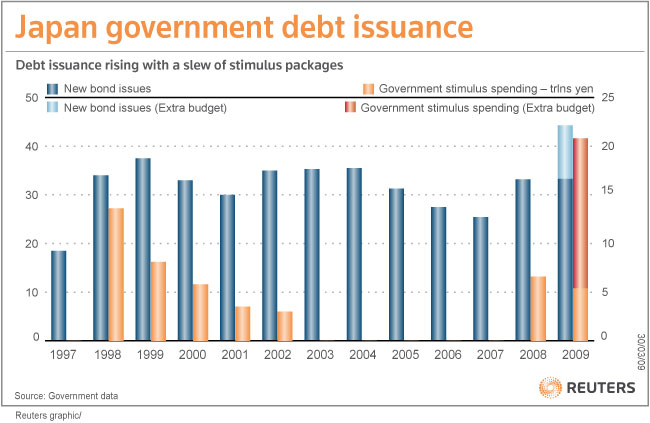
The government is finally responding to the economic crisis, having most recently unveiled a $150 Billion plan, to supplement the $100 Billion initiative announced earlier this year. “If implemented competently, these steps could stabilize the domestic economy and stop the bleeding in labor markets.” At the same time, the intertwined tailspin in confidence and spending suggest that the government’s efforts could be in vain.

While equity investors have reacted positively - pushing the stock market into positive territory for the year- bond and currency traders are understandably concerned. Yields on Japanese bonds are already rising in anticipation of $100 Billion in bonds that the government will have to issue in 2009 alone. Naturally, the burden to purchase these bonds will fall on the Bank of Japan, which will be forced to print money and contribute to the further devaluation of the Yen in the process.

japan-government-debt-issuance

Ultimately, the duration of the Yen’s slide depends on the duration of the global stock market rally. If you believe that the global economy has turned a corner, then the Yen is done. If, on the other hand, you are inclined to side with George Soros, who opined recently that “It’s a bear-market rally because we have not yet turned the economy around,” then there is still cause for Yen bullishness.

[...]

IMF Currency Could Threaten Dollar’s Reserve Status

0 comments

Last week, SDR became the latest addition to the growing list of forex acronyms. So-called Special Drawing Rights are a unit of account used by the IMF, “defined as the value of a fixed amount of yen, dollars, pounds and euros, expressed in dollars at the current exchange rate. The composition of the basket is altered every five years to reflect changes in the importance of different currencies in the world’s trading system.”

The sudden rise to popularity of SDRs (in spite of their 40 year history) can be attributed both to developing countries’ growing unease about the status of the Dollar, as well as to their perceived usefulness as a tool in fending off economic depression. Ignoring the latter- for the purpose of this post- let’s look, at how SDRs will impact the role of the Dollar as the world’s reserve currency.

First of all, as I noted in Tuesday’s post, the success/scope of the SDR program depends on the positions of the US and EU, the largest and most important members. In the case of the US, the most recent SDR expansion (1997) was never implemented because the US blocked it. Neither can the support of the EU be taken for granted. According to one member of the European Central Bank, “There was no examination of whether there is a global need for additional liquidity at all… One used to take a lot of time to examine something like this.”

In addition, it’s not clear what benefits the synthetic currency would yield. Asks one commentator: “What is one to tie it to?…in a world of depleting resources it is difficult to fathom how to create a list of constituents which would not constrain global growth and tie us into many years of deflation.” In other words, given that the SDRs will derive their value from underlying currencies, it doesn’t seem like the end result would be anymore stable than the current system.

China, meanwhile, has showed fervent support for the expansion in the form of a $40 Billion pledge, which is not surprising since a report issued by the head of its Central Bank provided some of the impetus. This $40 Billion is tantamount to an exchange of Dollars for a basket of currencies. The benefit to China is articulated by one analyst as follows: “ ‘We could see the IMF being put in a position where it could raise in the capital markets funds in SDR-denominated debt….The debt could be used ‘by China and other central banks to be put into their currency reserves, at the expense of the U.S. dollar.’ “

[...]

The Way to Trade Forex by Jay Lakhani

0 comments

Jay Lakhani is a successful Forex and stock trader with a great experience as a mentor for the newbie Forex traders. He believes that the trader’s psychology and the money management basics should receive much more attention during the learning process than the usual market theory. His book «The Way to Trade Forex» is a good starter’s choice for the unexperienced Forex traders as it may put the whole education process on the right way. Readers will definitely try to find their own trading strategies and techniques that will comply with their emotional state and the trading character after finishing this book. Now you can download this book from my site for free. Being extremely useful to the beginning traders, «The Way to Trade Forex» is also an interesting and not too long read for others. But, of course, for people practically familiar with Forex trading, this book is barely something greater than a polite invitation to the author’s mentoring courses.

[...]

Euro Posts Small Gain as Economic Conditions Improve

0 comments

EUR/USD is currently trading with a small daily gain after a rather weird volatility demonstrated yesterday (it posted long spikes both up and down but closed near the open level). The U. S. fundamental released are quite optimistic. Although they should benefit U.S. currency more, the whole risk-aversion decrease favors such currencies as the euro more than such as the dollar. EUR/USD is now trading near 1.3280.

U.S. import prices rose by 0.5% in March, following 0.1% decline in February, while export prices decreased by 0.6% after falling by 0.3% in February. This is quite good for the U.S. companies as their products are becoming more competitive.

Initial jobless claims were at 654k — a little below the previous week’s value of 674k (revised from 669k).

U.S. trade balance deficit shrank unexpectedly fast in February — from $36.2 billion to $26 billion, as the imports declined strongly, while the exports rose in that month.

[...]

Hectortrader Forex Course

0 comments


The Hectortrader forex trading course is different to the hundreds of hyped up Forex products you are likely to find online. This is not the typical e-book product that you read through in one evening. Hectortrader is a comprehensive Forex trading course consisting of more than 15 hours of training videos, 1 on 1 e-mail support, custom indicators and various other tools that will help you in your trading.

If you are looking for purely mechanical system that only requires 10 minutes in front of the charts a day and don’t really care about understanding what your are doing, then perhaps one of the other products on this list will be better for you, but if you are serious about becoming a Forex trader and want to learn a complete trading system that can be applied to any currency or time frame, then the Hectortrader Forex course should be on the top of your list of Forex systems to consider. >>Read Full Review

Click Here to Visit Hectortrader

[...]

Fap Turbo

0 comments


Fap Turbo took the industry by storm when it was released on 25 November 2008. The creators of Fap Turbo promised to deliver the most advanced Forex trading robot there has ever been on the market and so far they have not dissapointed the thousands of traders that were eagerly waiting for the launch. The reason why Fap Turbo is so popular is the fact that it offers a system that is more profitable, but less risky than the famous Forex Autopilot..exactly what the market has been waiting for.

I purchased Fap Turbo on the day that it was launched and 3 days after that it had already earned me more than 500 pips in profit on my demo account. Fap Turbo is a fully automated trading system that requires virtually no human intervention or in depth understanding of the Forex markets. If you are interested in Forex trading, but have limited time and don’t want to spend more than a few minutes every day in front of the charts, then Fap Turbo is the system for you. >>Read Full Review

Click Here to Visit Fap Turbo

[...]

10 Minute Forex Wealth Builder

0 comments


10 Minute Forex Wealth Builder is another system that was developed specifically for the part time trader who has limited time to spend on trading. Like Fap Turbo, this system only requires 10 minutes in front of the charts every day, but the difference is that this is not an automated trading system. The 10 Minute Forex Wealth Builder system teaches your 2 simple, but effective Forex trading techniques that only require about 10 minutes in front of the charts every day.

One advantage of this system of an automated system like Fap Turbo is that this system does not rely on any specific trading platform, so you can use it with any broker..automated trading systems like Fap Turbo only works with brokers that support the Metatrader trading platform. The other advantage of 10 Minute Forex Wealth Builder over an automated system is that you have a better understanding of why each trade is placed and are much more in control of your own money, so if you have limited time, but prefer to have more control than what Fap Turbo offers you then this is a great system for you. >>Read Full Review

Click Here to Visit 10 Minute Forex Wealth Builder

[...]

4. Forex Avenger

0 comments


Forex Avenger is a mechanical trading system that is positioned about midway between the Hectortrader system and the 10 Minute Fortex Wealth Builder systems mentioned above. The Forex Avenger system requires a bit more time in front of the charts than the 10 Minute Forex Wealth Builder system, but is not as in depth as the Hectortrader system, so it is a nice combination of both for people who want to be actively involved in trading, but perhaps still part time.

The biggest advantage of the Forex Avenger system is that it is 100% mechanical and requires absolutely no discretion. The package consists of 2 distinct trading methods - one for day trading on the hourly charts and one for trading part time on the daily charts. I spent a couple of hours backtesting the system and was very impressed by it, especially the “Set and Sleep” system that only requires a 10 minute analysis of the daily charts each day. If you are looking for an easy system to trade manually with that is completely mechanical, then Forex Avenger is deinifitely a good system to consider. >>Read Full Review

Click Here to Visit Forex Avenger

[...]

Is it Real or is it a Scam?

0 comments

Forex Funnel is one of the newest Forex trading robots to enter the market. They have a fantastic back testing graph on their homepage showing a very smooth upward equity graph, with a high success rate, low drawdowns and a net profit of more than $400,000 from 4 years of trading.

Forex Funnel

Forex Funnel

I spent hours online looking for actual customer reviews of the product, but all I found was general overviews containing exactly the same info that was already available on their webite, which isn’t a lot. So I decided to purchase the product and see for myself if it really is the profit pulling system that they say it is.

..So is Forex Funnel the real deal or is it a scam ?

After testing the system for a week I can say that this product is definitely not a scam, but it is also not suited for everyone. Forex Funnel uses a high risk, high reward trading strategy that can make you a LOT of profit, but it can also wipe out your account quickly if you are not careful.

Compared to Fap Turbo (the most popular Forex Trading Robot), Forex Funnel is a much more risky system that requires nerves of steel and a lot of starting capital to achieve roughly the same results. Nevertheless, if you are looking for an exciting system that produces high returns and you are prepared to take the risk, then Forex Funnel could be the product for you. See the full review below for more details.

What’s Included in The Package?

As soon as you purchase Forex Funnel, you get access to the following downloads:

  • The Forex Funnel Robot
    The Forex Funnel system itself comes in the form of an Expert Advisor written for the Metatrader Forex trading platform. The system performs anything from 10 to more than 50 trades per day and constantly has at least 2 or 3 open positions in the market. Not much is known about the indicators it uses to enter trades, but the main trading strategy seems to revolve around the Martingale principle, which is also the thing that makes it risky. More about this later.
  • The Goldminer Indicator
    According to the creators of Forex Funnel, the Goldminer indicator was originally meant to be sold as a unique Forex product on its own, due to it’s accuracy. Goldminer consists of 2 indicators working together to generate trade signals. I spend a few minutes looking at Goldminor and the signals it generated seemed to be quite accurate. The trading signals work as follows: Purple Arrow + Red = Sell,Yellow Arrow + Blue = Buy. See a sample chart here.
  • Documentation
    The package includes a manual for the main Forex Funnel system as well as the Goldminer indicator. The manuals give basic installation and setup instructions, but no further details are given regarding trading strategies.

Is Forex Funnel a Profitable System ?

Commercial Forex trading robots usually have great results in backtesting, so I’m going to assume that the report they have on the Forex Funnel website is accurate and instead focus on real trading results that I achieved in my own trading account. I activated Forex Funnel in one of my demo accounts and let it trade for me on complete auto pilot for a period of one week to get a quick insight into how the system works.

During this week, Forex Funnel performed no less than 250 trades and made a net profit of $407, from a starting capital of $5000..very similar results to what I achieved with Forex Autopilot. Expressing the profit in pips is not easy, because varying lot sizes are used, but with a default lot size of 0.1 lots I guess you can say that this is a net profit of +407 pips. At first glance these results look very good, but the real answer to the question of profitability lies in the actual trades performed.

While there are part of this system that I don’t quite understand yet, the trading records shows definite evidence of some kind of Martingale strategy. The basic concept of the Martingale strategy is to double up after a losing trade and continue doing this until eventually a winning trade is found, which will cover the losses of all previous losing trades. There are many examples of this in the Forex Funnel trading results, but let’s look at one example:

Trading Log

Trading Log

It is quite clear that a Martingale strategy is followed here. A short trade of 0.01 is entered at 95.96 and when the trade starts making a loss, another short trade of 0.02 lots it entered. Price continues to rise and every 20-25 pips another short trade of double the previous trade’s lot size is entered. This continues until 10 trades have been opened and the price finally retraces by 20 pips from 97.91 to 97.71. The 20 pip profit with 5.12 lots is enough to cover the losses of the 9 other losing trades and all trades are then closed at this price, resulting in a breakeven situation.

This strategy has a near 100% success rate, but you need a LOT of capital to cater for long losing streaks, because one losing streak can effectively wipe out your account with a margin call. In this case, if the price continued to rise, my $5000 account would have been wiped out very soon, but lucky for me the retracement happened.

Conclusions and Recommendations

The Forex Funnel system is a high risk, high reward type system that is not for the faint hearted. If you do decide to try out Forex Funnel, test it on demo first and if you do decide to go live, I would not recommend running this sytem with less than $10,000 starting capital and a default lot size of 0.01. However, I only tested the system for 1 week and some of my conclusions may be proven wrong by a longer case study. The Goldminer indicator shows some promise, so even if I never trade with the system in a live account, I feel that I didn’t waste my money on this system.

After all that is said and done, I would still recommend Fap Turbo as the preferred Forex trading robot to most traders, simply because it is $40 cheaper, it does not use a Martingale strategy and it also has a very high success rate. See my full review of Fap Turbo Here.

[...]
A Possible Winner Without the Usual Hype ?

0 comments

Due to some information I received from one of my subscribers I recently decided to investigate the Pips Leader Forex robot. As expected, the Pips Leader Homepage feature screenshots of Forex accounts making thousands of dollars per month, charts showing consistent earnings and the promise of a profitable automated system. We all know that most of the reviews online can not be trusted, so the question is - does Pips Leader really work or is it just another scam like so many others ?

Click Here to Visit the Pips Leader Homepage

Pips Leader

Pips Leader

After spending an hour or two researching this system I found enough evidence that showed that Pips Leader is not the typical garbage Forex robot that is launched on a weekly basis. Pips leader uses what is called a “basket trading” strategy, which can be very effective if you understand the risks involved and enforce strict money management rules.

I have read many reviews from users of the Pips Leader system and I have to say that it was hard to find any negative comments about this product. Those who did lose money or gave Pips Leader a bad rating didn’t seem to understand the money management requirements of this system.

A Basket trading system like this can have up to 30 or more open trades at any given time, so it is important to understand what your percentage of risk is in order to avoid margin calls. While the Pips Leader Homepage states that you can start with as little as $300, the amount of margin used on such a small account will be way too high and the general feedback from customers is that the optimal account size for Pips Leader is $2000 or more.

I am very impressed with what I have found about Pips Leader so far and decided to make this the 2nd Forex robot that I will test in 2009, in addition to the recently launched Forex Megadroid. Check back regularly or subscribe below to see my latest trading results using this system.

[...]

Forex Training: Technical Analysis

0 comments

Using technical analysis to develop a forex trading strategy

One of the ways to increase your chances of success in forex trading is to develop a strategy. One way that you can develop a currency trading strategy is to use technical analysis to determine when to enter or exit a trade.

Technical analysis

Technical analysis is basically the study of charts. You use this method to study what currency prices are doing, and to determine whether one currency is more likely to rise or fall against another. It is based on current and past performances.

You can use technical analysis by drawing trend lines on charts, and by using such techniques as Elliott Wave and Fibonacci to decide when and where to enter or exit a trade. When you develop a forex trading strategy based on the charts (hard data that shows what the currencies are doing), and stick with it, you are more likely to post earnings on a regular basis. Of course, there is no full-proof way to profits, and you are just as likely to lose. A strategy on helps you increase your chances.

[...]

Sterling Rangebound in Currency Trading

0 comments

U.K. pound lower against the U.S. dollar in FX trading

Even though the U.K. pound is lower against the U.S. dollar in FX trading, it isn’t that much lower. Actually, it appears as thought the sterling has settled into a rather wide range in currency trading. FX Street reports on the range expected of the U.K. pound:

"Initial resistance stands at 1.4683 but real test (triple top and upper limit of current range) comes at 1.4778." Said Peter Rosentreich, analyst at ACM - Advanced Currency Markets. On the downside, he expects crucial levels are 1.4620 (recent low) and more importantly a strong floor at 1.4583.

Even so, the U.S. dollar is heavily favored right now in FX trading – and for good reason. Indicators are that the U.S. economy is improving, while the British economy continues to languish. Until the British economy starts to see some improvement, sterling is likely to remain down in currency trading.

[...]

U.S. Dollar Gains in Forex Trading

0 comments

Greenback moves ahead in currency trading

The U.S. dollar is gaining in forex trading this morning on the news that the U.S. economy is improving. Earnings reports yesterday, especially from Wells Fargo and other financial institutions, are spurring optimism.

Indeed, it’s an interesting dynamic today in currency trading on the FX market. Even though risk appetite has improved, the greenback is gaining. Recently, the U.S. dollar has been benefiting from its status as a safe haven currency.

However, it is possible that forex traders are more comfortable with the U.S. dollar right now because the economy is showing signs of improvement while other economies — especially the euro zone economy — continue to show weakness. The euro is struggling in forex trading on economic weakness.

Until other economies start to show strength, the U.S. dollar will probably be preferred in forex trading. The underlying fundamentals (like national debt) are not terribly important right now while it appears that things are strengthening for the U.S. on the surface.

[...]

Euro Weakens in Currency Trading

0 comments

Quantitative easing fears sends euro lower in forex trading

Yesterday, the euro was largely rangebound in forex trading on the currency market. Today, though, the euro is moving lower. With concerns over the direction the European Central Bank will be forced to take, it is little surprise that the euro is struggling in currency trading.

Right now, the main concern is that the ECB will be forced into quantitative easing. European leaders have been slow to engage in aggressive economic stimulus, and they have also lowered interest slowly and grudgingly. However, speculation is circulating that the ECB will have little choice in the immediate future.

The euro zone economy continues to weaken, and it appears that the staid efforts up to this point have not been as effective as leaders would like. As a result, the euro is being punished in forex trading, and there is a good chance it will continue with its losses until more aggressive economic stimulus measures are adopted.

[...]

Chinese Yuan Forex Trading Forecast

0 comments

Yuan likely to remain stable for the coming months

It is true that individuals cannot trade the Chinese yuan (sometimes called the renminbi) on the FX market. However, movements by the yuan do affect the currency market, and impact other currencies. Right now, the Chinese yuan forex trading forecast is likely to be one of stability. Bloomberg reports on the Chinese yuan in forex trading:

China’s policy of keeping a relatively stable currency will continue for at least a year,” said Lian Ping, chief economist at Shanghai-based Bank of Communications Ltd., part- owned by HSBC Holdings Plc. “Declines in exports won’t be reversed very soon, although the pace of the drop will be slower in coming months.”

The fact of the matter is that the Chinese yuan is not a free-floating currency, and the government has an extraordinary amount of control over it. As a result, it is possible for China to keep the yuan relatively stable. And right now it is likely to remain somewhat weak since the government wants to help exporters maintain an edge in this global economy.

[...]

London Session - April 10, 2009

0 comments

The price action in the London session was extremely quiet as most markets are closed for the Easter holiday and volumes remain thin in FX land. The only noteworthy piece of economic data was French industrial production and it slipped -0.5% in February to an annual rate of -15.5% from -14.5% — a new low since records began in 1981. This elicited little reaction however. Full text »

[...]

Asia Session - April 10, 2009

0 comments

With a good part of Asia on holiday as well as all of Europe and the US out later today, the Euro dropped versus both the US Dollar and the Yen as traders continued to dump Euros on the statements of the ECB that it may use “unconventional” measures at its upcoming meeting in May. The ECB remains behind the global curve of rate cuts and is under pressure to mirror moves by the US Fed or RBA to help pump life in the credit markets. With exaggerated moves in thinned markets, the EUR/USD set off stops to the downside, leaving early 1.3169 highs in the dust, the pair hit bottom at 1.3089, a low not seen in almost a month as traders bailed out of their positions prior to the four day holiday weekend in Europe. EUR/JPY saw similar action today, starting the session near highs of 132.50 and subsequently dropping almost a full handle to 131.52. EUR/JPY started the week on Monday at 137.42 highs, and melted 6 big figures through the week to its current levels, bucking the trend as global equities had a winning week. USD/JPY drove to early highs above 100.70, but the gains were short lived and soon the pair collapsed to the humbler grounds near 100.20 as profit takers swooped in to reap their rewards. Most other pairs were relatively quiet for the session. Despite the holiday, France has CPI and Industrial Production out later in the day. Keep in mind that Europe is out for a four day weekend and next week should be interesting with the US financials releasing earnings….Besides that, enjoy the holiday weekend. Full text »

[...]

Weekly Trading Update

0 comments

Well it's been a very dull week on the markets this week. The GBP/USD and EUR/USD have barely moved whilst the USD/JPY cannot seem to decide whether it wants to stay above 100 or not. I did, however, manage to find two tradeable positions, both of which occurred yesterday afternoon.

The EMAs that I use crossed upwards on the 4 hour chart of both the USD/JPY and the FTSE 100. On the USD/JPY pair I used the 2 hour chart to get a good entry point and entered on a pull-back at 100.25. I then closed half my position for 40 points just after midnight last night and let the other half run, moving my stop loss to break-even. I was only targeting 101.00 but unfortunately the price came back and hit my adjusted stop loss so I was stopped out at break-even.

On the FTSE there was a textbook EMA crossover and using the 2 hour chart I entered a long position on a pull-back at 3966.5. I was hoping to close out before the London market closed and was starting to regret this trade as it was hardly moving, but as the position was slightly in profit I decided to move my stop loss to break-even and set my target price at 4006.5 (a 40 point profit) and let it run after hours. Thankfully the Dow rallied strongly and took the FTSE up with it and I was automatically closed out at this level.

So although it wasn't a bumper week overall, it's still nice to make some modest profits, particularly in a week leading into a holiday period which are notoriously quiet anyway.

If you would like to check out my main 4 hour trading strategy in more detail, you can access it by filling in the form above and subscribing to my newsletter.

Have a good Easter.

[...]

Risk Aversion Returns to Forex as Hope from G20 Fades

0 comments

The period leading up to the G20 meeting was generally marked by optimism and hopefulness. One commentator urged his readers: “Don’t write off the London G20 meeting. It could lay the foundations for fundamental global change, impacting currencies, gold and bond markets.”

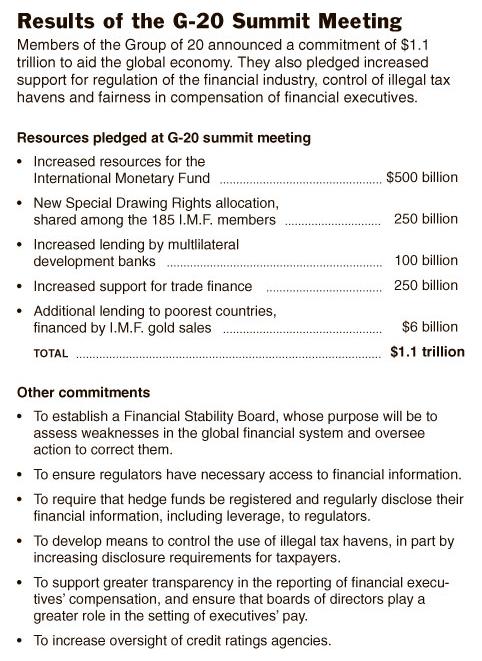
On some level, the meeting probably did fulfill expectations. After only a few hours of discussions, the G20 agreed to “stricter limits on hedge funds, executive pay, credit-rating companies and risk-taking by banks. The summit also committed more than $US1 trillion to boost the resources of the International Monetary Fund and provide emergency cash to help distressed countries.”

Investors rejoiced and the markets rallied, with the Dow rising above 8000 points and capping “the best four-week rally since the week ending May 12, 1933.” Bulls can now retort that the stock market bust of 1929 took four years to recover, while the recession of 2008-2009 required less than one year. Forex markets also reacted “positively” to the G20 summit, lifting the Dollar above the important psychological barrier of 100 Yen/USD, and causing emerging market currencies to rise across the board.

Monday, however marked a return to business as usual: “Post-G20 euphoria, which had helped to boost market confidence about a global recovery, proved short-lived as investors once again focused on the continued risks to the banking system.” It was probably only a matter of time before investors drilled beneath the surface of the impressive-sounding G20 rhetoric and large numbers, into the nuts and bolts of the summit’s policy prescriptions. [The chart below comes courtesy of the New York Times].
results-of-the-g-20-summit-meeting
The headline-grabbing $1.1 Trillion figure, for example, is somewhat misleading. Over half of the $500 Billion “pledged” to the International Monetary Fund has either not been raised or not been explicitly authorized. Then, there is $350 Billion in trade credit, most of which is either redundant or double-counted, since “trade financing is rolled over every six months as exporters get paid for their goods and repay the agencies that lent them the money.” The remaining $250 Billion is accounted for in the issuance of IMF synthetic currency to member nations. However, given that the synthetic currency derives a significant portion of its value from the Dollar and Euro, this program cannot be effective if the US and EU opt out, of which there is a real possibility.

The summit also failed to meaningfully address concerns of the continued ole of the USD as the world’s de facto reserve currency. The expansion of the IMF synthetic currency program represents an important starting point, but at this point, it looks like China and the other supporters of an alternative system will have to wait for the next G20 meeting, to be held in September.

One commentator captured this frustration quite well: “The G20 Plan…tries very hard to preserve and perpetuate the existing US helmed global financial and economic order. An act of commission, on the one hand— buttressing the IMF— and an act of omission, on the other— remaining silent on the position of the US dollar— bear testimony to this.”

[...]

Dollar Grows against Euro for Third Day

0 comments

EUR/USD is falling for the third day today. It’s currently in the red zone but the most of the daily fall is in the past — in a form of a rather long downward spike. Traders expressed almost no reaction to the today’s U.S. fundamental news. EUR/USD is currently trading near 1.3229.

Wholesale inventories were down by 1.5% in February compared to January’s level. A 0.7% decline was reported a month ago. Market participants expected a 0.6% decline today.

U.S. crude oil inventories gained 1.7 million barrels last week and are now well above the upper limit of the average range for this time of year. With the current rate of growth they will surpass 400 million barrels by the end of the year.

[...]

Trailing Stop in MetaTrader 4

0 comments

Trailing stop allows you to automatically protect the profits with your positions. It adjusts itself according to the current market rate and the amount of pips you give it to trail behind. Trailing stop is a great tool for the conservative and long term traders as it easily creates protective «airbag» for the trades. There are two basic ways to set the trailing stop in your MetaTrader 4 platform — use the built-in tool and attach a special EA that will apply a single trailing stop to all orders. But before going into describing these ways I’d like to tell you how the correct trailing stop should work:

  1. It should go into the action only when the position is in profit (or at a break even point).
  2. It should apply itself only when the difference between the current stop-loss and the current market price is greater than the trailing stop value.
  3. Trailing stop should never «decrease» the stop-loss level.
  4. If used without the initial stop-loss, trailing stop doesn’t protect your position from the excess losses; it only provides a good profit-following tool.

Here are the details on these two ways:

The most easy and convenient way to set the trailing stop-loss is to click with the right mouse button on the order in the Terminal window and select the Trailing Stop submenu. There you’ll be able to either choose some of the preset amount of pips or enter a custom number:

Trailing Stop Order

Trailing Stop Select

This way of setting your trailing stop-loss is very convenient but it has two important disadvantages. The first con is that it doesn’t allow trailing stop lower than 15 pips. That’s probably not a problem for long-term traders, but it’s a great trouble for scalpers and short-term traders. And the second disadvantage of this method is that it doesn’t work properly with the brokers that provide extended quotes (5 and 3 digits after the dot instead of 4 and 2 digits). Trailing stop confuses the pips in this case and acts incorrectly.

The second method is to add a special expert advisor to some chart in your MetaTrader 4 platform and it will follow all open orders trying to apply the trailing stop value you give it in the input parameter. This is a very simple expert advisor that doesn’t load up your system resources and can be turned on and off anytime. Here is its code:

#property copyright "Copyright © 2009, EarnForex.com"
#property link "http://www.earnforex.com"
extern double TrailingStop = 5;
int init()
{
return(0);
}
int deinit()
{
return(0);
}
int start()
{
double PointValue;
for (int i = 0; i < OrdersTotal(); i++)
{
OrderSelect(i, SELECT_BY_POS, MODE_TRADES);
//Calculate the point value in case there are extra digits in the quotes
if (MarketInfo(OrderSymbol(), MODE_POINT) == 0.00001) PointValue = 0.0001;
else if (MarketInfo(OrderSymbol(), MODE_POINT) == 0.001) PointValue = 0.01;
else PointValue = MarketInfo(OrderSymbol(), MODE_POINT);
//Normalize trailing stop value to the point value
double TSTP = TrailingStop * PointValue;
if (OrderType() == OP_BUY)
{ if ((Bid - OrderOpenPrice()) > TSTP)
{ if (OrderStopLoss() < (Bid - TSTP))
{ OrderModify(OrderTicket(), OrderOpenPrice(), Bid - TSTP, OrderTakeProfit(), Red); } } }
else if (OrderType() == OP_SELL)
{ if ((OrderOpenPrice() - Ask) > TrailingStop * PointValue)
{ if ((OrderStopLoss() > (Ask + TrailingStop * PointValue)) || (OrderStopLoss() == 0))
{ OrderModify(OrderTicket(), OrderOpenPrice(), Ask + TSTP, OrderTakeProfit(), Red); } } } }
return(0);}

As you see, the code is really simple. You can also download this trailing stop EA and use it freely with your orders.

While, it lacks the disadvantages of the first MetaTrader trailing stop method, unfortunately, it also has two of its own important disadvantages. First, it works for all currently open orders. So, if you want attach it to only one order and leave another one without a trailing stop this method is not for you (but, of course, you can alter this EA to work with some specific orders). Second, it utilizes the same trailing stop value for all orders, you can’t set 10 pips trailing stop for one position and 50 trailing stop for another one. In case you want to use different stop-loss values for different orders you’ll have to heavily alter the code of this MT4 expert advisor.

[...]

Yen and Dollar Continue Their Advancement

1 comments


Both the U.S. dollar and the Japanese yen continued their growth on the Forex market today as the yesterday’s stock trading sessions were negative and today’s Asian session ended in the red zone.

The dollar rose against the euro for the third day today and declined against the yen for the second one as the Japanese currency still remains the unquestionable leader on the global Forex market.The bad fundamental reports coming out of the Eurozone and U.K. today weren’t the last reasons for the current strength of the «safe haven» currencies.

The dollar is performing better than everything else except the Japanese yen and the reason lies in the elevated risk levels — believe the currency analysts. The greatest challenge for other currencies and the stock markets still lies ahead — the month May will be deciding for the current state of affairs on the global financial markets. If stocks fail, the yen and the dollar automatically gain a strong advantage against everything else.

USD/JPY fell from 100.52 to 99.75 as of 11:21 GMT today. EUR/JPY declined from 133.35 to 130.94; GBP/JPY went down from 148.15 to 145.70. EUR/USD dropped from 1.3267 to 1.3214, while GBP/USD fell from 1.4735 to 1.4688 today.

[...]

Won Once Again Leads in Gain in Asia

0 comments


The Korean won advanced at a fastest pace among the most-traded Asian currencies today as the risk-aversion that prevailed earlier this week ended unexpectedly and the outlooks for the Asian emerging economies improved.

The South Korean currency gained also because the government managed to sell successfully $3 billion worth of the global bonds, which would allow it to hold down the demand for the foreign currency if it arises in the futures. The run-away to stocks from the dollar and the yen positively influences the won today. The fundamental indicators also help the emerging currencies as they suggest gradual but stable recovery from the recession.

Some Forex traders now try to ride the won’s appreciation wave just because it showed a very sharp turn from being the worst-performing regional currency to being the leader of the growth. Currency analysts has almost nothing to say about won’s steep gains — the currency’s behavior greatly depends on the government’s interventions.

USD/KRW declined from 1349.6 to 1317.6 as of 6:00 GMT today, it was still trading above the 3-month low set on April 6 at 1.306.0.

[...]

Japanese Yen Performs on Stocks Slump

0 comments

The Japanese currency rose from the local bottom levels against all other major currencies today after the stock markets fell yesterday and the outlook for today’s sessions remain bearish.

The rally of the high-interest currencies was supported mainly by the growth in the developed and emerging stock markets that was clearly visible during the last two weeks. As the optimism of the investors vanishes and the technical analysis theories suggest a correction, the low-yielding currencies, such as yen, begin to rise on the Forex market.

The decision by the Bank of Japan to leave the interest rate unchanged at 0.1 percent today wasn’t a surprise to the market participants. But the lack of announcement of the quantitative easement definitely improved the attractiveness of the Japanese currency.

The traders simply believe that more losses are yet to be reported by the financial institutions throughout the world and that the available anti-criss measures won’t make those losses look too small to be neglected. Such currencies as the euro have little chance against the Japanese yen in these conditions. However, analysts suggest great care with entering the long positions on the yen as the period of the global decline might not last longer than a week.

USD/JPY fell from 101.05 to 100.39 as of 9:32 GMT today after reaching as high as 101.43 yesterday — the highest level since October 21st 2008. EUR/JPY declined from 135.42 to 134.00, while GBP/USD dropped from 1.4745 to 1.4725 today.

[...]

Last Chance to Get the Forex Profit Accelerator Course

0 comments

Forex Profit Accelerator

(Due to ‘email pleading’, you
may have a chance to get in on
this sold out Forex solution…)

http://www.allforextraining.com/y/?i=773362&u=1&l=f64

Last week, 35+ year trader Bill Poulos filled up his next group
of students who jumped at the chance to grab his sold out Forex
Profit Accelerator home study course.

This course was then pulled off the market last Wednesday (the
countdown timer flashed “Sorry, Expired” at midnight that day).

Then over the next week, Bill received an unusual amount of
“email pleas” from hopeful traders who missed the deadline…
begging him to open up a few more spots…

————————
GET ON BOARD BY THURSDAY
————————

So, Bill decided to open up his enrollment page again, but only
for 35 more traders.

Why 35?

Well, this year marks the 35th year he’s been trading the
markets…

…but the page is only open through Thursday, April 9th, at
11:59pm Eastern because he doesn’t want the final 35 traders to
fall behind his other students who got on board in time last
week.

Bill already has hundreds of traders who signed up on his
‘Soldout’ page for his notification list, so these 35 copies
will be gone - the question is HOW SOON… ?

So if you missed out last week, and want a final chance to “get
in”, go ahead and claim your copy of Bill’s step-by-step Forex
home study course that reveals how you can finally achieve Forex
F-R-E-E-D-O-M in less than 20 minutes a day…

Get it here:

http://www.allforextraining.com/y/?i=773362&u=1&l=f64

Good Trading!

p.s. These final 35 copies will be “doled out” on a first come
first served basis, so please be sure to make your decision
quickly and then do your best to grab one of the remaining
copies here:

http://www.allforextraining.com/y/?i=773362&u=1&l=f64

[...]

Free Elliott Wave Online Tutorial

0 comments

elliott_wave_international-logo.gif

Greetings Investor/Trader!

“Successful market timing depends upon learning the patterns of crowd behavior. By anticipating the crowd, you can avoid becoming a part of it.”

I pulled this quote directly from the opening paragraphs of the free Elliott Wave Online Tutorial. It’s critical to your understanding of how markets really work.

Now some might say, “What’s wrong with following the crowd? I’m just following the easy money, right?” The problem with this logic is that most investors follow the crowd (or herd) all the way up the mountain … then right off the cliff.

Look at today’s situation: How many people you know got out of the stock market before the October 2007 top? Heck, how many you know cut losses and cashed out even six months after the top?

If you’re like most people, your answer ranges from “zero” to “very few.”

Being a successful investor over the long term means you must always strive to be part of that “very few.”

Famed market analyst Robert Prechter, the leading practitioner of the Elliott wave method of market analysis, once said, “Missing a market move may be a shame, but getting caught on the wrong side of one means you lose money. People who have gone through the experience know there’s a big difference.”

To be a successful individual investor, you must understand what it means to take risks when the probabilities are behind you and shun risk when they’re not.

Robert Prechter’s method of analysis, the Elliott Wave Principle, is designed to help him and his subscribers do just that. In fact, just this week, a MarketWatch.com columnist wrote this about Prechter’s performance:

“Over the past 12 months the Elliott Wave Financial Forecaster is up 22.8% by Hulbert Financial Digest count, vs. negative 43.32% for the dividend-reinvested Dow Jones Wilshire 5000.

“And so terrible has the damage to the stock market been that the HFD now shows EWFF ahead over the past 10 years, with a annualized gain of 1.7% vs. negative 2.55% annualized for the total return DJ-W.”

Buy and hold is dead. Trading isn’t any easier. Having a big-picture outlook doesn’t mean you must “set it and forget it,” as the late-night infomercial guy says. And it certainly doesn’t mean you must be in and out of the markets every day. It simply means you can see the forest for the trees.

You can go long when the markets are behind you, short if you have the guts, and stay out completely when the risk is too high. Simply put, adopting an independent, unbiased method is the very best way to ensure you don’t get caught up in the investment herd.

Elliott wave analysis is not for everyone. It’s highly technical. And it presents probabilities, not certainties (there’s no such thing as a black box trading system). The most successful investors and analysts – the guys who are still around after 30 years like Prechter – are able to assign probabilities and assess risk; and they act only when probabilities are high and risk is not.

I encourage you to learn more about the method that has kept Robert Prechter out of the herd and in the game for more than three decades. His company, Elliott Wave International, has an extremely useful Elliott Wave Tutorial for free online. It’s broken up into 10 lessons across 50 pages, so it’s easy to read and review at your leisure.

Check it out at the link below, give yourself some time to digest it, and decide for yourself if Elliott is a method you should add to your investment arsenal.

Separate your investments from the herd; get started with the free Elliott Wave Tutorial today

[...]

Asia Session - April 9, 2009

0 comments

The upcoming Easter holiday weekend and a slew of earnings reports by US financial institutions next week made the FX markets look stuck in the mud today as the ranges were small and the excitement sparse. The Yen lost some of the ground it made in late NY trading despite surprisingly decent Machinery Orders data, with USD/JPY drifting above 100.00 briefly to post a net gain of about 20 pips for the session. Rumors out of Japan are that the upcoming stimulus package could be worth up to 15 trillion yen. EUR/JPY was slightly higher, moving in a 54 pip range between 132.01 and 132.55. The EUR/USD was even more lackluster, stuck in 39 pip sideways range despite bad news out of the UK Times stating that Germany’s economy was second only to Japan in weakness. Full text »

[...]

Is The GBP/USD Making A Reversal?

0 comments

The GBPUSD has been in quite a strong upward trend in recent weeks and has once again tested the all-important 1.50 level. So far it has failed to break through, but with so many traders watching to see if this level is broken, it will surely move strongly upwards if it does eventually do so.

I'm always banging on about the 1.50 resistance area and why it's so important, but Adam Hewison also talks about this price in his latest video which analyses this pair in more detail. He also discusses possible price targets if the breakout is successful.

You can watch this short video by clicking here.

[...]

Your Guide to Successful Forex Trading

0 comments

By forextrading
If you really want to learn forex trading the right way you need to be aware that 95% of traders lose - not because they because they don't try, its just they get the wrong Forex education and this results in a swift wipeout. Trading Mastermind is a community of Traders who are committed to sharing insights and experiences for the benefit of the entire community. Our trading principles Like Forex Trading Courses, online currency trading and Forex Training methods can be applied to any of the financial markets and some are focused on Futures, Commodities, Bonds, and other instruments.You have seen the potential for how much money can me made in Forex trading and you really want to make it work for yourself. But somehow it just doesn't seem to work as well as you expected even after taking several high priced forex training programs and courses. Well the reason that others are not able to show you how to trade successfully will become clear to you once you experience the insights and breakthroughs that this video training course reveals. Trading Mastermind is a community of Traders who are committed to sharing insights and experiences for the benefit of the entire community. Although many of the members of this community focus on the Forex Trading, the trading principles and methods used can be applied to any of the financial markets and some are focused on Futures, Commodities, Bonds, and other instruments.At Trading Mastermind we often get calls and e-mails asking if this really works, who we are, what our credentials are, whether Scott really trades etc. We will continue to provide more interviews with current students and documented results from those who wish to share their results. Please do not call to find out if this really works and ask for proof. If you are interested in our course we welcome you to purchase it. If you have listened to the interviews with students and you have any doubts, you are welcome to not purchase it. We do not claim to have any credentials, do not offer any proof to the skeptics, have no additional sales pitch, and there is no information available beyond what is on this web site.

[...]

Bold 2009 Prediction for You

0 comments

Here's my bold prediction for you in 2009!

You will break your trading resolutions by the end of February.

* You will abandon your trading plan
* You will fall into the same destructive trading patterns you resolved to change
* Your account will earn the same or less than in 2008

I know this this sounds harsh, but statistically speaking, that's what will happen to most traders. So, are you going to let this happen to you?

True, statistics cover populations and not individual traders. The fact is, its traders who are outside of th enorm and trade with focused discipline that really achieve their financial goals. When is now the time to re-focus with discipline and dedication and really commit yourself to your trading plan?

Today is January 15, 2009 and February is just around the corner.

Let this be your wake-up call!

Be honest with yourself and focus with the discipline of a seasoned trader on staying true to your trading plan or risk becoming a statistic!

Happy "Disciplined" Trading!!

[...]

What Is Forex Scalping?

0 comments

Take care if you are considering trying your hand at Forex trading for the first time. There are better ways to begin that will save you a lot of possible trouble.Do your research. Do you even know what Forex trading is or how it works? Learn these things and everything else you can about trading on the Forex market. As you learn about the market, you will learn that there are two ways to trade. You can wing it and just go with your gut or you can research and analyze the market. Become familiar with the market and the trends and then go get a demo account and give it a try.

Scalpers are people that make hundreds of trades each day based on the tiniest fluctuation in the exchange rate. Scalping is risky and not for the faint of heart. Once you decide that you would like to give it a try, come up with a long term strategy rather than just floating along with no plan. Keep in mind that the Forex market is not a get rich quick kind of thing.

If you build slowly and cautiously you will prevent yourself from taking major losses.

[...]

Forex Definition

0 comments

The Forex, and also known as "The Foreign Exchange" market exists wherever one currency is traded for another. It's the largest financial market in the world. Simply if we compare the New York Stock Exchange trades vs changing hands in forex, we will discover Forex market is a lot of times larger than both Equity and Treasury markets combined.
Forex or "Foreign Exchange" is where the money of one nation is traded with another. The most important and popular pairs of exchange in the forex market are "Euro Dollar", and you will see this pairs in all forex display screens as "EUR/USD". There are also a lot of others pairs but sure not important and not famous as "EUR/USD" pairs, like:-
1-The British Pound, and you will see this pairs in all forex display screens as "GBP/USD".
2- The Japanese Yen, and you will see this pairs in all forex display screens as "USD/JPY".
3- The Swiss Franc, and you will see this pairs in all forex display screens as "USD/CHF".
However there is a problem in the forex market until this day, there is no one central exchange where everyone can exchange the currency. All the currency traded are done over the telephone and online through a very big networks that connects all the banks, brokers and currency traders with each others.
Currency trading in the past was just for the banks, but today and after the new revolution electronic economy, online forex trading companies start to offer a lot of services to all traders around the world. Today if anyone have a computer and internet connection can easily start to trade currencies, but sure the experience and analysis is very important to success in forex game.

[...]

Forex For Beginners - Purpose

0 comments

The purpose of trading on any market is to buy low and sell high. The foreign currency market FOREX, the largest trading market in the world, is no exception. The goods traded on this market are rates of currencies of different countries that are traded on the market.A deal on the Forex market consists of buying one currency and selling another at the same time. Many people choose to include the Forex market in their investment plans because of the flexibility that it allows.

It is important to do your research before you being and know what you are doing to avoid taking a large loss. Trading is very easy if you do your research and practice with a demo account first to learn how it works. This way you can trade without taking a chance on losing any of your own money at first.

In the beginning, try to stick with the more popular currencies so that you are not left with currencies that you will have a problem selling and also the spread will probably be narrower so it will be easier to pull in a profit.

[...]

Forex For Beginners Part 2- Quotes orex For Beginners Part 2- Quotes

0 comments

Learning to read Forex quotes is one of the first steps to beginning to trade on the Forex market. The quotes are always listed in pairs with the first one listed being known as the base currency that is always the value of one unit of that currency.

The currency that is listed second is known as the counter. So, the first number shows the value of one currency compared to the second currency’s value. In laymen’s terms this means if you want to trade for one unit of the first currency, you will have to pay what ever dollar amount is listed after the second currency.
Sometimes there is something called a two sided quote. This is when there is two dollar amounts listed rather than just one. The first amount is the bid price which is the price that you can sell the base currency at. The second number is called the ask price and it is the price to buy the base currency. The difference between these two amounts is known as the spread and is where the money comes from to pay a broker if you are using one so that you don’t have to charge commission fees

[...]

Forex For Beginners Part 3- Major Players

0 comments

Forex market trading consists of a huge volume of trades everyday but in the past this trading was only available to banks, huge corporations and currency dealers.

There was large minimum business size requirements and very strict financial requirements to be allowed to trace on the Forex market at that time. In 1998, it was made available to the general public to be allowed to trade and take advantage of the market’s extreme liquidity and strong currency exchange rates trends.

The major currencies that are traded on the Forex Market are the US dollar, the Euro, the Japanese yen, the British pound, the Swiss Franc, the Canadian dollar and Australian dollar.

The US Dollar is the most traded currency on the Forex Market. It is easier to begin trading using a currency that you are familiar with, if you happen to live in one of the countries that has currency on the market, because you can watch the newspapers and be able to judge the strength of your currency.

[...]

5 Tips To Successful Trading

0 comments


Several investors have learned to profit with Forex trading. Many more have jumped on the bandwagon and failed miserably. To keep you from making the same mistakes, we have listed 5 essential tips that should be followed by all beginners.1. Lose the gambling mentality - spontaneous, uniformed decisions in Forex trading are viewed as gambling. And just like gambling, trading is no fun when it comes to losing real money.

Never trade without carefully studying the market.

2. Practice makes perfect - you should never invest money into a Forex account without practicing on a demo version. Give yourself at least two months of demo training before stepping into the fierce market.

3. Think ahead - if you’re trading under a 15 minute time frame, look into hourly charts as well as it could give you a clearer picture of daily and weekly price movements.

4. No emotions - trying to avenge yourself after losing money is not recommended. Don’t get greedy, trade with a clear head and you’ll make better decisions.

5. Don’t blow it - a successful trader properly manages their account and survives during tough times. The unsuccessful trader loses everything after a few unfavorable trades. Don’t let this be you.

[...]

Why Start Forex Trading?

0 comments

Foreign exchange trading can be quite interesting, and nerve wracking. Yet each day witnesses new entrants into this puzzling world of Forex trading. There are new investors, new buyers, new sellers and new traders who are ready to try their luck at striking gold. The money making potential is extremely high and the losses incurred can also be quite similar. The Forex trading is even bigger than the US stock market the value of the daily Forex trading is higher than all the stock markets combined. The daily trading is worth $9 trillion. Now, do you really want to be a part of this mega business? If you are still confused or scared of taking the dive, then let us offer you a few hot tips of why you should start Forex trading.

1. Easy: Unlike the stock market, Forex trading is relatively easier. If you have been involved in selling or buying of stocks then you will know how nightmarish it can be. Sometimes even some of the best stockbrokers are not informed regarding the best stock options available. In a stock market, brokers specialize in selling a particular type of stock. On the other hand, trading in Forex is far different. It is much simpler and is something that you can also do on your own. There are three primary currencies and they are the U.S. dollar, the Japanese yen, and the British pound.

2. Flexibility: There are two types of flexibility offered by Forex trading. The first one is time and the second one is convenience. Forex trading is open 24 hours a day, so you can enter anytime and sell or buy currencies. Secondly, you can do it from the comforts of your home. You can just sit at home, finish your dinner and then log on to the Internet, and start trading.

3. Tools: The basic tool required for Forex trading is a computer with an Internet connection. The other important tool is knowledge. You can take some time out and learn more about the Forex market understand the various indicators and go through statistical data and graphs. All this will provide you with an insight into the world of foreign exchange. If you check the technical data of previous year then you will be able to identify the various trouble periods and the high periods. Accordingly, you can then start trading or you can try and avoid those periods or that particular time.

4. Investment: There is no fixed investment in Forex unlike stocks. There are trading options that can start from as low as $100 also. This will allow you to understand the risk involved and accordingly work out your future plans. Even if you are unable to make a profit, at least you will not end up loosing a high amount.
5. Profits: All you need to make profit is knowledge of foreign exchange, understanding of how the system works and a little bit of luck. There are some traders who make large sum of money although the profit is directly proportional to the investment

[...]

What You Need To Know About Forex Brokers

0 comments

Forex brokers are one of two different types of brokers out there who offer the opportunity for speculators to trade.These brokers can sometimes be subject to scams, but they are largely regulated strongly by the NFA and the CFTC.
These governing bodies are currently in the process of imposing requirements that are much more strict than they were in the past to try to avoid any scams or other types of impropriety.
Since this has been undertaken, most of the smaller brokers who might have been dishonest have left, and mostly only the safe brokers that can actually be trusted remain in the marketplace. Caution is still advised, though, because most people don’t understand how these brokers really work.

Often they take the other side of their trades and trade against their clients, which can cause problems with conflict of interest. If this issue is clearly understood then there is much less of a problem.

[...]
 
© 2009 | FOREX SETS | Privacy policy Forexsets.blogspot.com