New Zealand Dollar Rise Threatens Economic Recovery

0 comments

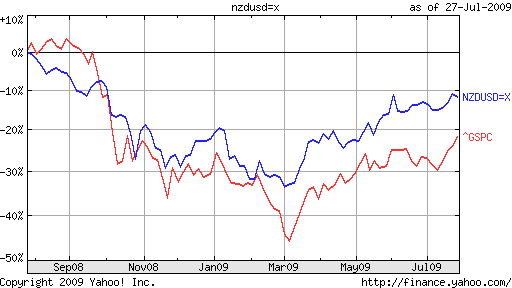
Having risen nearly 30% against the US Dollar since March, the New Zealand Dollar (NZD or Kiwi) is now close to a 9 1/2 month high. While still far from the record highs of 2008, the currency is already erased a large portion of the losses it racked up since the credit crisis gave way to economic recession.

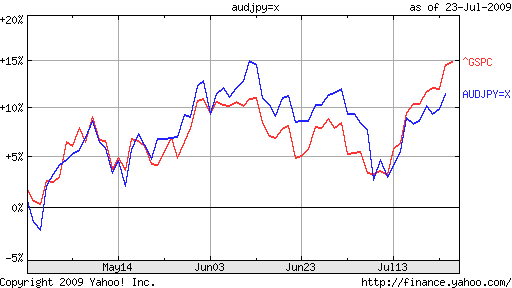
As part of last Friday’s coverage of the Japanese Yen, we included a chart which compared the performance of the AUD/JPY cross to the S&P 500. Even without calculating the correlation coefficient, a cursory review of the chart revealed an uncanny relationship! Unsurprisingly, it turns out the same relationship also applies to the New Zealand Dollar, whose recent performance closely mirrors US equities.
nzd

In other words, the interplay between risk appetite and risk aversion continues to dominate the forex markets, as traders move to calibrate the split of funds between so-called safe haven currencies and the riskier alternatives, among which the New Zealand Dollar is certainly counted. Much of the rally in the Kiwi, then, represents a correction, as investors acknowledge that the near 50% slide from-peak-to-trough was an overreaction.

Going forward, however, the Kiwi will have to rest on its own feet, as new themes move to the fore of investors’ minds. Specifically, they will begin to look more closely at the New Zealand economy, and demand evidence of a recovery. “Reserve Bank of New Zealand Governor Alan Bollard told a business audience the world has ‘avoided a repeat of the Great Depression. Now, we and the world, appear to be on our way to recovery. New Zealand looks likely to start recovering ahead of the pack.’ ”

At the same time, the most recent economic data showed an economy in freefall, as “New Zealand’s economy shrank for a fifth straight quarter…The economy contracted 2.7 per cent in the January-March quarter.” While forecasts vary, GDP is expected to fall by at least 2.1% in 2009, with a modest pickup expected in 2010. Investors are betting that the recovery will be driven by rising demand for commodities, which will help to buoy New Zealand exports. Once again, this conflicts with the data, which shows an annualized trade deficit of $3 Billion. Despite a fall in imports, the country is still importing more than its exporting. This could be a product of the stronger currency, which all stakeholders agree is not conducive to economic growth. In the end, the economy’s best chance for recovery lies in a resumption of debt-induced consumption and residential construction, the very forces which caused the current downturn. Says Mr. Bollard, “Reliance on past experience of strong house price inflation and easy credit will be untenable.”

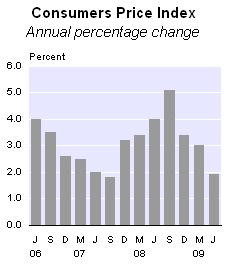
Given the uncertain prospects for growth, combined with moderating price inflation, the RBNZ can be expected to hold interest rates at current levels for the near-term. “Bollard will leave the benchmark interest rate unchanged at a record low 2.5 percent on July 30, according to all 10 economists surveyed by Bloomberg.” Based on swap rates, the markets feel similarly, and are pricing a mere 25 basis point hike over the next twelve months. With such a dubious prognosis, one has to wonder whether the Kiwi’s rally is really sustainable.
new-zealand-cpi-inflation2

[...]

Japanese Yen: Exports Versus Carry

0 comments

Plot the Japanese Yen against almost any “major” currency over the last few months (or few weeks for that matter) and you get a pretty consistent picture. Moreover, when you graph most Yen currency pairs against the S&P 500 (I like the AUD/JPY), the correlation is uncanny! Sure enough, it was reported recently that “Japan’s currency also fell the most in a week against the euro as futures on the Standard & Poor’s 500 Index rose 0.5 percent.”

japanese-yen-is-correlated-with-sp

This suggests that the main driver for the Yen is proximally, the demand for US equities, and ultimately, appetite for risk. “We’re seeing high-yielding currencies still rallying along with stock markets…The market is reverting to business as usual. That’s just spurring risk currencies forward,” explains one analyst. In other words, the carry trade is back, and investors are borrowing in the world’s cheapest currency (Japanese overnight interest rates are only .1%) and investing in higher-yielding alternatives. “There’s strong momentum behind this risk taking. You cannot keep your money in cash for zero returns unless you believe in deflation,” added a trader.

Experts on both sides of the Pacific Ocean are now encouraging their clients to short the Yen. “Japanese financial institutions are encouraging investors to put money into mutual funds focused on assets denominated in currencies such as the Turkish lira, South African rand and Brazilian real…Japanese investors were net buyers of 709.4 billion yen of overseas assets in the week ended July 11…” Goldman Sachs, meanwhile, has declared that the Yen is still overvalued, and “recommended investors use three-month forward contracts to sell the yen.”

There’s certainly some second-guessing taking place, especially with earnings season upon us. “Risk aversion is likely to stay prominent, given earnings announcements by companies including CIT. The bias is for haven currencies such as the yen to be bought,” insisted one analyst. In addition, Central Bank diversification has created some demand for the Yen and the Euro, but this is more of a Dollar-negative story than a Yen-positive story.

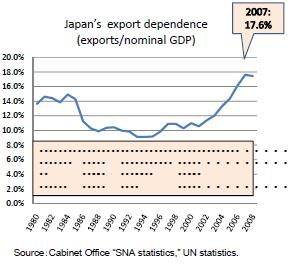
There are also signs that the Japanese economy is recovering, thanks to a pickup in exports. The fact that its economy remains so dependent on exports to drive growth certainly exacerbated the impact of the credit crisis. On the other hand, it could also magnify any recovery. “Japan’s merchandise trade surplus widened in June…to 508 billion yen ($5.42 billion) from 104.1 billion yen a year earlier. The nation’s trade performance appears to be improving, as the surplus was bigger than May’s 299.8 billion yen figure.”

japan-export-dependence
Still, prices in Japan are falling (by 1.1% at last count), and there are strong concerns among economic officials that deflation could take hold. Accordingly, carry traders borrowing in Yen can rest easy, knowing that Japan is probably the least likely of any industrialized country to raise interest rates in the near-term.

[...]

ECB to Hold Rates Until 2011

0 comments

The next rate-setting meeting of the European Central Bank (”ECB”) is rapidly approaching (August 3), and analysts are stepping up to offer their opinions on the direction of EU monetary policy. At its last meeting, on July 2, the ECB voted to hold rates at the current record-low level of 1%, and all indications are that the August meeting will yield the same result.

Despite getting off to a late start, the ECB has since moved adroitly to strike a balance in its monetary policy between inflation and growth. For those that insist that its rates are still too high - especially compared to the US and UK - the ECB can counter by arguing that this way it still has some scope to lower rates, if need be. “If a deflationary spiral does become entrenched, unlike most of the other major global economies, at least the European Central Bank still has some of the interest rate tool left to fall back on,” agrees one analyst.

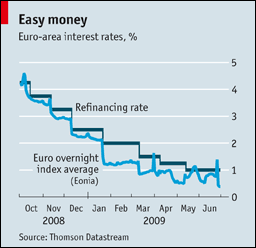
The ECB can also refer critics to its overnight lending rate, which are 75 basis points lower than its main policy rate. “Before the crisis, the ECB would aim to keep overnight interest rates close to the refi rate. Since it moved to unlimited fixed-rate funding, the central bank has been content to allow the overnight rate to drift much lower than the policy rate.” It is at this refinancing rate that it recently lent out a record €442 billion to banks and other financial institutions.

eurozone-interest-rates

While the ECB “has had one eye on the exit since the start of the crisis,” it nonetheless appears to be in no hurry to hike rates - neither its overnight nor its refi rate. Jean-Claude Trichet himself has said, “The current rates are appropriate.” He even refused to rule out the possibility that rates could even fall further before policy is tightened.

According to a Bloomberg survey of economists, this won’t happen for at least a year - the fourth quarter of 2010 to be specific. After all, inflation has touched a record low of -.1%. The Eurozone economy contracted by a record 4.5% last quarter. Private sector lending growth has fallen to a record low of 1.8%. All in all, not exactly the right environment for a rate hike. There is at least one vocal inflation hawk on the governing board of the ECB who is arguing for preemptive rate hikes, but for now at least he has been silenced. “Economists at Barclays in London have forecast that Europe’s policy makers won’t begin raising rates until late 2011.”

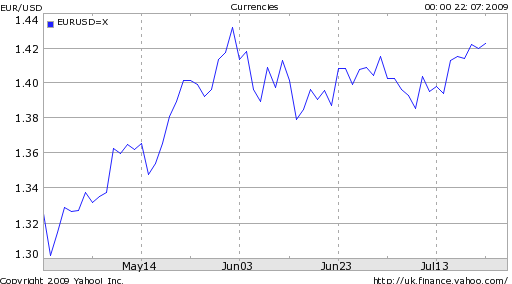
The forex markets, meanwhile, appear to be indifferent to this whole debate, concerned not about Eurozone growth, inflation, low interest rates, not to mention political uncertainties and trade deficits. The Euro has resumed its upward rise against the Dollar, begun in March, and may not slow down until the Fed starts to tighten monetary policy.

z1

[...]

Brazilian Real Surges Ahead

0 comments

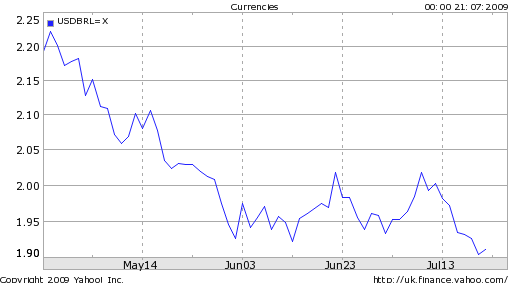
In the last three months alone, the Brazilian Real has risen by an impressive 15% against the Dollar alone. What’s driving this impressive importance? The lead paragraph for one article offered the following encapsulation: “Brazil’s real climbed to the highest in more than nine months as stronger-than-estimated corporate earnings, rising equities and higher metal prices bolstered the outlook for Latin America’s largest economy.”

real

These factors certainly represent a good starting point for any analysis of the Real. As signs continue to emerge that the global economy - and China specifically - have turned a corner in their fight to overcome recession, commodities will likely continue to rally, which is excellent news for Brazil bulls. In addition, “May industrial production and especially retail sales came in stronger than expected, following incipient signs of improvement in labor and credit conditions, consumer and investor confidence, and inventory levels.” As a result, after a modest contraction in 2009 (the bulk of which took place in the first quarter), 2010 is expected to mark a return to solid growth, with estimates ranging from 3.5% to 4.5%, rising to 5% in 2011.

The Central Bank of Brazil, however, is not necessarily on the same page. Last week, it cut rates to a record low of 8.75%, in order to ensure that Brazilian monetary policy remains easy enough to support growth. While this is an unwelcome development for carry traders, there are a few mitigating circumstances. First, considering that Brazilian inflation is projected to average 4.5% in 2009, this still affords investors a solid 4% real return, without factoring in currency fluctuations. Second, Brazilian rates are still significantly higher than levels in industrialized countries, such that the interest rate differential which makes Brazil attractive has been carefully preserved. Finally, while precise forecasts vary, the Central Bank is expected to begin hiking rates as soon as the end of this year, with further hikes throughout 2010.

The Central Bank has also been busy on other fronts. Thanks to a healthy trade surplus, its foreign exchange reserves are burgeoning, recently touching a record $209 Billion. This figure well exceeds Brazil’s outstanding debt, which gives it great flexibility in determining how to allocate these reserves. Already, the Central Bank has begun to pare down its holdings of US Treasury securities, in search of higher-yielding alternatives. In addition, the Central Bank has taken to intervening regularly in the forex spot market, in a vain effort to stem the rise of the Real.

In the short term, analysts are now lining up around various technical levels, backed by little real fundamental analysis. “Moreover, without fundamental economic news showing better times ahead for the U.S. economy, principally, then the BRL1.90 support will remain cemented in place,” offered one analyst. “You show me some more good news and the support will be closer to 1.85,” argued another. It looks like traders are just looking for excuses to keep bidding up the Real.

[...]

China’s Forex Reserves Cross $2 Trillion, but Still No Signs of Diversification

0 comments

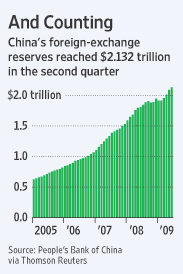
After a brief pause, China’s foreign exchange reserves have resumed their blistering pace of growth: “The reserves rose a record $178 billion in the second quarter to $2.132 trillion, the People’s Bank of China said today on its Web site. That dwarfs a $7.7 billion gain in the previous three months.” Considering that the global economy remains embroiled in the worst recession in decades, this is frankly incredible. [Chart below courtesy of WSJ].

chinas-forex-reserves-q2-20091

As far as currency traders are concerned, this development has two important implications, the first of which concerns the Chinese Yuan (also known as RenMinBi or RMB). A quick parsing of trade and capital flows data reveals that the majority of the $178 Billion came from unconventional sources. “The trade surplus was $34.8 billion in the second quarter and foreign direct investment was $21.2 billion.” Currency fluctuations (i.e. the depreciation in the Dollar relative to other major currencies) can explain a small portion, “leaving the bulk of the increase in the reserves unaccounted for.”

In short, most of the capital now flowing into China is so-called “hot money,” chasing a piece of the action in China’s surging property and stock markets. The benchmark stock index has risen 75% this year, making it the world’s best performer. In short, China is once again “caught in a squeeze similar to the one that bedevilled policymakers earlier this century, with a flood of hot money trying to force the government’s hand on the currency.” Either it allows the RMB to resume its upward path against the Dollar, or it raises interest rates rapidly to head off inflation. With the money supply now growing at an annualized rate of 30%+, the government is running out of time on this front.

The second implication concerns the composition of China’s reserves. You can recall that in recent months, Chinese officials have become more vocal about ending the Dollar’s role as the world’s reserve currency, and have even taken token steps towards achieving that goal. But the latest analysis suggests that when push comes to shove, China is still firmly behind the Dollar: “Estimates suggest around 65% of China’s official holdings are in U.S. dollar assets, and the remainder are denominated in euro, yen, sterling and other currencies. This mix has been relatively stable as the Chinese government continues to place the bulk of its reserves in U.S. Treasury securities.”

In fact, “stable” is an understatement. While other Central Banks are gradually paring their holdings of US Treasuries, China is adding to its own stockpile. Already the world’s largest holder of Treasuries, China added another $38 billion in May, for a total of $800 Billion. “On the contrary, Japan, Russia and Canada were sellers of US assets in May. Japan, the second-biggest international investor, reduced its total holdings by $8.7 billion to $677.2 billion.” Meanwhile, Zhou XiaoChuan, governor of China’s Central Bank has endorsed the current composition of reserves: “Despite the $800 billion in U.S. Treasuries, it is a diversified portfolio overall.” This certainly represents a step backwards for Mr. Zhou, who only a couple months ago was leading the charge for a global reserve currency.

Perhaps over the longer-term, it can begin to take steps to dislodge the Dollar, but for now, it appears that China has accepted the status quo. As one analyst observed, “We do expect China to increase its purchase of gold and other commodities over time, but these markets are just not big enough to make a meaningful dent in the structure of the overall FX holdings. For example, if China decided to hold 5 percent of its current $2 trillion reserves in gold, it would need to buy …the equivalent to about one year of world production. For other hard commodities, the cost of storage is high and prices fluctuate wildly.”

China did recently appoint a new official (an economist trained in the US) to manage its reserves. “The move isn’t likely to fluster foreign-exchange markets or herald any change in China’s exchange-rate policy and reform.” Still, Chinawatchers are advised to continue to monitor the situation closely for any signs of discontinuity.

[...]

Swiss National Bank Still Committed to FX Intervention

0 comments

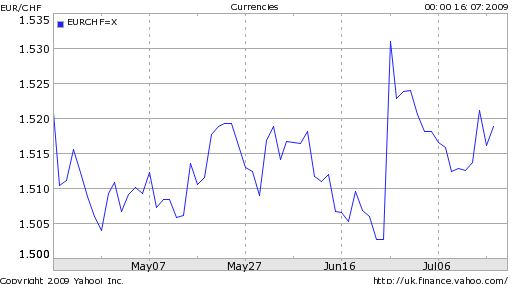
When the Swiss National Bank (SNB) intervened three weeks ago in forex markets, the Swiss Franc instantly declined 2% against the Euro. Since then, the Franc has risen slowly, and it’s now in danger of touching the “line in the sand” of 1.5 EUR/CHF that analysts have ascribed to the SNB.

swiss-franc
That’s not to say that the Central Bank lacks credibility. Quite the opposite in fact. Every time a member of the SNB speaks about the possibility of intervention, the markets react. For example, “Swiss National Bank Governing Board member Thomas Jordan said the central bank remains willing to intervene in currency markets to prevent a further appreciation of the Swiss franc..The franc declined against the euro after the remarks.” Also, “The Swiss National Bank is sticking decidedly to its policy to prevent an appreciation of the Swiss franc, SNB Chairman Jean-Pierre Roth said in an interview published on Friday…The Swiss franc dipped after Roth’s comments.”

In addition, given that the SNB premised its intervention on deflation fighting, its credibility is now higher than ever, since the latest figures imply an inflation rate that is well into negative territory: “Swiss consumer prices dropped 1 percent year-on-year in June, the same rate as in May when prices fell at their fastest rate in 50 years, underscoring deflation dangers although most of the drop was due to oil.” Despite a fiscal stimulus, coupled with an easing of monetary policy and quantitative easing, the Swiss money supply is barely growing. At this point, the only thing the SNB can do is (threaten to) manipulate its exchange rate.

Perhaps this is why traders are willing to push back against the SNB, backed by “foreign-exchange analysts [that] argue that the SNB won’t have an appetite to continue buying foreign currencies in large amounts much longer.” The SNB is also fighting against the perception that Switzerland is one of a handful of financial safe havens. The fact that the Swiss Franc is probably undervalued is also contributing to the steady inflow of capital into Switzerland.

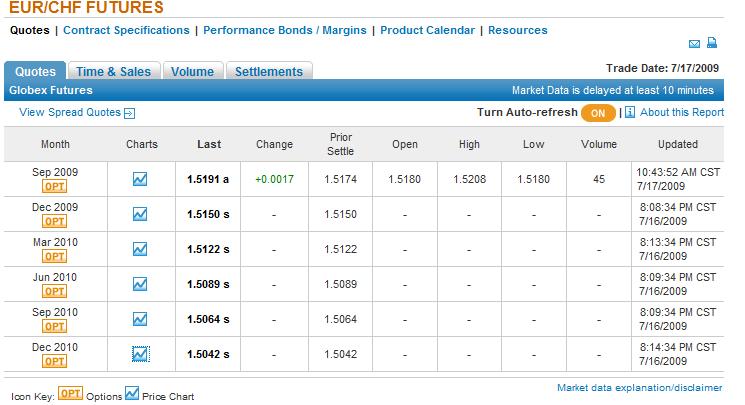
Still, investors are afraid to step across the line. Futures prices for the EUR/CHF are all hovering slightly above 1.50, for the next 18 months. Prior to the latest round of intervention, the expectation was for a steady rise in the Swiss Franc.

chf-futures-prices

In addition, “There are significant options in place for the euro near the CHF1.50 level on the expectation the SNB will carry through another intervention if its resolve is questioned.” While the SNB would probably prefer a slight buffer zone, it will nonetheless rest assured as long as the Franc doesn’t appreciate further: “The SNB is just trying to stop the franc from becoming a one-way bet. ‘If the euro stays in the [current] CHF1.50 to CHF1.54 band, I think the SNB would be satisfied.’ “

[...]

Pound: All Indicators Point to Down

0 comments

If an investor only read the story, Pound a Buy Before ‘Steep’ U.K. Recovery, they could be forgiven for assuming that the fundamentals underlying the Pound must be strong enough to just such a bold claim. In fact, virtually all economic indicators are trending downward, and most analysts (with the exception of the source behind the above story) are revising their Pound forecasts proportionately.

While all data is subject to “spin,” all of the big picture indicators paint a consistently negative picture of the UK economy. The Organization for Economic Cooperation and Development said on June 24 that U.K. gross domestic product will shrink 4.3 percent this year, revising its March forecast for a 3.7 percent contraction. Sterling has fallen 1 percent in the past month. Meanwhile, unemployment is still rising (albeit at a slower pace than before), and prices are falling.

The BOE will probably expand its liquidity program by the sanctioned 25 Billion Pounds, and “Speculation has also started to circulate that the Bank of England could announce it will seek approval from the Treasury to boost the size of the program even further.” Meanwhile, the government deficit is surging: “The U.K.’s credit rating is an issue that’s still there and public spending in an election year is causing concern for investors.

A sane analyst, then, could only come to one reasonable conclusion- that the Pound is doomed. In the short-term, the Pound will be punished by a weak economic prognosis, low interest rates, and the inflationary monetary/fiscal policy. Additionally, as the summer rolls in, investors will likely move funds outside of the UK into more stable locales. In the long-term, the Pound is equally dubious: “The pound’s decline in 2008 returned the currency to its real trade-weighted exchange rate of the 1970s, which could be its ‘new fair value’ as the U.K. becomes a net oil importer and is less able to rely on financial services to earn foreign exchange.”

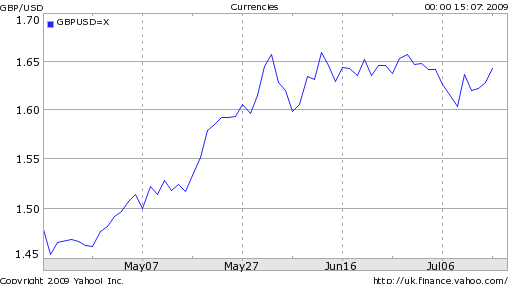
There is even less equivocation among investors, themselves. According to the Commodity Futures Trading Commission, “More hedge funds and large speculators have positioned for a decline in the pound against the dollar rather than a rise — so-called net shorts — every week since August.” While the Pound is currently trading around $1.65, “The median of 39 analysts and strategists’ forecasts compiled by Bloomberg is for the pound to trade at $1.59 by the end of September and $1.62 by the end of the year.”

Pound Rises

SocialTwist Tell-a-Friend
Posted by Adam Kritzer | in British Pound, Economic Indicators | No Comments »

Summer Could Provide a Boost to the Dollar

Jul. 15th 2009

There is a pattern in the following smattering of forex soundbites: “It feels like we’re already in the summer doldrums;” “[We] are moving into summer trading;” “We are in a summer period.” From three different analysts, three identical conclusions- summer has arrived. Granted, summer officially began on June 21, but given all that’s transpired since last summer, I think we can excuse investors from delaying their summer vacations this time around by a few weeks, until the kickoff of second quarter earnings season.

Summer usually means a couple things for the financial markets: less liquidity/volume and less fluctuations. The decline in volume is largely self-explanatory, due to what can best be summarized as more play and less work. The decline in volatility is due to a different, but related cause, which is a delay in important investment decisions until the fall, when traders return to their desks and resume monitoring the markets full-time. Both phenomena tend to cause asset prices to move sideways.

This is especially true for forex markets. “Traders noted major currency pairs remain largely range-bound…Markets for now are hung up by uncertainty over the shape of any future economic recovery, he said. Economic data at this point ‘can be spun either way,’ likely leaving currency markets next week to key off of any earnings surprises from U.S. companies,” observed one analyst. As far as the decline in volume is concerned, “Emerging markets are becoming particularly volatile as liquidity declines over the summer period,” and “Bid-offer spreads are quite wide.”

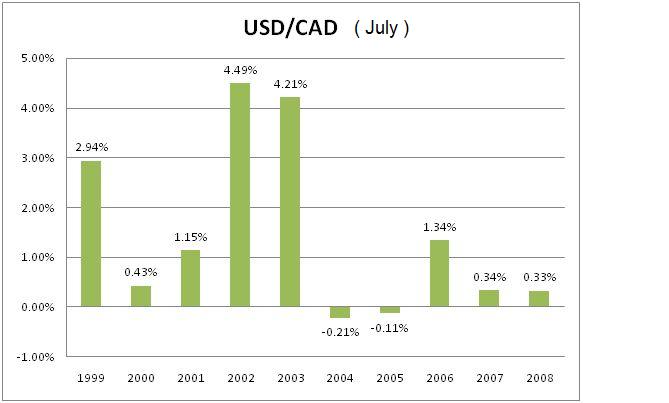
Kathy Lien, of Forex 360, has observed another summer trend: “Over the past 10 years, the Canadian, Australian and New Zealand dollars have seen their steepest slides in the month of July. In addition, we have seen the U.S. dollar outperform the Canadian and New Zealand dollars 8 out of the past 10 years during this month.” This could be a byproduct of delayed allocation, as investors shift capital out of risky markets/positions/currencies. The lesson might be to stick to the majors.

untitled

Based on all current indications, this summer will be no exception to this rule. While investors have certainly grown more complacent about risk over the last few months, there is a lingering uncertainty. “Economic data at this point ‘can be spun either way,’ likely leaving currency markets next week to key off of any earnings surprises from U.S. companies.” Even with across-the-board positive earnings results, investors will likely remain wary and could hold off on taking any risky (overseas) positions until the fall.

[...]

Chinese Yuan Poised for Appreciation

0 comments

I toyed with today’s headline for a while, given that an equally cogent case could be made for either “Chinese Yuan Poised for Significant Appreciation” or “Chinese Yuan Poised for Stability.” Let’s face it- when it comes to to the Chinese Yuan, it’s a complete guessing game, since you’re not only dealing with the normal factors that affect currencies, but also with the whims of China’s Central Bank. Still, I think that the Yuan will continue to appreciate slowly and steadily, because such is in the best interest of China.

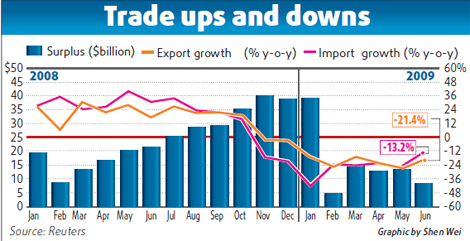
For the sake of context, consider that the Central Bank has held the Yuan around $6.83 for the better part of a year now, since the advent of the credit crisis. Prior to that, it had appreciated nearly 20% over the previous three years. The reason China has been able to get away with holding the Yuan constant for such a long period of time is the collapse in its trade surplus. Meanwhile, inflation has abated, down from a high of 7% to the current level of near 0%. As a result, the Central Bank can now have its cake and eat it to, by holding the Yuan constant without worrying about the effect on prices.

china-trade-balance
The most recent forecasts, however, suggest this is about to change. According to the World Bank, “China’s current-account surplus is likely to reach $388 billion in 2009…while foreign-exchange reserves will likely rise by $218 billion to $2.168 trillion at the end of this year.” Depending on who you ask, China’s economy is on track to grow by 7.2% to 7.5% in 2009, and by 8.5% in 2010. These forecasts represent upward revisions, and “Private economists have also been upgrading their outlook for China’s economic growth this year in the past couple of months since some major indicators including fixed-asset investment and industrial output growth have shown signs of improvement.” Second-Quarter GDP is scheduled for release in the next week, at which point we will likely see another round of revisions.

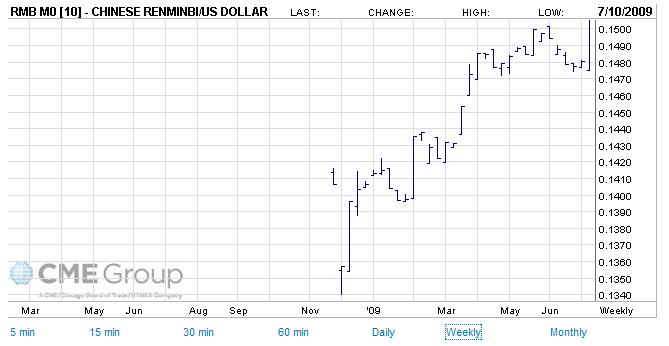
If such growth materializes, this would place China in a dilemma, such that it would have to choose between higher prices or more expensive currency. According to the Royal Bank of Scotland, “Policy makers will keep benchmark interest rates on hold this year because of declining consumer prices,” which implies, “The yuan will strengthen to 6.7 by the end of 2009 and 6.5 a year later.” Chinese Premier Wen JiaoBao agrees that “China should stick to an appropriately loose monetary stance and an active fiscal policy.” This notion is also reflected in futures prices, which have priced in a modest 1-2% rise in the Yuan over the next year [compared to previous expectations of a 5% decrease].

rmb-usd
Economics aside, there is another major reason why the Yuan should continue to appreciate. China has been clamoring for several months now for a decline in the Dollar’s role as the world’s reserve currency, and a commensurate rise in the Yuan. Already, the country has started to take steps to increase the use of Yuan in settling cross-border trade, and “HSBC predicts that by 2012 nearly $2 trillion of annual trade (over 40% of China’s total) could be settled in yuan, making it one of the top three currencies in global trade.”

Still, the currency is still nowhere near satisfying the requisite convertibility inherent in reserve currencies. According to one analyst, “China would need to scrap capital controls so foreigners could invest in yuan assets and then freely repatriate their capital and income, but the government is wary of moving too quickly. A reserve currency also requires a deep and liquid bond market, free from government interference.” If China is able to achieve any of these feats, capital will likely pour in at an even faster rate, making an appreciation in the Yuan once again self-fulfilling.

[...]

Investors Disagree over Emerging Markets

0 comments

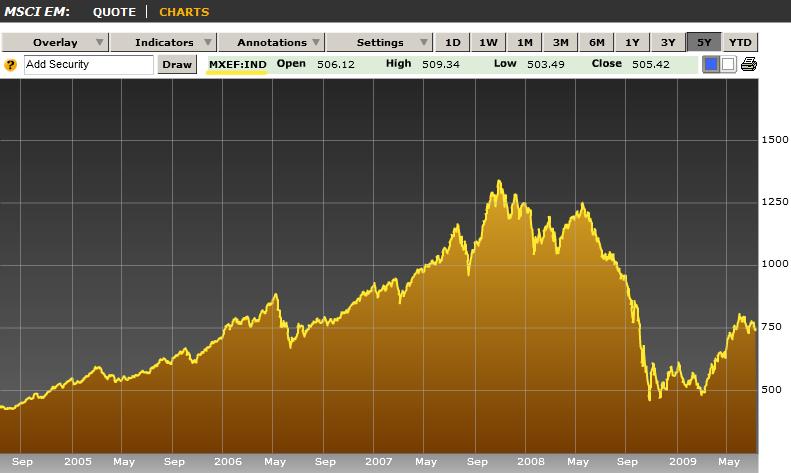
Since touching a low in March, the emerging market class has risen by 50%, according to one measure. This led to concerns that another bubble was forming, a swift pullback ensued. The bulls, however, point out that valuations remain well below 2007-2008 bubble levels and that according to some measures, fundamentals are actually quite strong.

emerging

They have a point. With the exception of a few bailouts in Eastern Europe, emerging markets as a whole have actually weathered the storm quite well. As one analyst points out, “Governance has improved, many countries run current-account surpluses, foreign-currency reserves have grown, the middle classes are expanding and savings rates are high. Countries such as Brazil and Turkey have been able to cut rates during the crisis and still attract money.”

In fact, it wasn’t even until the collapse of Lehman Brothers in September 2008 (when some might say the credit crisis entered the worst stage) that investors even began to pull money from emerging markets. “During the first half of 2008, gross capital inflows to EMEs held up remarkably well, in many cases reaching 60–70% of the record high inflows in 2007…The fact that other investors (banks and bondholders) maintained their positions in EMEs may be attributed to a number of factors…including much larger official foreign exchange reserves and more robust banking systems in many cases.”

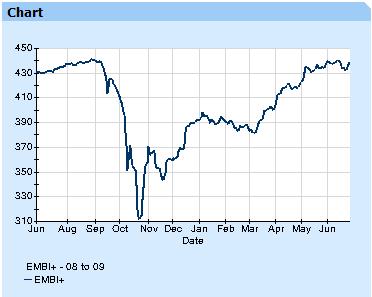
Accordingly, it could be argued that the recent rally in emerging markets could represent a “reverse correction”- an acknowledgment that the record decline was simply an overreaction. While stocks still remain well below their record highs, bonds are rapidly approaching pre-crisis levels. The spread between the JP Morgan EMBI+ index and US Treasury securities is now approximately where it was one year ago.
chart
The naysayers, though, like to remind people that emerging markets are inherently risky: “The past decade or so alone has seen the Asian crisis, the Russian default and another round of restructuring in Latin America. Populist politics, poor fiscal management, a reliance on foreign-currency borrowing and fixed exchange rates were a magnet for trouble.”

Sound macroeconomic and fiscal policy notwithstanding, it’s clear that certain structural problems remain extant: “In February 2009 it became clear that the state of these economies was deteriorating faster than expected. Many borrowers faced challenges repaying or rolling over their loans. The loss of investor confidence suddenly exposed long-standing vulnerabilities, such as the widespread practice of foreign currency borrowing by households and by small and medium-sized enterprises.” In addition, emerging markets collectively remain heavily reliant on exports to drive growth, which is problematic given that, “The synchronised fall in exports intensified in the first quarter of 2009 with an average year-on-year decrease of around 25% in a set of larger EMEs. In some commodity-exporting countries, notably Chile and Russia, exports fell by more than 40% in the first quarter of 2009.”

The best way to account for this schism between capital inflows and economic uncertainty is a shift in the way emerging market investors view risk. Previously, it was default risk that predominated. Now, however, it is inflation and currency risk, as well as corporate credit risk, that guides investor thinking.

[...]

Risk Aversion Edges Up

0 comments

Over the last few weeks, the stock market rally has fizzled and commodities prices have cooled off. It’s not clear what triggered this sudden surge in introspection (I would call it reasonableness). Regardless, the markets are now wondering out loud whether the optimism of the second quarter wasn’t a bit naive.

After all, there still isn’t any evidence that global economy has turned a corner. Virtually all of the economic indicators that matter are still trending downwards. In addition, the apparent stabilization in housing prices could prove temporary, as banks move away from loan modifications and back towards foreclosure. Rumors that the Obama administration are considering a second stimulus plan are already circulating

With second quarter corporate earnings season set to kick off next week, investors are once again bracing for the worst: “Given the strong performance of stocks relative to March lows, a reality check from earnings could be detrimental to risk appetite.” Adds another analyst, “It’s renewed risk aversion, triggered by mounting doubts about a near-term economic recovery that’s evident in the sell-off on Wall Street and the subsequent decline in risk assets in general.”

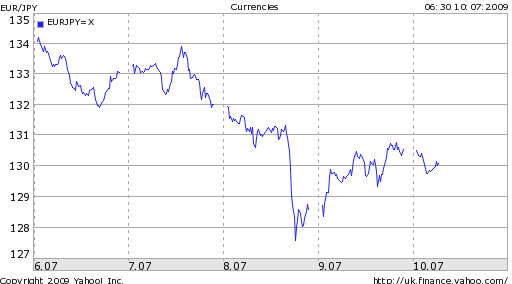
This pickup in risk aversion is also manifesting itself in forex markets, via the upturns in both the US Dollar and Japanese Yen: “The prospect of a slow and bumpy recovery remained the overriding driver of market sentiment and the dollar was soon reasserting itself as the currency of choice - apart from the yen.” Ironically, negative economic data that applies directly to the US is benefiting the Dollar, which goes a long way towards explaining the current market orientation. Currency traders have yet to turn towards comparative growth differentials (despite the predictions of some analysts) and remain firmly focused on risk. Meanwhile, “The yen rally has extended, driven by the liquidation of long-risk asset positions.” In other words, the carry trade has come under pressure as investors move back into low-risk government bonds.

euro-yenThe “uncertainty” narrative will likely continue to drive the markets for the near-term, as neither the optimists nor the pessimists have the data to support their respective positions. In all likelihood, the markets will trend sideways and safe haven currencies will see a slight inflow, until there is confirmation that the economy is firmly on the path to recovery.
[...]

Inflation Update: US Prices Creep up in May

0 comments

The debate over US inflation continues to be waged- in academic circles, among economists, and in the financial markets. There is no still no clear consensus as to the likelihood that the inflation will flare up at some point, as a result of the Fed’s easy monetary policy and the government’s record budget deficits. While the unprecedented nature of this crisis means that such a debate is still a matter of theory, that hasn’t stopped both sides from weighing in, often vehemently.

Admittedly, the risk of inflation in the short-term is still low: “With so much of the world ensnared by the economic downturn, demand for goods and services is weak, which tends to push down prices. Amid high unemployment, workers are in no position to demand wage increases.” Still, the Consumer Price Index (CPI) is already creeping up. The Fed’s “core” measure, which excludes food and energy prices, rose 1.8% from a year ago. If commodity prices continue to rise, the total CPI could soon become positive. (It currently stands at -1.3%).

Among academics and economists, the discussion is being framed relative to the Fed; specifically, can it - and more importantly, will it - move to unwind its quantitative easing program when the time comes? “If it acts prematurely to reduce the money supply, the Fed could stifle the recovery. If it waits too long, it could contribute to a jump in inflation. Its timing is going to have to be perfect,” says a former Fed economist.

This question remains divisive, as evidenced by the ongoing feud between the chief economist at Morgan Stanley and his counterpart over at Goldman Sachs. MS is concerned that the Fed will leave rates too long. According to one of his supporters, “The Fed absolutely has the tools and know-how, but the question is, will they have the guts to use them? I don’t think there is a snowball’s chance in hell they will be willing to tighten to slow inflation down.” Counters the GS camp: ““The Fed will be able to contain inflation pressures through a combination of raising interest rates and unwinding its balance sheets.”

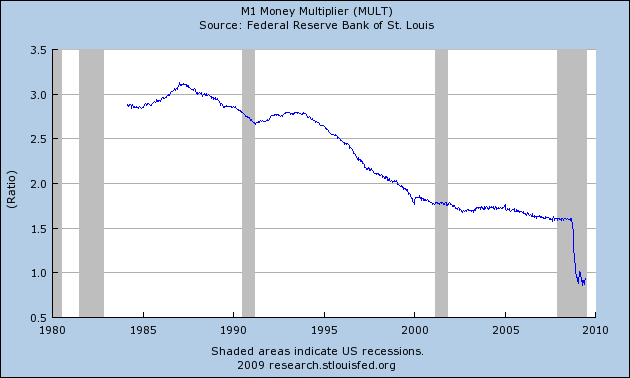
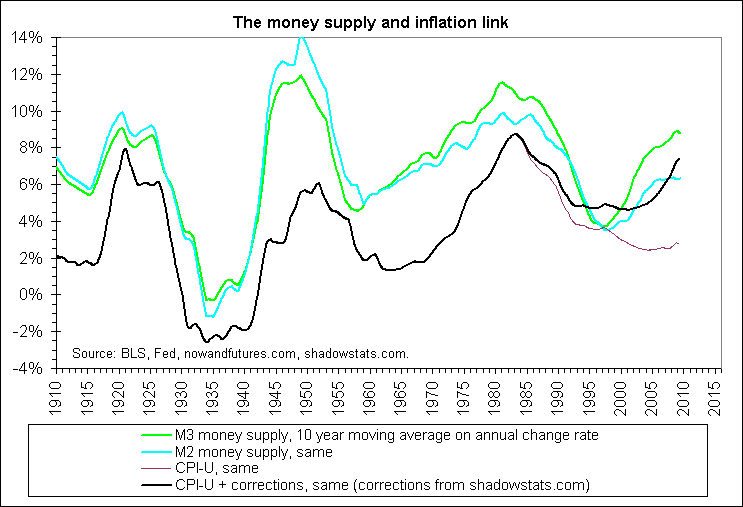
All of this talk seems premature when you consider that the money supply is barely growing, despite the Fed’s QE program: “M2, a gauge that includes savings and checking accounts, is 4.7 times the base cash supply, down from 9.3 times a year ago.”

m1-money-multiplier

“Of the $2.1 trillion that the Fed is injecting into the financial system, more than half, or 51 cents per dollar, is being posted back at the central bank by financial institutions in the form of excess reserves, a record high.” In other words, most of the Fed’s cash is not actually finding its way to consumers.

us-money-supply-and-inflation-link
Financial markets are equally ambivalent, although erring on the side of caution. Treasury yields on the long end of the curve have risen over the last few months, though this can be attributable to several causes. More specifically, “The spread been nominal 10-year Treasury yields and comparable-maturity TIPS yields has increased from approximately 0.25% at the start of the year to 1.65% currently, reflecting a 1.4% increase in expected CPI inflation over the next decade.” Based on this, it’s clear that while investors don’t share the doomsday pessimism of inflation hawks, they are nonetheless growing increasingly concerned.

[...]

Interview with Sean Hyman: “Trade with the trend”

0 comments

As part of our ongoing series, printed below is an interview with Sean Hyman, of World Currency Watch. [Blog found here]. Sean has collected over 15 years of experience as a stockbroker, manager, and trader, working for enterprises as varied as a technical analysis “call in” line for their million dollar+ clients and active traders, Charles Schwab, and FXCM. Over this period, he has refined his trading approach through the use of fundamental/technical analysis and intermarket analysis, and now takes a very “macro” approach.

Read the rest of this entry »

[...]

Forex Reserve Growth Could Slow

0 comments

Most of the recent discussion surrounding foreign exchange reserves has focused on the allocation of those reserves; specifically, whether or not these reserves will be invested in Dollar-denominated assets to the same extent as before. But what if this discussion fails to see the forest through the trees? In other words, this issue is built on the implicit premise that Central Banks will continue to build their forex reserves, and hence they need a place to invest them. With this post, I will examine whether this is indeed the case.

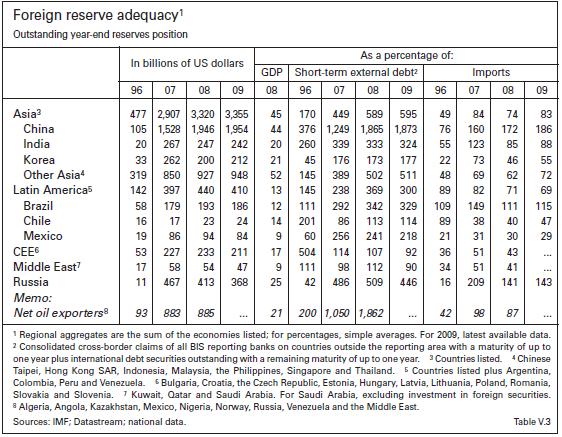
Since the start of the credit crisis, forex reserve growth has slowed as Central Banks (mainly in emerging markets) began to deploy some of their cash: “In the first quarter of 2009, foreign reserves were at 80% of their June 2008 levels in Korea and India, around 75% in Poland and 65% in Russia.” Most of the spending was used for direct intervention in currency markets and to finance capital outflows, as risk-averse investors moved funds out of emerging markets. Russia, alone, spent nearly $200 Billion trying to prevent a complete collapse in confidence in the Ruble.

Thanks to their prudence following the 1997 Southeast Asian economic crisis, however, reserves are still more than adequate based on most measures: “A well known rule of thumb (the so-called Guidotti-Greenspan rule) is that foreign reserves should cover 100% of external debt coming due within one year. In 2008, almost all EMEs far exceeded this threshold – coverage was more than 400% in Asia and Russia and around 300% in Latin America. Another rule of thumb, that foreign reserves should cover three to six months of imports (ie 25–50% of annual imports) was also typically exceeded at the end of 2008.” Even despite the recent declines, coverage remains strong enough to meet financing requirements for the immediate future. China, whose cache of forex is by far the world’s largest, boasts a coverage ratio of nearly 2,000%!

foreign-reserve-adequacyGiven such robustness, it’s clear that the impetus to continue accumulating reserves has eroded slightly. Central Banks have also come to realize how vulnerable they are to credit and currency risk, vis-a-vis the allocation of their reserves, which means that the best alternative going forward is probably to start investing in commodities and/or domestic economic initiatives. China has already begun to move in this direction.
There are several alternatives that are less risky/expensive than directly holding foreign exchange reserves. “First, in October 2008 four EME central banks each entered into a $30 billion reciprocal currency arrangement with the US Federal Reserve. Second, a $120 billion multilateral facility, drawing on international reserves, was recently established in East Asia…Third, recent G20 initiatives have called for large increases in resources for international financial institutions…[such as the] IMF’s recently created Flexible Credit Line.” Such programs provide countries in crisis with the cash to draw from without forcing them to build up reserves in advance.

To be fair, not all Central Banks are prepared to break from the current system. “In spite of significant interventions in the fourth quarter of 2008, many EMEs still had larger foreign reserves at the end of 2008 than they did in 2007.” Reports are coming in that Indian and Korean reserves, for example, have reached their highest levels since the collapse of Lehman Brothers last fall. This is sounding alarm bells for economic officials: “There is a hope the lesson taken away from the current experience is not that these countries need even larger foreign exchange reserves. These things are not terribly efficient. Our concern is that these things are going to be built up even further as a consequence.”

[...]

Will the Euro Survive the Credit Crisis?

0 comments

The Euro has always had a marginal group of naysayers; there were always those who insisted that a common currency didn’t make sense for a region as diverse as the EU. As a result of the credit crisis, a bevy of critics have come out of the woodwork and declared that the Euro will not survive its first official crisis. Are they right?

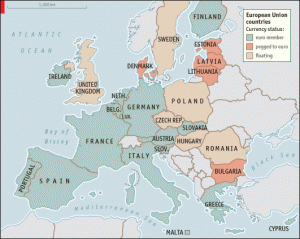
According to a Special Report on the Euro Area published in the Economist (which inspired this post), the Euro has been a modest success by most measures. “The ECB has fulfilled its remit to maintain the purchasing power of the euro. Since the currency’s creation the average inflation rate in the euro area has been just over 2%. Fears that the euro would be a “soft” currency have proved unfounded. It is unquestioningly accepted at home and widely used beyond the euro area’s borders.” While the Euro hasn’t facilitated meaningful gains in productivity or GDP, it has unquestionably engendered greater stability.

euro-zone-members1

Ironically, the countries that are now complaining the loudest about the Euro are mainly those that benefited the most from its membership. The economy of Spain, for example, “grew at an average annual rate of 3.9% between 1999 and 2007, almost twice the euro-zone average and much faster than in any of the currency area’s other big countries…Unemployment fell from close to 20% in the mid-1990s to just 7.9% in 2007.”

Unfortunately, the economic boom also corresponded with a rise in prices and unit wage costs, both of which are now proving to be particularly painful in the context of recession. Aided by a strong currency, its current account deficit has risen to 10% of GDP. Meanwhile, the same problems are affecting Portugal, Ireland, Italy, and Greece. As the report explains, “The main hazard for investors in high-inflation countries—that a steady loss of domestic purchasing power will drag the currency down—is eliminated in a fixed-exchange-rate zone.”

A country with an independent monetary authority would normally deal with these problems by raising interest rates and/or devaluing the currency. Actually, given how extreme the imbalances are in some of these countries, the markets probably would have accomplished this for them. In this case, however, their membership in the EU and their deference of monetary power to the European Central Bank precludes such possibilities. As a result, the main solutions will have to be originate in the political arena. Wages will have to become more flexible, and labor market controls will have to be loosened, in order to increase productivity.

The alternative - leaving the Euro zone- is unthinkable. “The costs of backing out of the euro are hard to calculate but would certainly be heavy. The mere whiff of devaluation would cause a bank run: people would scramble to deposit their euros with foreign banks to avoid forced conversion to the new, weaker currency. Bondholders would shun the debt of the departing country, and funding of budget deficits and maturing debt would be suspended.” As a result, borrowing costs would increase drastically, which could induce a wage-price spiral. Inflation and currency stability would be tenuous, at best. As a result, it’s not surprising that in most Euro member states, polled citizens remain strongly in favor of the Euro.

support-for-the-euro-is-strong

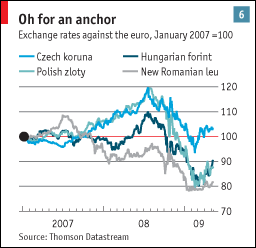
In addition, those on the cusp of joining remain firmly committed to doing so. For such economies, the economic crisis has actually strengthened the case for Euro membership. “As emerging economies they are prone to sudden shifts in foreign-investor sentiment, which makes for volatile currencies, so exchange-rate stability holds considerable appeal for them.” Romania and several baltic states have already had to go hat-in-hands to the EU and IMF to ask for assistance in order to stave off a complete loss of investor confidence. Poland is also vulnerable to currency decline, since many of its loans are denominated in foreign currency; it is currently aiming for Euro membership in 2012.

eastern-europe-wants-to-join-the-euro

Concludes the Economist, “For all its shortcomings, the euro zone is far more likely to expand than shrink over the next decade. Most EU countries that remain outside, bar Britain and Sweden, are eager to join.” This is certainly a bit glib, and ignores the imbalances that the currency is at least partially responsible for. Still, the tentative consensus is accepting of the Euro. It’s like the old joke about capitalism - “it’s the worst system– except for all of the others…”

[...]

Do You Trade Anything Else Except Forex?

0 comments

I think that the Forex market offers a lot of advantages compared to the other types of financial trading. Currency pairs offer a variety of choices, events to react on and the technical analysis is simply beautiful in Forex. But I also like to trade in other markets. Because many Forex brokers also offer gold and oil, I sometimes like to set up long-term positions on these instruments. I also have some portfolio in stocks, but it can hardly be called a real trading because I only trade like once in 3-6 months in stocks. What about you? Do you trade in anything else than currency pairs?

Do You Mix Forex Trading with Any Other Type of Financial Trading?

View Results

[...]

GBP/USD Chart Patter — July 26th 2009

0 comments

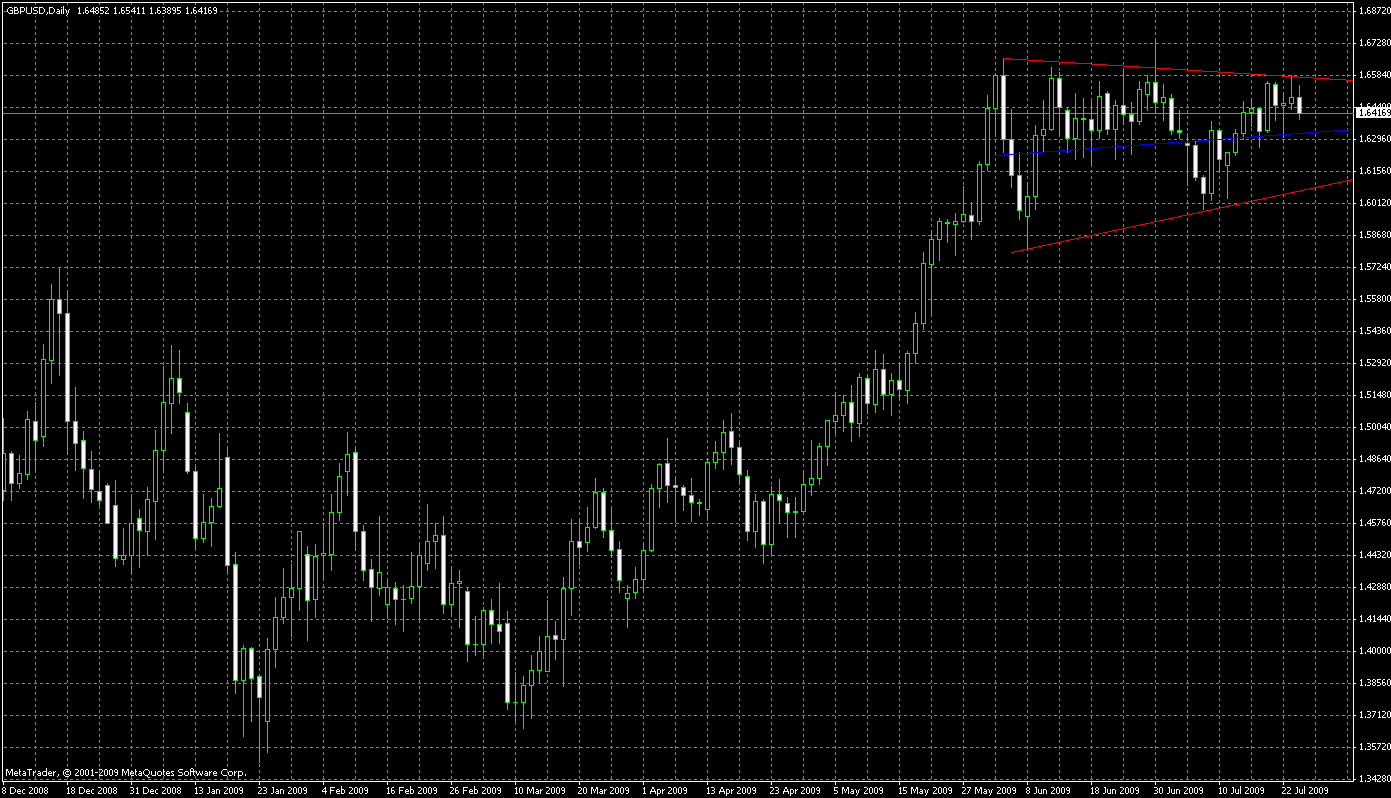
This time I once again show only one Forex chart pattern that I’ve detected during the last trading week. It’s GBP/USD ascending triangle with a small downward slope. This is a bullish continuation figure and I recommend expecting an upward breakout, which can happen in a week or two. Click on the image to get the full-size chart screenshot:

GBP/USD, Daily Timeframe Chart, Ascending Triangle

[...]

Forex Technical Analysis for 07/27—07/31 Week

0 comments

EUR/USD trend: sell.
GBP/USD trend: sell.
USD/JPY trend: buy.
EUR/JPY trend: sell.

Floor Pivot Points
Pair 3rd Sup 2nd Sup 1st Sup Pivot 1st Res 2nd Res 3rd Res
EUR/USD 1.3927 1.4018 1.4109 1.4200 1.4291 1.4382 1.4473
GBP/USD 1.6013 1.6161 1.6289 1.6437 1.6565 1.6713 1.6841
USD/JPY 91.28 92.18 93.48 94.38 95.69 96.59 97.89
EUR/JPY 129.06 130.57 132.59 134.10 136.12 137.63 139.65
Woodie’s Pivot Points
Pair 2nd Sup 1st Sup Pivot 1st Res 2nd Res
EUR/USD 1.4018 1.4110 1.4200 1.4292 1.4382
GBP/USD 1.6156 1.6279 1.6432 1.6555 1.6708
USD/JPY 92.28 93.68 94.48 95.89 96.69
EUR/JPY 130.70 132.84 134.23 136.37 137.76
Camarilla Pivot Points
Pair 4th Sup 3rd Sup 2nd Sup 1st Sup 1st Res 2nd Res 3rd Res 4th Res
EUR/USD 1.4101 1.4151 1.4167 1.4184 1.4217 1.4234 1.4251 1.4301
GBP/USD 1.6265 1.6341 1.6366 1.6392 1.6442 1.6467 1.6493 1.6569
USD/JPY 93.57 94.18 94.38 94.58 94.99 95.19 95.39 96.00
EUR/JPY 132.67 133.64 133.96 134.29 134.93 135.26 135.58 136.55
Fibonacci Retracement Levels
Pairs EUR/USD GBP/USD USD/JPY EUR/JPY
100.0% 1.4291 1.6585 95.29 135.61
61.8% 1.4221 1.6480 94.44 134.26
50.0% 1.4200 1.6447 94.18 133.84
38.2% 1.4178 1.6414 93.92 133.43
23.6% 1.4152 1.6374 93.60 132.91
0.0% 1.4109 1.6309 93.08 132.08

[...]

CFD, Indices, Equities and Forex Trading Broker

0 comments

Aurora Global Markets is a new Forex broker company that was added to the list on my site today. It’s on-line since 2009 and offers brokerage services on almost every kind of financial market — starting from Forex and ending with the equities. They have their own custom browser-based platform, which supports charts and other useful trader’s tools. Other highlights of Aurora Global Markets include:

  • Hundreds of trading instruments
  • Only traders from South Africa, European Union, Canada, New Zealand and Bahrain are accepted
  • Non-EU traders need to send notarized copies of ID documents
  • Variable spreads on all instruments
  • Regulated by FSA

[...]

EUR/USD Posts Small Change for 3rd Day

0 comments

EUR/USD rose slightly today, but again, just insignificantly, hovering slightly below the major resistance line. The lack of significant movement in the dollar-against-euro pair was accompanied by the increase of the initial jobless claims in the past week. EUR/USD is now trading near 1.4222.

Initial jobless claims were at 554k last week — that’s a 30k increase compared to the previous week’s 524k. The release came out to be almost exactly the same as the forecast value of 555k.

Existing home sales increased to 4.89 million annual rate in June, following the revised rate of 4.72 million in May and 4.83 million forecast for June.

As was reported yesterday, the U.S. crude oil inventories showed another declining week — -1.8 million barrels, while the motor gasoline inventories rose once again — by 0.8 million barrels.

[...]

Money Management and Risk Management

0 comments

A new trading e-book has been uploaded to my site today. It’s Money Management and Risk Management by Ryan Jones. As the title of this book goes, it’s about money management — one of the most important parts of Forex trading (and not only Forex, but any other financial trading that involves risk and probability). The author wisely divides the money management into two kinds — the proper and improper money management. Where the first type refers to the one that always keeps in mind both the risk and reward parts of each trading action, while the improper tries to amplify the importance of only one of those to vital parts. Unfortunately, the majority of traders, especially newbie traders, that see the possibilities opened by the on-line Forex market and its huge leverage, fail to see the full picture and all the more so they can’t apply the proper money management to their trading strategy. But now you can download this book to learn more about the proper money management:

[...]

Free Professional Forex Course from eToro

0 comments

From now on every trader that opens a demo or real account with the eToro Forex platform will receive the first lesson from a professional Forex training course for free. To get the rest of the lessons of this course, trader just need to contact eToro via one of the available methods to get the information on how to obtain this course for free. I’ve browsed through the first lesson of the course and it seemed quite introductory to me (as it’s probably supposed to be). There are ten lessons overall and they cover the following topics:

  1. Basics of Forex.
  2. A quick guide to eToro’s revolutionized trading platform.
  3. Fundamental analysis.
  4. Technical analysis basics, charts, chart types, timeframes.
  5. Trends, trend lines, support & resistance lines.
  6. Fibonacci and pullbacks.
  7. Popular indicators.
  8. Breakouts and swing trading.
  9. Trading examples.
  10. Adapting technical analysis to commodity trading.

Looks quite interesting to me, especially the last topic since I’ve been trading commodities a lot lately. You can get more information about eToro and open account with this Forex broker.

[...]

Expert Advisor Based on MACD Patterns

1 comments

Another MetaTrader expert advisor was added to my site today — MACD Pattern. It’s based on the MACD patterns (Moving Average Convergence/Divergence), specifically for EUR/USD H4 chart. It shows quite interesting back-test results but, unfortunately, has also two major problems. First, it has more than 27% maximum relative drawdown (that’s more than $6,000 drop during one moment). Second, it doesn’t explicitly control bar opening and uses stop-loss and take-profit levels, which means that the backtests aren’t very accurate and the resulting data should be treated very skeptically. But 60% profit over the course of less than 19 months is quite nice. Here you can see the test results graph (click to enlarge):

MACD Pattern Test Results

A strong drawdown can be seen close to the end of the test — its reason is unknown to me, but I guess it’s tolerable.

You can also view the complete testing report. Go directly to MACD Pattern expert advisor page to download this EA or get more information about it. If you don’t like MACD Pattern, you can check other MetaTrader expert advisors.

[...]

Will EUR/USD Reach 1.5000 Before September?

0 comments

Looking at the weekly chart of the EUR/USD currency pair it’s easy to say that it’s currently trading in some kind of a long term triangle pattern with the narrowing boundaries. Although, the upper boundary offers a strong resistance far below 1.5000 level, there is a high probability of the bullish breakout. Fundamental analysts talk about the inevitable dollar’s weakness that will come soon as the global economy starts to recover from the crisis. On the other hand, the U.S. dollar still remains a global reserve currency, while the euro still haven’t managed to gain the proper reputation, which suggest a bearish breakout in EUR/USD. And what do you think about it?

Will EUR/USD Reach 1.5000 Level Before September 1st 2009?

View Results

[...]

Trend Visualization with ADX Based Indicator

0 comments

Trend indicators seem to be the most popular ones among the Forex traders. Indeed, Forex market is quite trendy and if a trader manages to catch this trend in its early stage and exit not long after the trend ends, considerable profit can be made. Today, a new free Forex indicator for trend detection was uploaded to my site. It’s quite accurate and shows where the trend starts and also where it ends; the zone without a trend is marked with a straight horizontal line, which also serves as some kind of support and resistance level. This indicator is easy to use but you should be aware of the fact that it’s redrawing on the current bar and thus only completed bars can used as signals:

[...]

Only a few days left to take advantage of GFT’s account bonus

0 comments

Forex traders in the U.S. can become eligible for an additional 0 when they open an account with GFT
Only three days left for foreign exchange traders in the U.S. to take advantage of a special offer from GFT. We’re offering an account bonus until July 31. Contact us via live chat now.

The 0 bonus is available to new GFT customers who open a standard trading account with a minimum balance of ,500. However, GFT President and CEO Gary L. Tilkin said traders who open larger accounts may be eligible for even more perks.

"Traders with accounts larger than ,500 will be not only receive this limited-time account bonus, but could also be eligible for even more bonuses through our new account packages program," he said. "It’s quite appealing given that you get free tools, news and other benefits."

See Also

[...]

London Session - July 28, 2009 6:33 AM

0 comments

Twice this morning EUR/USD has tested 1.4300. So far the EUR has failed to hold above this level with the slightly softer tone of stock markets in Europe draining some of the enthusiasm for risk and pushing EUR/USD back to the 1.4270 area. In Asian hours, the day belonged to the AUD. Comments from the RBA Governor Stevens that “upside risks balance downside risks” cemented the view that the next rate move by the RBA will be a rate hike. The AUD extended its gains into the London open with AUD/USD hitting highs just shy of 0.8340 before meeting resistance. AUD/JPY hit 79.29 before the JPY found buyers on the softer tone of stocks. Full text »

[...]

Asia Session - July 28, 2009 1:29 AM

0 comments

The Asia session belongs to the Aussie Dollar as Reserve Bank of Australia Governor Glenn Stevens spoke of a “glass half full” as opposed to a “glass half empty” in reference to the Australian economy. Steven’s speech was upbeat; stating that the current downturn may not be “one of the more serious ones of the post-War era” for the land down under, and that current upside risks will in turn counter the risks to the downside. The reaction in the AUD/USD was swift and serious, as the pair blasted to highs over 0.8285, levels not witnessed since September of 2008 on the news and the hint that rates could be moving higher in due time. Prior to the news the pair had drifted listlessly lower to the tune of 30 pips to just under 0.8200 as Steven’s took the podium and sent the pair higher. All Aussie based pair’s printed solid gains for the day, pulling the Kiwi and its components higher despite poor trade balance data that hurt that currency early on. The RBNZ will meet on Thursday for its rate decision. Full text »

[...]

New York Session - July 27, 2009 5:08 PM

0 comments

The NY session was choppy to say the least and the dwindling of risk appetite helped the US dollar rebound modestly. US stocks managed to close up on the day, but the 0.3% gain was meager compared to European and Asian marts. Not even a booming new home sales report could help make for a euphoric market. US new home sales shattered expectations by rising to 384K in June from a 346K prior result. The better number was on the back of massive price capitulation – median prices fell nearly -6% month-on-month – and this was cause for pause. Full text »

[...]

Japanese Yen, U.S. Dollar Lower in Currency Trading

0 comments

Safe haven currencies fall on risk appetite

Right now, the pound and the euro have the upper hand in forex trading. Safe haven currencies are falling on the FX market as risk appetite reduces the need for capital preservation. Forex traders are becoming a little more eager for higher yields, and that is resulting in some movement away from safety and some dabbling with riskier currencies.

Action Forex has some highlights from early trading on the FX market:

  • The USD/JPY hits 95.16 in early trade on the heels of an 11 day stock market rally, continued speculation of an easing global recession drains demand for the currencies
  • The EUR/JPY staged to break out of its previous range with 3 week highs at 136.89 being challenged
  • The GBP/USD may find support on improving housing markets, this week’s economic calendar will give insight as National Building Society forecasts an increase of 0.2%
  • The CAD remains on a positive note vs. USD, hits 2008 levels as greater risk appetite for commodity based currencies is seen
  • EUR/USD posts a 7 week high, rising 0.6% to 1.4298, its highest level since June
  • AUD/USD opened in Asia at 0.8125 before filling a small technical gap at 0.8150, remains somewhat range bound between 0.8100 - 0.8200 despite bullish outlook from the RBA and support from global equity markets

[...]

Pound, Euro Gain in Forex Trading

0 comments

U.S. dollar pulls back in currency trading

The pound and the euro are both higher in forex trading on the currency market today. While the U.S. dollar made some moves to head higher in currency trading, things have changed, with the greenback now pulling back.

Global equities are rallying, and that is providing a bit of risk appetite. Additionally, it appears as though economic data is showing signs of recovery in Europe. GFT’s Boris Schlossberg reports in FX360 on the positive news coming out of the euro zone and Britain:

In Germany the GFK consumer confidence survey jumped to 3.5% from 3.0% eyed – its best reading in more than a year. The news suggests that conditions on the ground in Eurozone’s largest economy are beginning to stabilize, although a true test of that thesis will happen on Thursday after the market sees German unemployment data for June. Meanwhile stabilization was also the theme in UK where the Hometrack survey showed that prices were no longer declining with house prices holding their value for the third month in a row.

While things could change quickly in this volatile market, it does appear as though it could be a turning point fr the global economy.

[...]

Dollar sky-rockets, but how long will it last?

0 comments

Dow reaches its highest point in nearly two years so will currencies fall against the dollar?

Recent data that shows existing-home sales, which rose in June for a third straight month, could be the reason the U.S. dollar soared against the Japanese yen and other currencies.

Read insight from Kathy Lien in this article on MarketWatch.com Click here.

[...]

London Session - July 27, 2009 6:28 AM

0 comments

Following the trend that developed in the Asian afternoon EUR/USD pushed higher into the London open before finding sellers ahead of the 1.4270 area, still within its established range. Further gains in stock markets both in Asia and Europe were the chief driver behind the improvement in risk appetite. On the back of the move in stocks, the yen is weaker across the board, AUD and the CAD are edging towards their June highs vs the USD, and even cable is pushing higher despite a report in The Times that UK banks could face more losses as a result of exposure to commercial property loans.
While the strong performance of earnings reports so far has underpinned risk appetite we remain concerned that the cost cutting that has enabled this will continue to take its toll on unemployment and consumption going forward.Full text »

[...]

Asia Session - July 27, 2009 1:32 AM

0 comments

Out of the gate to start the week, the yen and dollar looked stronger as currencies continued their link to equities and carried over the lackluster performance from Wall Street on Friday. However, as the day moved on and Asian stocks picked up steam led by the Japanese Nikkei, the yen and dollar sank as risk came back to the market. The US dollar and the Japanese yen have a propensity to suffer amidst positive economic news and soaring equity markets. The Nikkei 225 was up over 2% at a point and crossed the 10,100 level to a nine month high ahead of a week of what are hoped to be solid earnings out of Japan. After dropping to 134.25 levels after an open near 90, the EUR/JPY followed the equity markets higher, and breeched the 135.00 big figure prior to the London open. AUD/JPY took that move one step further, slipping below 77.20 from an open near 77.65 and subsequently took off to over 77.85 as a high. GBP/JPY and NZD/JPY both followed, but in a less dramatic fashion. USD/JPY was in a 25 pip range but traded sideways for the session. Full text »

[...]

FX risk trades not confirming stocks rally

0 comments

* FX risk trades not confirming stocks rally
* China-US talks to put USD back under scrutiny
* Risk rally really long in the tooth
* GBP softens, BoE QE risk sees some revival on weak data
* Key data and events to watch next week

Stock markets continued to outpace gains in other risky assets, with shares breaking to new highs for the year on the back of a series of better-than-expected 2Q earnings reports. We are extremely skeptical of the sustainability of the current rally in stocks, based on both the fundamental outlook (see below) and the lack of confirmation seen in other risk asset markets. Among key markets failing to make new highs for the year, the CRB commodity index, oil, 10 year US Treasury yields, gold, and the Baltic Dry Index (a proxy for commodity demand) are all well below their highs for the year… Full text »

[...]

Weekly Trading Update - 20-24 July 2009

0 comments

After the disappointment of last week, it's been a much more profitable week this week. My 4 hour trading system generated three decent set-ups (on the GBP/USD, GBP/JPY and USD/JPY pairs) and thankfully all of them worked out nicely.

The first two trades occurred on the GBP/JPY and USD/JPY pairs at roughly the same time on Tuesday evening. The daily Supertrend was (and still is) red so I was only looking for opportunities to go short and the EMAs did indeed cross downwards on the 4 hour chart for both of these pairs.

I went short on the GBP/JPY at 154.10 and opened a short position at 93.73 on the USD/JPY pair. Unfortunately they didn't move very much straight away so I had to let them run overnight. I set my profit targets at 100 and 40 points respectively. The 100 point target was triggered overnight on the GBP/JPY pair but the USD/JPY trade was still running when I woke up the next morning. However it did move nicely downwards and I managed to close half the position for 40 points and let the other half run, moving my stop loss down to break-even, however this stop loss was later taken out.

The other trade this week was on the GBP/USD pair. This pair is still in an upwards trend according to the Supertrend indicator on the daily chart so I was looking for upwards EMA crossovers on the 4 hour chart. I missed the first one unfortunately, because it happened between Sunday evening and Monday morning, but I did manage to catch the second crossover. This one occurred on Wednesday and I managed to go long at 1.6437.

I closed half the position for 50 points and let the other half run. I wasn't really sure how much upside potential there was so I ended up closing out at 1.6500, which was rather impatient of me but I was more than happy with that.

So overall it's been a pretty profitable week on the whole. There's a few set-ups developing today as well on the EUR/USD and GBP/JPY pairs but I won't be trading either of these as I made the mistake of opening a trade last Friday and it cost me dearly. A trader once told me he never ever trades on Fridays because they are too unpredictable and I'm starting to think he may be right.

Anyway have a great weekend and if you want to find out more about my 4 hour trading system, you can access it for free by filling in the short form above and subscribing to my newsletter.

[...]

Supertrend Indicator - MetaTrader4 (MT4) Download Links

0 comments

Due to the fact that my main 4 hour trading strategy uses the very effective Supertrend indicator and I mention it regularly in this blog, I'm constantly asked where you can download this indicator for MetaTrader4. So today I thought I'd create a list of every single download link that I have come across so far, so that I can simply refer people to this page.

I should point out that I cannot guarantee that these links actually work because I don't personally use MetaTrader4 myself. I access the Supertrend indicator through ProRealTime and I also have an account with IGIndex who also provide this indicator because they use the same platform.

Okay so here's the links where you should be able to download the Supertrend technical indicator for MT4:

http://codebase.mql4.com/3959

http://codebase.mql4.com/4725

http://www.forex-tsd.com/indicators-metatrader-4/15133-supertrend.html

http://www.fxfisherman.com/forums/forex-metatrader/indicators/1568-hi-all-silver-trend-indicator-wanted.html

http://siliconvalleyforex.com/index.php?option=com_docman&task=cat_view&Itemid=63&gid=55

[...]

Swiss Continue to Intervene in Forex Trading

0 comments

The Swiss want to keep the franc lower in currency trading

Rumors that the Swiss have been intervening in forex trading in order to keep the franc lower have been circulating for months. The Swiss themselves publicly admit that they are willing to tamper with the franc's performance in currency trading in order to keep it from appreciating. Sean Hyman at the Forex Trading Blog points out that the Swiss are likely to keep it up for some time:

The Swiss are intervening in their currency when they notice the franc’s strength. This is likely to continue until their economy no longer suffers from the franc’s appreciation OR until global economic growth is solidly underway to where traders are “franc sellers” once again as they seek out higher yielding currencies at that point.

And, with risk aversion the order of the day, it is no surprise that the Swiss feel it necessary to continue intervening in forex trading.

[...]

Meltdown for USD/JPY in Currency Trading

0 comments

Forex trading with the Japanese yen

Yesterday, the U.S. dollar had a complete meltdown in forex trading against the Japanese yen. This was relatively surprising at first, since the dollar has been expected to do better than the yen as economic conditions improve. GFT's Kathy Lien explains the USD/JPY meltdown in FX360:

U.S. interest rates are also sharply lower with bond yields falling across the board. The narrowing spread between 10 year U.S. Treasuries and 10 Year JGB (Japanese Bonds) yields may have also added pressure on the currency pair. Japan also imports the majority of its oil and therefore the continual slide in crude prices provides exceptional relief for the Japanese economy and finally, the IMF released its updated growth forecasts and based upon their projections, sharply higher growth is expected in Japan next year. As you can see, it was a combination and not a single factor that triggered the meltdown in USD/JPY.

Today, the U.S. dollar appears to be on the road to recovery in currency trading against the Japanese yen, moving higher even as it falls to the euro and the sterling.

[...]

Bank of England Keeps Interest Rate Steady

0 comments

[...]
 
© 2009 | FOREX SETS | Privacy policy Forexsets.blogspot.com