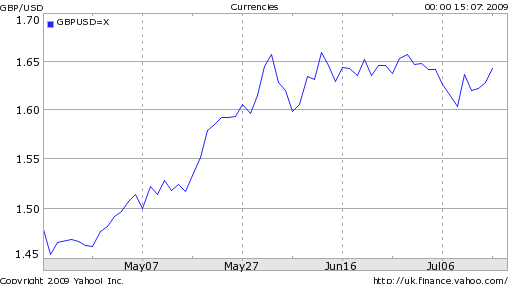
If an investor only read the story, Pound a Buy Before ‘Steep’ U.K. Recovery, they could be forgiven for assuming that the fundamentals underlying the Pound must be strong enough to just such a bold claim. In fact, virtually all economic indicators are trending downward, and most analysts (with the exception of the source behind the above story) are revising their Pound forecasts proportionately.
While all data is subject to “spin,” all of the big picture indicators paint a consistently negative picture of the UK economy. The Organization for Economic Cooperation and Development said on June 24 that U.K. gross domestic product will shrink 4.3 percent this year, revising its March forecast for a 3.7 percent contraction. Sterling has fallen 1 percent in the past month. Meanwhile, unemployment is still rising (albeit at a slower pace than before), and prices are falling.
The BOE will probably expand its liquidity program by the sanctioned 25 Billion Pounds, and “Speculation has also started to circulate that the Bank of England could announce it will seek approval from the Treasury to boost the size of the program even further.” Meanwhile, the government deficit is surging: “The U.K.’s credit rating is an issue that’s still there and public spending in an election year is causing concern for investors.
A sane analyst, then, could only come to one reasonable conclusion- that the Pound is doomed. In the short-term, the Pound will be punished by a weak economic prognosis, low interest rates, and the inflationary monetary/fiscal policy. Additionally, as the summer rolls in, investors will likely move funds outside of the UK into more stable locales. In the long-term, the Pound is equally dubious: “The pound’s decline in 2008 returned the currency to its real trade-weighted exchange rate of the 1970s, which could be its ‘new fair value’ as the U.K. becomes a net oil importer and is less able to rely on financial services to earn foreign exchange.”
There is even less equivocation among investors, themselves. According to the Commodity Futures Trading Commission, “More hedge funds and large speculators have positioned for a decline in the pound against the dollar rather than a rise — so-called net shorts — every week since August.” While the Pound is currently trading around $1.65, “The median of 39 analysts and strategists’ forecasts compiled by Bloomberg is for the pound to trade at $1.59 by the end of September and $1.62 by the end of the year.”

Summer Could Provide a Boost to the Dollar
There is a pattern in the following smattering of forex soundbites: “It feels like we’re already in the summer doldrums;” “[We] are moving into summer trading;” “We are in a summer period.” From three different analysts, three identical conclusions- summer has arrived. Granted, summer officially began on June 21, but given all that’s transpired since last summer, I think we can excuse investors from delaying their summer vacations this time around by a few weeks, until the kickoff of second quarter earnings season.
Summer usually means a couple things for the financial markets: less liquidity/volume and less fluctuations. The decline in volume is largely self-explanatory, due to what can best be summarized as more play and less work. The decline in volatility is due to a different, but related cause, which is a delay in important investment decisions until the fall, when traders return to their desks and resume monitoring the markets full-time. Both phenomena tend to cause asset prices to move sideways.
This is especially true for forex markets. “Traders noted major currency pairs remain largely range-bound…Markets for now are hung up by uncertainty over the shape of any future economic recovery, he said. Economic data at this point ‘can be spun either way,’ likely leaving currency markets next week to key off of any earnings surprises from U.S. companies,” observed one analyst. As far as the decline in volume is concerned, “Emerging markets are becoming particularly volatile as liquidity declines over the summer period,” and “Bid-offer spreads are quite wide.”
Kathy Lien, of Forex 360, has observed another summer trend: “Over the past 10 years, the Canadian, Australian and New Zealand dollars have seen their steepest slides in the month of July. In addition, we have seen the U.S. dollar outperform the Canadian and New Zealand dollars 8 out of the past 10 years during this month.” This could be a byproduct of delayed allocation, as investors shift capital out of risky markets/positions/currencies. The lesson might be to stick to the majors.
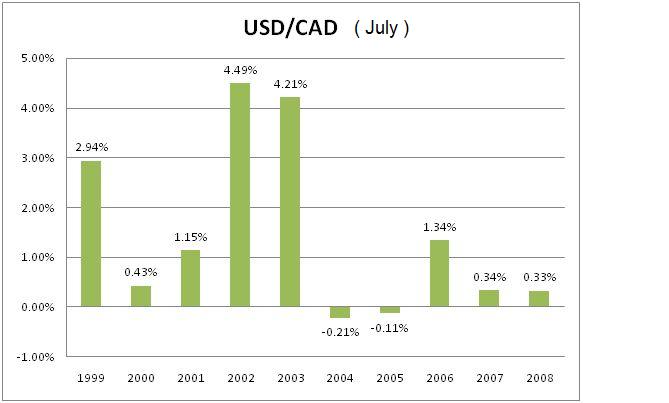
Based on all current indications, this summer will be no exception to this rule. While investors have certainly grown more complacent about risk over the last few months, there is a lingering uncertainty. “Economic data at this point ‘can be spun either way,’ likely leaving currency markets next week to key off of any earnings surprises from U.S. companies.” Even with across-the-board positive earnings results, investors will likely remain wary and could hold off on taking any risky (overseas) positions until the fall.
0 comments:
Post a Comment