Euro Optimism (And not just Dollar Pessimism)

0 comments

According to a recent Merril Lynch (Bank of America) survey, Europe has officially returned to favor among investors. “A net 30% of global portfolio managers see euro-zone equities as undervalued relative to other regions, the highest reading since April 2001. A net 11% are overweight Europe, the first overweight allocation in nearly two years, said Baker.”

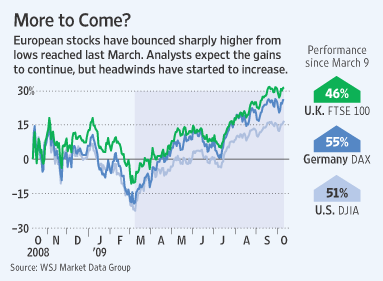
The numbers, meanwhile, reflect this perception. Over the last month, investors have poured a net (inflows minus outflows) $2.1 Billion into EU capital markets, an impressive sum when you consider that the figures for Japan and the US were both negative. Meanwhile, stock markets in the region are up by 50%+ since bottoming last March. When you account for currency fluctuations (i.e. Euro appreciation), stock market comparisons between the US and EU start to look pretty lopsided.

According to a WSJ report, there’s no mystery behind the European stock market rally: “Even though prices have risen sharply since March, valuations aren’t stretched. Average price-to-earnings ratios in Europe, on a trailing 12-month basis, are about 16, up from seven back in March, according to Citigroup…On a price-to-book ratio, stocks are trading about 15% below their long-term average, and dividend yields compared to government bond yields are historically still very attractive.”

EU stocks

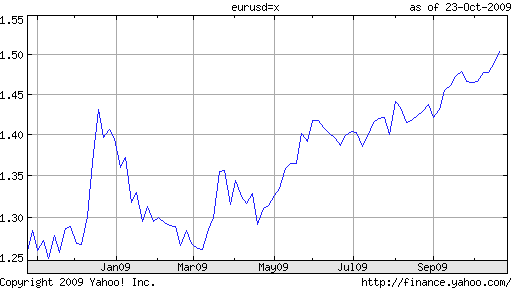
At this point, you’re probably wondering, “Why the long preamble on European stocks?” Because, it’s easy to forget that there are inherently two sides to every currency pair. In the case of the USD/EUR (the most frequently traded pair in the world), most of the recent commentary has focused exclusively on Dollar-negatives, portraying the dynamic as a depreciation in the Dollar. In this context, it’s easy to forget that the Dollar’s depreciation implies an appreciation in the Euro. Duh?! But seriously, for every Dollar bear, it seems there is at least one Euro bull.

To be fair, those who don’t see much to be excited about in the Euro can be forgiven. After all, the European economy is technically still mired in recession, and isn’t projected to return to growth until 2011. While some of the intangible indicators are improving, others continue to stagnate. “Industrial output in the euro zone is 20% lower than its February 2008 peak, despite some recent improvements.” In addition, the appreciation in the Euro threatens to choke off exports and stifle the recovery before it has a chance to get off the ground.

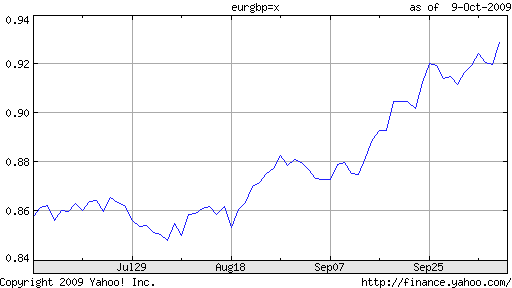
Speaking of which, the European Central Bank (ECB) will probably hold of on raising rates because of the strong currency. A more valuable Euro keeps inflation in check (via cheap imports). Besides, higher interest rates would attract carry traders hungry for yield, and would make it even more difficult to keep the Euro in check. Many EU monetary officials (including ECB President Jean-Claude Trichet) have already made their concerns about the Euro’s appreciation clear. If they are able to succed in halting its rise, that could make investing in Europe a lot less exciting…

euro

[...]

Prospects for Chinese Yuan Revaluation Improve

0 comments

In its semi-annual report to Congress, the Treasury Department once again failed to officially label China (or any country for that matter) a currency manipulator. No surprise there. While it’s self-evident that China manipulates the RMB (via the peg with the US Dollar), the political implications of such a label prevent it from being used except in the most extreme cases. Nonetheless, there is mounting pressure on China, both domestic and international, to “adjust” the peg and allow the Yuan to move closer to its fundamental value.

Most of the international pressure has been soft, coming in the form of roundabout pleas for China to allow the Yuan to float “for the sake of global stability.” Said one US Senator weakly, “I hope that with strong leadership from the United States, the G-20 nations and our international institutions will undertake what has been missing — a focused, sustained and meaningful multilateral engagement to address currency manipulation and current imbalances.” At the same time, some of this rhetoric has recently been translated into action. Last month, the Obama Administration enacted a 35% tariff on Chinese tire products. Other countries have also begun to raise concerns about Chinese dumping, and bringing their cases to the WTO for good measure.

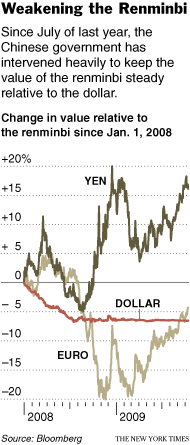
Many of these countries are in fact suffering more than the US. Since the Yuan is effectively pegged to the Dollar, the decline of the latter has been mirrored by the former. Since many other currencies of developing countries are also fixed, this leaves only a handful to absorb the shock. For example, the Euro and Yen have both risen about 15% against the RMB over the last year, in line with their appreciation against the Dollar. The handful of floating currencies in the region, such as the Korean Won, Indian Rupee, Malaysian Ringhit, etc. have also faced strong upward pressure. For them, it is not so much the weak Dollar that they fear so much as the weak RMB, since China is a direct competitor to all of them.

Chinese Yuan Agaianst Euro, Yen, Dollar
More importantly, there are now voices within China’s ruling Communist party that have also begun to press for a stronger Yuan. The Nationalist camp, for example, is pressing for China to make the Yuan a more prominent currency on the international trade scene. While such doesn’t inherently require a floating currency (in fact, all of the trade/swap agreements involving Yuan are based on fixed exchange rates), a loosening of capital controls and liberalizing of financial markets would probably bring about a stronger Yuan.

The other group pushing for a stronger Yuan is doing so on more fundamental, economic grounds. Just-released 2009 Q2 GDP data showed prelimenary growth estimates of a whopping 8.9%! Not bad, especially when you consider that the rest of the world remains mired in recession. Chinese economists largely ignore the political implications of the notion that this growth probably came at the expense of the rest of the world, and focus instead on the economc implications.

First is that the economy remains hopeless dependent on exports to drive growth, which can only be remedid through a stronger Yuan. Second, it heralds the coming of inflation. Many foreigners continue to pour “hot money” into Chinese asset markets hoping to reap the upside from both asset and currency appreciation. In response, “Analysts say China could let the yuan appreciate to help restrain inflation, since a stronger yuan would reduce the cost of imports. But some caution that Beijing tried a similar strategy in early 2008, but didn’t achieve great success in containing inflation or stemming the inflows.”

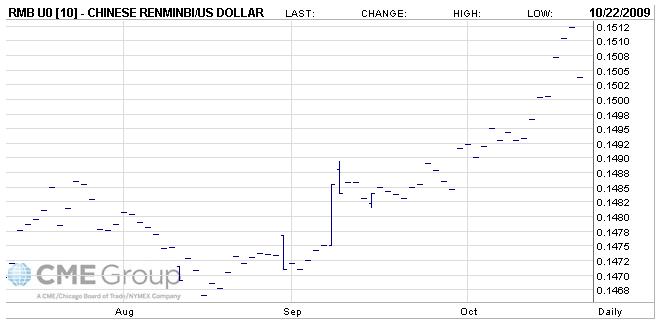
While analysts don’t expect the Bank of China to allow the RMB to rise until after the Chinese New Year in January, investors are pricing in incremental appreciation every month beginning with the next. In fact, futures prices already reflect the expectation that the RMB will rise 3% over the next twelve-months. My bet is that this will be kicked off by another one-off appreciation, in the same vein as July 2005. Now as was the case then, China needs to make up for lost time.

RMB - USD

[...]

New York Session - October 21, 2009 5:06 PM

0 comments

Earnings continued to dominate and remain mixed overall. Despite a stellar 18% bottom-line beat in earnings thus far this reporting season, the sales numbers have actually disappointed and are tracking -0.2% below conservative estimates. This suggests a similar situation to what we saw in 2Q when earnings expansion was driven by cost cutting (especially on the employment front) and not organic growth. Full text »

[...]

U.K. Pound Continues Rally in Currency Trading

0 comments

Forex trading with the sterling

The U.K. pound is continuing its rally in currency trading on the FX market today. Yesterday in forex trading, the sterling gained some ground, and today the pound is solidifying its gains. The risk trade is alive and while, in spite of the fact that equities and commodities are lower today.

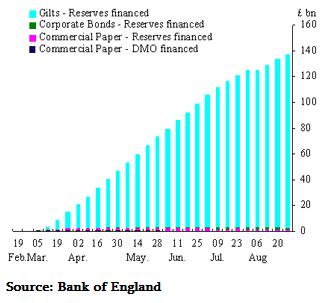
The sterling is being helped by the fact that the Bank of England is adopting a more hawkish tone right now. The end of Britain’s quantitative easing program is in sight, and that is providing some help for the U.K. pound in currency trading.

Another helpful factor is the expected emergence of China. Right now, China is a key to the risk trade in forex trading, sending sterling higher as traders look to the emerging markets to lead us out of the global recession. With China’s economic growth, it is expected to help stimulate global trade and get economic recovery moving.

[...]

London Session - October 21, 2009 6:19 AM

0 comments

Sterling has managed significant gains this morning on the back of more optimistic comments from the BoE. Cable ratcheted gains up to 1.6589 before meeting resistance; EUR/GBP is back below 0.9025. In his speech in Scotland last night Governor King remarked that “recent months have brought better news” and suggested that in the second half of this year the UK economy will return to positive growth. This speech was followed by an article for The Herald newspaper which reportedly suggested that at some point rates would go higher. This is another statement of the obvious, nevertheless, on top of the less pessimistic tone of King’s speech this was taken as a signal that the BoE could becoming less dovish. This morning’s releases of the minutes of the October MPC also reflected a more upbeat tone with respect to the UK economic outlook. That said, uncertainty over the robustness of the economic outlook was clear in both King’s speech and in the minutes and the latter also confirmed that there were differences of views on the inflation outlook suggesting that an extension to QE is still possible next month. This morning’s CBI Industrial trends data brought fresh support to sterling late in the morning. Survey data has suggested that tomorrow’s Sep retail sales data could also be strong (median +0.5% m/m). However, another disappointment in Friday’s Q3 GDP release could undermine sterling’s newly found confidence. Full text »

[...]

Asia Session - October 21, 2009 2:01 AM

0 comments

The Dollar sellers took a breather today in Asia. The battered buck hovered near late NY levels after poor US data and equities sent it safely away from recent record lows. Despite solid earnings on Wall Street, poor housing starts and PPI data quashed any chance of positive gains in equities, and as stocks fell, the dollar pulled back from the abyss. The EUR/USD that spent the day flirting with 1.5000 was suddenly a big figure lower. The pair opened in Asia nearer to 1.4945, and after a quick dip to 1.4890, was just shy of opening levels by the session’s close. Full text »

[...]

Sterling Holds Gains in Forex Trading

0 comments

U.K. pound in currency trading

The sterling is managing to hold its gains in forex trading on the currency market today. The U.K. pound has been having a little bit of trouble, thanks to economic data coming out of Britain. However, sterling is managing to maintain the upper hand due to dollar weakness.

Indeed, dollar weakness has been an issue as we start this week, against currencies in Europe, as well as against the Japanese yen. Comments from Japanese minister Fujii are causing problems on the front, while European rhetoric has been unable to provide support for the dollar.

In the end, the sterling is managing to retain the upper hand on dollar weakness in currency trading, as well as interest in the risk trade as the stock market rallies and investors seek better returns.

[...]

Yen Volatility Due, In Part, to Finance Minister Fujii

0 comments

Yen moves higher in currency trading

The yen is moving higher in currency trading on the FX market today, driven by remarks from Japanese Finance Minister Fujii. There had been expectations that economic data coming out of the U.S. would help the USD/JPY currency pair, but Fujii’s ill-timed and insensitive remarks continue to encourage yen volatility and dollar weakness.

Indeed, Fujii has been making a lot of mistakes lately with regard to comments on the forex market. GFT’s Boris Schlossberg reports on Fujii’s most recent remarks and their implications:

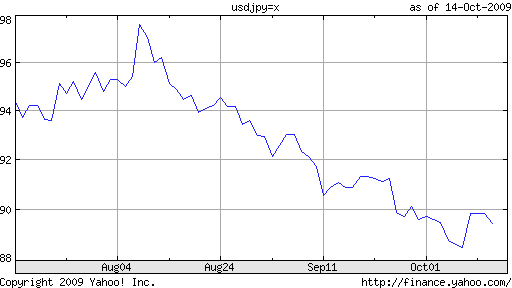
Mr. Fujii stated that, “The United States is caught in a dilemma. You can’t deny that the current yen rise was caused by a weak dollar." His remarks sent USD/JPY& to 90.10 in a knee jerk reaction as traders once again interpreted Mr. Fujii’s words as an open invitation to push the pair lower. Although Mr. Fujii was simply reiterating the obvious, his leaden ear to the sensitivity of the market continues to create volatility for the yen.

[...]

London Session - October 20, 2009 6:00 AM

0 comments

EUR/USD reached a high of 1.4994 in Asia but, while tantalisingly close, has lacked the incentive to push through the psychologically important 1.50 level. Unsurprisingly, the Ecofin meeting provided a platform for ECB President Trichet to reiterate support for the US Treasury’s strong USD policy. Such comments have arguably slowed the pace of the gains in EUR/USD but, while the EUR nominal effective exchange rate is approaching the highs of the past year, the market sees no great risk that the ECB will put its money where its mouth is to prevent the EUR for moving higher. As a consequence a break above 1.500 remains likely near term assuming risk appetite holds up. Stocks this morning are trading lower in Europe despite the gains registered in Asia overnight. The dip in risk appetite is supporting the USD for now. The continued flow of US Q3 earnings will likely have a determining impact on EUR/USD this afternoon. Full text »

[...]

Asia Session - October 20, 2009 2:08 AM

0 comments

The Dollar’s woes continued once again today in Asia as it hit new lows for 2009. The causes for the fall differed, with many traders citing the fact that interest rates in the US look to remain low into 2010 while conversely, the RBA minutes showed a hawkish stance that could see rates raised two more times before the year’s end. Added to this mix were higher equities in the US, and that wave of optimism and opportunity that spilled over into Asian equity trading.
Full text »

[...]

New York Session - October 19, 2009 5:25 PM

0 comments

Currencies remain beholden to the goings on in the equity space and the rally in stocks continued to lead the riskier currencies higher. US equities closed up nearly 1% in the face of a weaker than expected housing number as the Fed signaled yet again that it is not ready to withdraw stimulus. The homebuilder sentiment index (NAHB) printed 18 in October while the market had forecast an increase to 20 from 19 the prior month. The homebuyer traffic number sank from 17 to 14 and the weakest read since July – looks like that looming expiry of the homebuyer tax credit is starting to bite. Full text »

[...]

Euro Eyes 1.50 in Forex Trading

0 comments

Will EUR/USD break through 1.50 in currency trading?

Right now, the euro is eying the 1.50 level in forex trading against the U.S. dollar. With gold higher today, after closing last week on a new record high, it is little surprise that some are wondering if EUR/USD, which is often supported by gold prices, is ready to make the move.

The euro has broken above 1.49 in forex trading on the currency market, and now there is speculation that the psychologically important level of 1.50 could be reached. This move would herald the true beginning, in some minds, of a definite beginning to the economic recovery, with the U.S. dollar on the defensive.

It will be interesting to see how things play out, with Barrons calling for a rate hike to 2% and Ben Bernanke expected to address a conference in San Francisco at 11 a.m. Eastern.

[...]

Dollar at a (Technical) Crossroads

0 comments

I deliberately concluded my last post (US Dollar: Same Old Story) on a somewhat ambiguous note; even though though the deck is stacked against the Dollar, its 14% decline in 2009 has left it perilously close to record lows, and traders are nervous about pushing the limits further.

Euro

On the one hand, everyone believes that the Dollar is fundamentally still in a weak position. The US balance of trade remains deep in deficit. Government spending has exploded, with record-setting deficits and an expansion in the national debt. Interest rates are at rock bottom, and are by some measures, the lowest in the world. Despite signs of life, the economy remains mired in recession. The money supply has also expanding, to the extent that some long-term investors are wondering out loud about the possibility of future inflation.

As a result, the decline in the Dollar since last spring has suffered very few blips, with volatility declining at the same pace as the currency, itself. “There seems to be a paradigm shift underway where more and more foreign investors are becoming concerned that the long-term path of the dollar is downward,” summarized one analyst. The consensus among investors is almost eerie. “Speculators betting that the dollar index will fall outnumber those betting that it will rise by nearly 2 to 1, according to the Commodity Futures Trading Commission.”

Some (mainstream) analysts have even begun to open consider the possibility of a crash in the Dollar, a view that had previously been relegated to conspiracy theorists and doomsday scenarists. “In a run on the dollar, that thinking would create a cascade — fearful global investors would shy away from dollars, expecting further steep declines, creating a self-fulfilling prophesy.” Adds a former Chief Economist of the IMF, “Every time the dollar starts depreciating there is angst and everybody starts raising the question what happens if there is a collapse.” While the majority of Dollar-watchers still believe that a Dollar crash is unlikely, the point is that they are now discussing it actively.

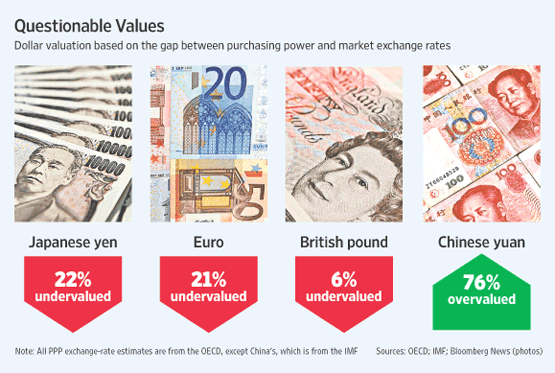
Despite the fact that all of these factors are already in place, the Dollar remains relatively buoyant. Personally, I think this is because investors don’t really want to acknowledge that this is a real possibility. For one thing, the alternatives aren’t any better. While forex investors in recent years have enjoyed ganging up on the Dollar, the fact remains the fundamentals for the other major currencies remain just as weak. For example, a model of purchasing power parity developed by “the Organization for Economic Cooperation and Development finds the dollar is worth roughly 0.85 euro, compared with its market valuation of 0.67 euro, suggesting that the euro is 21% overvalued.” Likewise, the Yen is held to be 22% undervalued.

Dollar Valuation 2009

As a result, the market as a whole is having trouble pushing the boundaries. The Dollar has approached the psychologically important level of $1.50/Euro on several occasions, but has retreated each time. “People are wondering whether we’re going back to $1.46 in euro/dollar or heading toward $1.54. But one thing is for sure, as we head toward $1.50, we’re going to experience a lot of volatility,” summarized one analyst.

“Risk reversals, a measure of currency sentiment in the options market derived by looking at the difference in implied volatility between out of the money calls and out of the money puts, show a bias for euro puts, trading at a mid-market level of 0.2. That means investors are hedging their short dollar positions with bets for a euro downside even though no one expects the euro to fall.” Meanwhile, volatility has edged up slightly, reflecting an increased level of uncertainty surround the near-term direction of the Dollar. It could be the case that if the Euro breaks through $1.50, heartened investors will send the currency up even higher, while a failure to break through means investors just aren’t read to commit. A classic technical crossroads!

[...]

US Dollar: Same Old Story

0 comments

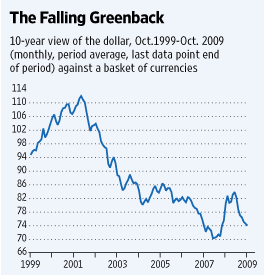
These days, it’s hard to offer a fresh perspective on the Dollar. The factors driving its short-term momentum – namely low interest rates and its perception as a financial safe haven – have been in place for nearly a year. It’s long-term prognosis, meanwhile, also hasn’t changed much. Since the beginning of the decade, the Greenback has been in a state of perennial decline as a result of its twin deficits and the related notion that it will be soon be replaced as the world’s pre-eminent currency.

The Falling Greenback

Since the last time I posted about the Dollar (October 6: Dollar’s Role as Reserve Currency in Jeopardy), then, there haven’t been many developments. Fears that oil will one day be priced and settled in an alternative currency – such as the Euro – continue to reverberate through the markets. Several ministers from OPEC countries have already officially dismissed such claims as baseless. A parallel debate is now taking place on the sidelines as to whether or not such a shift even matters.

Dean Baker argued in a recent article for Foreign Policy magazine, that pricing oil in Dollars represents a mere “accounting convention,” adopted by most simply by default, since the US is the cornerstone of the world economy. Argues Baker, “World oil production is a bit under 90 million barrels a day. If two-thirds of this oil is sold across national borders, then it implies a daily oil trade of 60 million barrels. If all of this oil is sold in dollars, then it means that oil consumers would have to collectively hold $4.2 billion to cover their daily oil tab.”

Unfortunately, Baker’s “simple arithmetic” is both erroneous and slightly irrelevant. Assuming a price of only $100 per barrel (pretty conservative if you believe the notion of peak oil), current consumption of 85 million barrels per day implies a daily turnover of $8.5 Billion per day, or $3+ Trillion per year. If the price doubles to $200 per barrel….well, you get the point.

Taking this line of reasoning further becomes somewhat problematic, however. First of all, while OPEC members currently hold the majority (70%+) of there reserves in Dollar-denominated assets, it’s unclear how this would change in the event that oil was no longer priced in Dollars. It’s conceivable that just as many of these Central Banks currently diversify their Dollar-denominated proceeds into other currencies, that they would “diversify” Euro-denominated proceeds back into the Dollar. Of course, it’s also conceivable that a combination of inertia and investment strategy would cause them to hold a larger portion of there reserves in Euros.

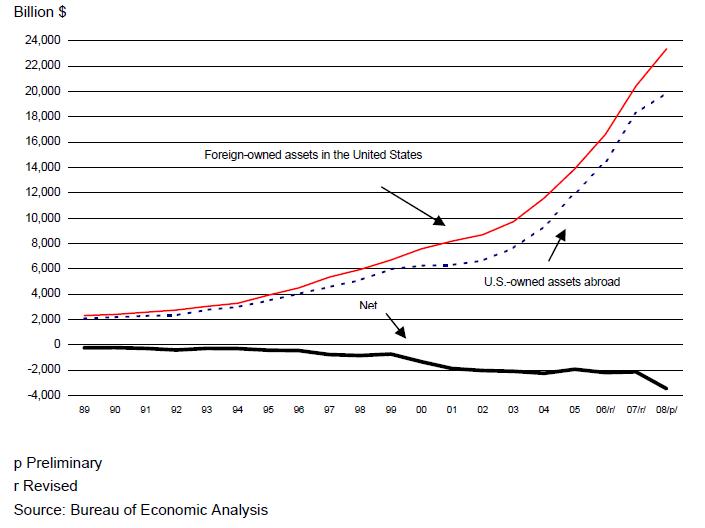
If OPEC Central banks continue to prefer Dollars, than Baker is right in arguing that the currency in which oil is priced has no implications outside of accounting. If, on the other hand, he is wrong, and a change in pricing causes/coincides with changing preferences, then the implications for the Dollar would be disastrous. [Consider that $3 Trillion/per year which is at stake currently represents more than 15% of total foreign ownership of US assets.] The problem is that we just don’t know.

Foreign-owned assets in the US

Regardless, the status quo favors the Dollar, since creating a new reserve currency would take at least a decade, if not more. For that reason, the World’s Central Banks (we’re not just talking about OPEC anymore) continue to prefer Dollars. “In the five weeks through Oct. 7, foreign central banks bought more than $48.55 billion in Treasury securities, an average of $9.71 billion per week, according to the latest data from the Federal Reserve.” In addition, “Finance Minister Hirohisa Fujii said he expects the dollar will remain the key reserve currency for some time to come.” Private foreign investors, meanwhile, are dragging their heals a bit, perhaps waiting for the Dollar to fall further before jumping in. Asks one columnist rhetorically, “Why buy now if the dollar might be even weaker in six months’ time?”

What else is new? The US budget deficit came in at $1.4 Trillion for the fiscal year, the highest level since World War II. On the bright side, the deficit was $200-400 Billion less than earlier estimates. Meanwhile, members of the Federal Reserve’s Board of Governors restated the unlikelihood of higher rates in the immediate future. “Richard Fisher, president of the Dallas Fed and thought to be a rare hawk on the Fed’s Open Market Committee, chimed in that no one at the Fed thinks this is the time to raise interest rates.” Finally, the US trade deficit is once again narrowing, due in no small part to the declining Dollar.

At this point, it seems reasonable to assume that much of the bad news has already been priced into the Dollar. Sure, the Australian rate hikes came as a surprise and forced many to rethink their calculations. Investors have already begun to separate the healthy currencies from the sick (to borrow an analogy from a previous post), but that the Dollar would be grouped with the “sick” currencies has long been anticipated. Given that the currency has already fallen by double digits in 2009 and is nearing the record lows of 2008, some are wondering how long it can continue.

[...]

Japan Flip-Flops on Forex Intervention

0 comments

In my report on last month’s Japanese election, I noted that the newly-appointed Japanese finance minister, Hirohisa Fujii, had spoken out against forex intervention. With that, it seemed the matter was closed.

But not so fast! Over the following few weeks, Fujii (as well other members of the new administration) moved to clarify his position, backtracking, sidestepping, contradicting, but never going forward. The following is a summary of selected remarks, beginning with the original statement against intervention and ending in what seems like a promise to intervene:

September 15: “I basically believe that, in principle, it’s not right for the government to intervene in the free-market economy using its money, either in stock or foreign-exchange markets.”
September 27: [The Yen's rise is] “not abnormal…in terms of trends.”
September 28: “That’s not to say I approve of the yen’s rise.”
September 28: “I don’t think it is proper for the government to intervene in the markets arbitrarily.”
September 29: “If the currency market moves abnormally, we may take necessary steps in the national interest.”
October 3: “As I have said in Tokyo, we will take appropriate steps if one-sided movements become excessive.”
October 5
: “If currencies show some excessive moves in a biased direction, we will take action.”

Confused? I know I am. Is it possible to glean any semblance of meaning from these remarks? Summarized one columnist, “Hirohisa Fujii has gone through several cycles of remarks that first appeared to favor a strong yen and then seemed to backpedal after markets took him at his word and sent the Japanese currency soaring.”

I think this encapsulates the regret that Minister Fujii must have felt, after his original comments were taken a little too seriously. In hindsight, it appears that Fujii attempted to convey the new administration’s stance on forex, in a nutshell, and certainly didn’t expect that investors would run wild and send the Yen up another 4%, bringing the year-to-date appreciation against the Dollar to 15%. In the words of the same columnist cited above, “Japan’s finance minister has been rudely reminded of the cardinal rule when speaking to markets — less is more.”

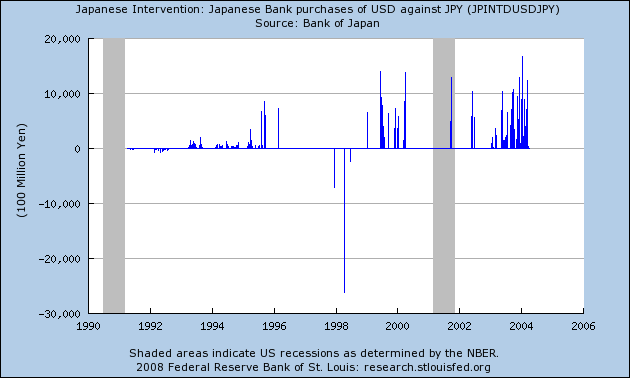
So where does Fujii actually stand? I would personally hazard to guess that his original explication is still the most accurate portrayal of how he will tend to the Yen while in office. The former Liberal Democratic Party (LDP) administration intervened several times while in office (once under the direction of Fujii himself!) and most recently in 1994. Despite spending trillions of Yen, the campaign only marginally stemmed the rise of the Yen.
bank-of-japan-forex-intervention
Meanwhile, the Japanese economy has been mired in what could be termed the “world’s longest recession, dating back to the 1980’s. It’s clear that the cheap-Yen policy, designed to promote exports, hasn’t benefited the Japanese economy. The new administration, hence, has indicated a shift in strategy, away from export dependence and towards domestic consumption.

Ironically, the nascent Japanese economic turnaround is once again being driven by exports. Fujii is no doubt cognizant of this, and doesn’t want to jeopardize the recovery for the sake of ideology. For example, Toyota Corporation has indicated that a 1% appreciation in the Yen against the Dollar costs the company $400 million in operating income. In addition, while a strong Yen increases the purchasing power of Japanese consumers, an overly strong Yen can lead to deflation, as consumers forestall spending in anticipation of lower prices down the road.

In other words, Fujii is certainly not a proponent of Japan’s recent runup, but his stance is more nuanced than initially understood. “Fujii is basically saying currencies should reflect economic fundamentals and that it is wrong to manipulate their moves to lower the yen for the sake of exporters,” offered one strategist. This, the markets finally seem to understand, and the Yen has actually reversed course over the last week. After all, “A yen in the 80s is excessive,” given the context of record low interest rates and a economy that is still contracting.

In the near-term, then, it doesn’t even make sense to talk about intervention. It seems the markets were getting ahead of themselves in this regard. It doesn’t make sense to price out the possibility of intervention when interevention shouldn’t be a factor in the first place. If on the other hand, the Yen continues to appreciate, then Fujii may have consider how fixed his principles really are.

3m

[...]

Here's A Free 10-Part Trading Course…

0 comments

This is a guest post from Adam Hewison - the creator of INO TV and Marketclub. In this post Adam introduces himself first of all and then talks about his free 10-part trading course, which covers a wide range of different subjects. (The link to the free course is at the bottom of the page if you are in a hurry).


First of all I want to thank you for having me as a guest today.

My name is Adam Hewison and I'm the creator of INO TV and Marketclub.

There are plenty of people out there that create 'exclusive email courses' with little or no credentials to actually backup their teachings. So I think it's right that I share a little bit about myself with you before we even start.

I was a former floor trader on the IMM, IOM, NYFE and LIFFE as well as a risk manager of a large, multinational corporation in Geneva, Switzerland. I have also written books on forex trading and trend following. In 1995, I founded INO.com and later co-founded MarketClub. I’ve been in the trading business for over 30 years now and have pretty much seen it all. I created this course as a way of giving something back, and to share with you some effective tips and techniques that I still use in my trading today.

In my Free Trading Course, I will talk about the tools and strategies you need to increase your overall success rate when trading the markets. In fact to give you some more details, let me share with you the various subjects that I cover in this free email course:

1. The importance of psychology in price movement.

2. How to spot mega trends.

3. Understanding of technical price objectives.

4. How to picture price objectives.

5. How to trade with moving averages.

6. How to use point and figure trading techniques.

7. How to use the RSI indicator.

8. How to correctly use stochastics in your trading.

9. How to use the ADX indicator to capture trends.

10. How to capitalize on natural market cycles.

In addition you will also learn all about fibonacci retracements, MACD, Bollinger Bands and much more.

Just fill out the form and we’ll get you started right away:

- Free 10-Part Trading Course

Every success,
Adam Hewison
President, INO.com & Co-Creator, MarketClub

[...]

GBP/USD Analysis - Keep An Eye On The EMA (200)

0 comments

This is a guest post from Adam Hewison - the creator of INO TV and Marketclub. In this post Adam introduces himself first of all and then talks about his free 10-part trading course, which covers a wide range of different subjects. (The link to the free course is at the bottom of the page if you are in a hurry).


First of all I want to thank you for having me as a guest today.

My name is Adam Hewison and I'm the creator of INO TV and Marketclub.

There are plenty of people out there that create 'exclusive email courses' with little or no credentials to actually backup their teachings. So I think it's right that I share a little bit about myself with you before we even start.

I was a former floor trader on the IMM, IOM, NYFE and LIFFE as well as a risk manager of a large, multinational corporation in Geneva, Switzerland. I have also written books on forex trading and trend following. In 1995, I founded INO.com and later co-founded MarketClub. I’ve been in the trading business for over 30 years now and have pretty much seen it all. I created this course as a way of giving something back, and to share with you some effective tips and techniques that I still use in my trading today.

In my Free Trading Course, I will talk about the tools and strategies you need to increase your overall success rate when trading the markets. In fact to give you some more details, let me share with you the various subjects that I cover in this free email course:

1. The importance of psychology in price movement.

2. How to spot mega trends.

3. Understanding of technical price objectives.

4. How to picture price objectives.

5. How to trade with moving averages.

6. How to use point and figure trading techniques.

7. How to use the RSI indicator.

8. How to correctly use stochastics in your trading.

9. How to use the ADX indicator to capture trends.

10. How to capitalize on natural market cycles.

In addition you will also learn all about fibonacci retracements, MACD, Bollinger Bands and much more.

Just fill out the form and we’ll get you started right away:

- Free 10-Part Trading Course

Every success,
Adam Hewison
President, INO.com & Co-Creator, MarketClub

[...]

London Session - October 15, 2009 6:06 AM

0 comments

Big moves in cable and the AUD today Full text »

[...]

Asia Session - October 15, 2009 1:52 AM

0 comments

Reserve Bank of Australia Governor Glenn Steven sent the Aussie Dollar to a 14 month high today with hawkish commentary that almost guaranteed a rate hike come November. Comments stating that the RBA “can’t be too timid” in regard to raising the key Australian interest rate helped to reinforce the RBA’s stance as a frontrunner of the G20 nations trying to shrug off the stench of the global credit crisis. AUD/USD took off from early session lows near 0.9145 on its trek to highs over the 0.9220 levels. Early 2009 lows close to 0.6250 have long been forgotten on the Aussie’s ride toward parity. AUD/JPY was able to post a 70 pip gain to just over 82.45 on the move. Full text »

[...]

New York Session - October 14, 2009 5:01 PM

0 comments

Better earnings from JP Morgan drove risk assets higher in NY trading and US dollar bears were out in full force once again. The bank not only reported better bottom line results, but also blew right through revenue estimates. Should earnings continue to show top line expansion, we would look for equity marts to remain better bid into the end of the month. One of the big stories was the Dow Jones re-gripping the 10K handle as stocks added about 1.5% on the day. Gold was practically flat but remains better bid while above the 60 area. Full text »

[...]

Donald Kohn Sabotages the U.S. Dollar in Currency Trading

0 comments

Greenback tanks in forex trading

Federal Reserve Vicechairman Donald Kohn has played a rolling in today’s unceremonious tanking of the greenback in forex trading. The U.S. dollar is markedly lower today against the euro in forex trading as traders digest dovish comments made by Kohn.

After much effort has gone into upbeat statements on the U.S. economy and talk of exit from stimulus measures — not to mention some verbal intervention on the dollar’s behalf from Europe — Kohn has managed to undo all of that. GFT’s Boris Schlossberg reports in FX360 on Kohn’s effect on the dollar in currency trading:

Mr. Kohn’s cautious rhetoric stands in contrast to the more upbeat assessments recently made by Chairman Bernanke and St Louis Fed President James Bullard and has now managed to sabotage any efforts by US monetary officials to stabilize the greenback through jawboning. With EUR/USD within striking distance of the 1.50 barrier the temptation to run stops through that level will escalate as the day progresses.

Not even the new that, without auto sales, retail sales improved in September can help. It appears likely that the EUR/USD currency pair could make a run at 1.50 soon, breaking through a psychologically important barrier.

[...]

Retail Sales Dip without Cash for Clunkers

0 comments

Economic data out of the U.S.

September retail sales data is in for the United States, and it appears as though there has been an overall decrease. However, it is worth noting that, if auto sales are taken out of the picture, retail sales were actually up.

Clearly, Cash for Clunkers had a great deal to do with how well retail sales did overall in August. Without the program, it appears that auto dealers are suffering a bit. However, the news that retail sales without autos are up. It means that other consumer spending may be on the rise.

The news hasn’t done much in the way of helping the U.S. dollar, however. Yesterday the euro moved higher, and it appears that today will continue the rally for the euro in forex trading against the greenback.

[...]

London Session - October 14, 2009 6:06 AM

0 comments

The combination of risk appetite and dovish comments from the Fed’s Kohn has lifted EUR/USD to a 14 mth high of 1.4910 this morning. On the back of the weak USD, gold touched the 1070.00 level this morning before being subjected to some profit-taking. Cable pushed back above the 1.600 level supported by better than expected UK jobs data and AUD/USD is holding around 0.9150 as optimism in Australian economic prospects receives another boost. Full text »

[...]

Asia Session - October 14, 2009 1:49 AM

0 comments

The US Dollar was once again demoralized in Asia as it fell to fresh 13 month lows against the Euro. Investors continued to shun the greenback in favor of the higher yielding commodity currencies as the low interest rate in the US currency makes a favorable funding option. EUR/USD pushed to new 2009 highs near 1.4888, culminating a move in Asia that began in the 1.4830 ballpark. The push in the Euro helped to pull Gold to fresh all time highs just a few cents shy of the 70.00 mark. Full text »

[...]

New York Session - October 13, 2009 4:56 PM

0 comments

Risk traded relatively sideways but the market found a reason to sell the USD nonetheless. Equities slipped about -0.3% in broad terms but bonds were also lower, confounding the direction of risk overall. Gold caught another bid and was resting nearly higher by the 65 area. The seasonal pattern here is a major risk to out contrarian 4Q gold call. The trend over the last two decades suggests a short-term correction to around 0/940 early in 4Q but then a rally into the end of the year towards the 50 area. Full text »

[...]

Euro Breaks $1.48 in Forex Trading

0 comments

Currency trading with EUR/USD

The euro is on the rise in forex trading on the currency market today. Optimism about global equities is helping, as is the fact that gold prices are surging to new records today. In currency trading, EUR/USD normally moves in tandem with gold prices.

Euro is getting a great deal of support right now in forex trading as the risk trade moves forward. And the euro isn’t the only currency benefiting from the current state of affairs: The U.K. pound is also heading higher in currency trading on the FX market.

As commodities improve, and as the global economic recovery creates demand for commodities, the U.S. dollar is expected to continue moving lower in currency trading.

[...]

Sterling Moves Higher in Forex Trading as Risk Trade Gains Momentum

0 comments

U.K. pound in currency trading

The sterling is moving higher in forex trading on the currency market as the risk trade gains momentum today. The U.K. pound has been struggling in currency trading lately, and this is probably a positive thing for those who like the currency.

Even earlier today, the sterling was punished in forex trading. However, things are changing as the risk trade moves to the forefront. After dropping to below .58, the sterling is rising again, heading toward .59.

Part of the help for the U.K. pound in currency trading on the FX market is coming from the fact that commodities are on the rise. As a risk trade currency, the sterling does well when equities and commodities are rising. With gold prices setting new records, and oil prices approaching a barrel, it is little surprise that the sterling is trying to move out of its funk.

[...]

AUDUSD - Trade Closed

0 comments

Trade Closed: 2009-10-08 01:25
comdollsff
Good evening! Things were looking good for my trade as the pair met resistance and consolidated around .8900. Unfortunately, Australian jobs surprised to the upside with an increase of 40.6K jobs versus the forecasted decline of 10K jobs. The jobless rate also ticked lower from 5.8% to 5.7%.
Needless to say, this was very positive for the Aussie and the pair jumped above .9000 soon after the report was released. I was stopped out at that level for a small loss on the day.
Total: -100 pips/ -0.50% loss
My mistake on this trade was thinking that we would see job losses like in the US, but apparently things are going really, really well in Australia. No worries though as I know going against the grain was a bit riskier, which is why I reduced my normal position size.
Well, it looks like there's no stopping the Aussie from pushing higher from this point on. Of course, if the Aussie goes too high in value, it may hinder exports, but that may not come any time soon.
So, no luck on the counter trend trade, and for now I will be looking for dips to buy into the the Aussie rally. Stay tuned!
BabyPips.com AUDUSD Forums
BabyPips.com Forex Chatroom
Forex News
Forex Reviews
Forex Trading Journal
Forex Answers
Trade Idea: 2009-10-07 01:08
comdollsff
Good evening everyone! It's been quite a day for the Aussie and today's rally after interest rate hike has brought a counter trend, technical trade setup to my attention. Time for a pull back after the strong moves?
This is a simple technical setup on the 4-hour chart and using a mix of trendlines and anoscillator to indicate AUDUSD may have a swing lower. Today's rally has brought AUDUSD up to the rising trendline drawn on the chart where the pair has met resistance and reverse in previous encounters. Stochastics are indicating the pair may be short term overbought and that we may see a swing lower. I used the Fibonacci retracement tool on the current rally to show points of possible support and profit taking area.
Because this is a counter trend trade, I will reduce my position size to risk only 0.50% of my account on this trade. My stop will be above the rising trendline at the next major psychologically significant round number of .9000 and I will target the potential support area around the 38% Fibonacci retracement level. Here's what I am going to do:
Short AUDUSD at market (.8900), stop at .9000, pt at .8800
Remember to never risk more than 1% of a trading account on any single trade. Adjust position sizes accordingly.
If the pair does reach .8800 I will definitely look to go long after I take profits. Stay tuned!

[...]

Daily Chart Art - October 9, 2009

0 comments

AUDUSD: Daily
PoD Chart
There's no stopping the Aussie! The AUDUSD once again hit a new high for the year, touching at 0.9092. With stochastics showing overbought conditions, could buyers take a break? If sellers do bring in their A game, they could bring price back down to the 0.8900 price area, which seems to be a previous minor resistance point. It also lines up closely with the 38.2% Fibonacci retracement level. The pair could also find more support near the 61.8% Fibonacci level, at 0.8780, and at 0.8700, which will intersect the rising trend line. On the other hand, if buying is still in the cards, price action may bust pass through the 0.9100 handle, and possibly test for new highs around 0.9200.
USDJPY: 4-Hour
PoD Chart
Let's take a look at how things are going in the USDJPY 4-hour chart... The pair has been on a downtrend for quite a while now and a descending trend line can be drawn connecting the highs of the pair. Right now, the stochastics seem ready to climb out of the oversold area, suggesting that upward price movement could take place. If it does, the pair could move all the way up and retest the descending trend line. Who knows if the USDJPY will be able to break it this time? However, there seems to be some psychological resistance at 90.00. But if the pair heads down, it might find support at the previous low of 88.15 or at the psychologically significant 88.00 level.
USDCAD: Daily
PoD Chart
How low is it going to go? I don't know but we all know it's not nice to stand in front of speeding truck... If you're sick of my corny metaphors, I'm talking about the USDCAD which has consistently made new yearly lows week after week. Now, there's a bearish flag chart pattern that popped out in the daily chart after the pair's sharp drop last July. Notice how the pair consolidated and bounced around a channel from August to September. From the looks of it, if the flag breaks to the south, sellers could push the pair all the way to 1.0300 before encountering buying support. On the other hand, if the pair heads north, resistance could be found at 1.0600.

[...]

Daily Economic Roundup - October 9, 2009

0 comments

United States
The US capitals markets marked its fourth straight advance yesterday which consequently pulled the USD down. Except for some sudden spikes during the euro session, the USD pretty much exhibited a broad-based weakness for the most part of the day. More...
Euro zone
The EURUSD seemed to be confused about which direction to take based on ECB President Trichet's comments. The ECB left rates unchanged at 1% as expected but what caused the up-and-down movement in the EURUSD was the ECB press conference held a few hours after the rate statement. More...
United Kingdom
Chop chop! GBPUSD trading was choppy yesterday, probably because of anticipation of the BOE interest rate decision. Still, the volatile movement was to the topside and the pair hit a monthly high before cooling off and ending the day at 1.6073, a gain of over 100 pips on the day. More...

Japan
The yen was like an assorted sushi platter yesterday, as it went through some mixed trading. The yen posted minimal gains against the dollar, with the USDJPY pair closing at 88.48, but fell slightly against the EUR, as the pair rose to 130.77. More...

Canada
The Loonie, like its fellow commodity-based currencies, set another yearly high against the dollar yesterday. The USD/CAD pair traded as low as 1.0506 before giving up some ground and ending the US session at 1.0523. More...
Australia
The Aussie continued to flex its muscles against the Greenback yesterday as the country's employment report surprised to the upside. The AUD/USD made it all the way to 0.9092 before retracing some of its gains and ending the US session at 0.9056. More...
New Zealand
It seems like the Kiwi just can't get enough of hitting new highs! The NZDUSD reached a high of 0.7454 as Australia, its good ole Oceanic neighbor, reported a huge improvement in employment. More...
Switzerland
It was the Euro and not the dollar that dictated the Swissy as it reflected the Euro's volatile movement in yesterday's action-packed trading. After making some sudden swings on both directions, the CHF finally closed yesterday on a higher note against the USD. More...
Pipnoculars: What's on the Economic Horizon
Joblessness in Canada Expected to Worsen
UK Producer Prices Probably Fell in Sept
Trichet To Reiterate His Pro-USD Stance?
US Trade Deficit Seen to Expand

[...]

Cross-Eyeing: EURJPY - Closed Trade

0 comments

Closed Trade: 2009-10-07 12:32
crosseyed chart
Good afternoon! My long position was triggered at 130.00 and after consolidating for a short period of time, buyers pounced on EURJPY and quickly pushed the pair back up to 131.00. Unfortunately, that's where sellers were ready to take control and push the pair back lower.
This price action tells me that there are still plenty of Yen bulls across the board and that while we may see further efforts to push EURJPY higher, Yen strength will continue to persist. I have decided to close down my trade to avoid losing any further profits.
Closed trade at 130.30
Total: +30 pips/ 0.20% gain
Massive US Dollar selling has strengthened the Japanese Yen across the board, and until we see the possibility of currency intervention from the Bank of Japan or a return to safe haven play on the Greenback, Yen strength should continue. If it does, I will look to short EURJPY if the pair stays below 130.00. We'll have to wait and see if it does. Stay tuned!
BabyPips.com EURJPY Forums
BabyPips.com Forex Chatroom
Forex News
Forex Reviews
Forex Trading Journal
Forex Questions
Trade Idea: 2009-10-05 10:09
crosseyed chart
What's crackalackin! I am eyeing a potential swing in EURJPY as the pair is throwing a couple indications that support may push the pair higher from its current levels. Time for me to long EURJPY?
My trade is based on the Daily chart above and I have highlighted a few technical signals that support a potential move higher. First, the pair has run into a rising trendline where it has found previous support and now consolidating price action. Stochastics are in oversold territory indicating that the move lower may be running out of steam and running out of sellers. Lastly, we can see bullish divergence as the pair creates lower "lows" while stochastics are creating higher "lows" - highlighted with the red lines on the chart.
So, plenty of technical arguments for a rally in the pair, but I will wait to see if the psychological level of 130.00 is retested before going long. My stop will be 150 pips, the average daily range of EURJPY, and I will ultimately target 135.00 as it is the previous swing high and a psychological number itself. Here is what I am going to do:
Long EURJPY at 130.00, stop at 128.50, pt1 at 131.50, pt2 at 135.00
Remember to never risk more than 1% of a trading account on any single trade. Adjust position sizes accordingly.
Not much on the Forex calendar in the way of major events with the exception of the ECB interest rate decision on Thursday. Also, US third earnings are set to be released this month and they have the potential to affect global risk sentiment if we see worse than expected earnings data.

[...]

Gold soaring, paper plunging, and that dog won't hunt!

0 comments

Key News
Quotable
“How many millions of jobs? In the George W. Bush years, we lost 5.3 million manufacturing jobs, one-fourth to one-third of all we had in 2001.
“And our dependence on China is growing. Where Beijing was responsible for 60 percent of the U.S. trade deficit in manufactured goods in 2008, in the first six months of 2009, China accounted for 79 percent of our trade deficit in manufactured goods.
“How can we end this dependency and begin building factories and creating jobs here, rather than deepening our dependency on a China that seeks to take our place in the sun? The same way Alexander Hamilton did, when we Americans produced almost nothing and were even more dependent on Great Britain than we are on China today.
Let us do unto our trading partners as they have done unto us. As they rebate value-added taxes on exports to us and impose a value-added tax on our exports to them, let us reciprocate. Impose a border tax equal to a VAT on all their goods entering the U.S. and cut corporate taxes on all manufacturing done here in the United States.
“Where they have tilted the playing field against us, let us tilt it back again.”
                             Pat Buchanan, American Conservative magazine
FX Trading - Gold soaring, paper plunging, and that dog won't hunt!
A lot of people believe the stock market peaked around October 2007. In the proverbial nominal terms, that is true. But if we consider the two major classes of assets: real stuff (which is real tangible value best depicted by gold) and paper (which is real intangible promissory notes) the real value of the stock market peaked way back in the year 2000. From 2000 onward, it marked era of real stuff dominating paper—reflecting a decline in real wealth as so measured.
The valuation of paper peaked with E-mania (the reason paper was valued was because real wealth supporting those promises was created, to a degree), you remember those years toward the end of the Nasdaq boom. That’s when E-Whatever was soon going to obsolete real brick and mortar stores such as Home Depot and Walmart. The model was burn through cash as fast as you can, give away stuff for free, and your stock price will soar. But to be fair, the E-mania craze was near the end, pushing valuations into silly season.
The boom in technology/telecom sector in the US during the 90’s drew in lots of capital investment and created real wealth (and boosted the dollar). Incidentally, the US dollar was in a major bull market during the 90’s in case you are a believer that stocks can only based on the canard of a weak dollar.
The Nasdaq bubble went pop in 2000. That is when our illustrious central banks put the pedal to the metal and started creating free credit to save us from ourselves. Of course the run up in stocks after the bust to their 2007 peak was proof that our central banks succeeded. But as you can see in the chart below, measured in real stuff there was no such success. Proof positive again that real wealth is not created by artificially lowering the rate of interest (a lesson the Keynesian crowd for some unknown reason keep forgetting).
S&P 500 Index divided by Gold:

So, to say the price of gold has gone up is the same as saying the value of paper has gone down; or tangible value is more highly sought than paper promises.
This circles back to the debate today. To continue to issue paper promises in an effort to create wealth is proven a dismal failure. More paper supply and promises means lower prices on said paper (not just US paper, the biggest supplier, but all paper). It just so happens that the biggest supplier of paper is the one taking an inordinate amount of hits, as it should.
Take a look at the chart above again. Notice the nice looking symmetry. The left side looks a lot like the right side. If the time period is similar, it means we have another 10-years of paper falling in value relative to stuff (into 2020), though the majority of the move has passed, assuming we only sink to 1980 level valuations. Problem is there is no reason to suggest we can’t go much lower than 1980 levels. [The symmetry argument may not hold as we know valuations fall faster than they rise, but we shall see.]
I think the average person realizes his wealth had eroded despite being told how rosy everything was, even before the credit crunch. Financial types did well thanks to paper, and many are doing well again, thanks to taxes siphoned from the average person and of course, more paper.
Maybe this post credit crunch period will succeed in intensifying what the market might have been telling us since late 2000—there is a secular change in attitudes toward paper promises. It would help explain why the stimulus isn’t simulating. And it may help explain why consumer installment credit outstanding is tumbling fast for the first time in forever despite the fact we continue to be told recovery is here, please start dancing in the streets.
1943-2009:

The average guy, not having a chance to view the S&P 500/Gold chart was told by all the “free trade” mantra chanting types (which includes almost everyone in the media and economics at any level) that he was really adding wealth during the boom—pre crisis propaganda—and that the intensity of “free trade” and all those goods flowing in freely from China were really “enhancing” his purchasing power. It was no matter Mr. Average was finding his ability to obtain a high value-added manufacturing job shrinking by the day, as so-called platform companies made the only choice good for shareholders profits, transfer lock-stock-and barrel US manufacturing to our “friends” in China.
Friends indeed they are for the same power elite that have continued to position real asset investments in China—the Kissingers’, Bushes’, Gates, Feinsteins’, and Buffets’ of the world, and almost every major US multinational worth its salt. The point being a political and economic class all singing from the same sheet of music despite being on different spectrums of the political isle—supposedly. But they are all on the same side of the isle when they worship at the Church of Free Trade—the money isle. Who can blame them….Dog eat dog…Social Darwinism and all that…
All this wealth being created supposedly as the dollar becomes the sacrificial lamb of “free trade.” Because a lower dollar means more US trade, and wealth, despite the fact that it’s not true.
What is interesting, is that if we compare the Asset Accumulation chart of China from 2000 onward (below), it matches up pretty well with decline if US real wealth beginning in 2000 per the S&P/Gold chart above and the massive ramp up in all types of US dollar-based credit.
Chinese Assets

Maybe that is some evidence of a wholesale transfer of wealth from the US to China, sacrificed at the altar of “free trade”? Nah…it couldn’t be. Well, something just doesn’t wash. I do remember my old accounting professor saying to me once summing up proper accounting practice: “Don’t worry; sooner or later it all comes out in the wash.”
And that something, I think, is a realization by the average guy, no matter which side of the political isle he is seated, that things just aren’t right.
Of course the Adam Smith and David Ricardo (free traders that likely wouldn’t recommend national suicide in place of free trade) enthusiasts i.e. all Wall Street and think tank economists on the right or left will throw out the argument that the global economy is not a zero-sum game, producing a bevy of statistics to prove China’s gain is a US gain too. There are good arguments on that side of the fence—real free trade is not zero-sum when it crates wealth for both trading partners.
But when real wealth in the guise of “free trade” is siphoned off one country and almost literally deposited wholesale in another because of the interest of those “connected,” it becomes almost a zero-sum game. Thus, it is the real stuff wealth transfer that has created the massive global imbalances we are now trying to alleviate. The “free traders” will tell you it is all something completely different than a transfer of wealth that created the problem, despite that fact one can point to deep loss of manufacturing jobs and skills and decline in real wealth for most of the populace.
All of this stuff is complicated. But angst is felt in the belly of the average person even though he or she may not be able to verbalize the economics. Deep down, I think this is why there is so much concern about the US dollar and the potential for crisis. The disastrous wealth crushing policies of the US government, through many administrations consecutively is likely why gold is crushing their promises in a big way.
Being from, and living most of my life in the South (but born in the all-knowing all-seeing Northeast corridor), I have many wise friends that would never make it on Wall Street. They don’t know that stuff or care that much about it. They’d rather go huntin or fishin or watch a game and drink some beer; and be left alone to just do it. This doesn’t make them any less smart though about the ways of the world. They do clearly understand that something isn’t right—they don’t need a degree in economics to know what that something is—no good jobs.
Maybe the dollar catches a bounce. And maybe the dollar starts to look good against other paper that starts to look relatively worse, and does rally for a while.
But until there is a clear policy change in terms of papering over the world to create wealth, economists can talk all they want about recovery. My friends would say this, “That dog won’t hunt.”
Have a great weekend.
[...]

The MetaTrader 4 Platform - A Complete Guide

0 comments

I've got a guest article for you today. This particular one is from John Robinson (forextraders.com) and is all about the MetaTrader 4 platform, which I know is popular with a lot of my readers and subscribers. I don't use this particular platform myself but hopefully this article will give you all the information you need.


Due to the large number of brokers that are active in the field of forex trading, there is a large number of software and trading platforms available to traders. Similar to the case with brokers, some of these platforms offer very effective, competent solutions to the problems faced by a trader, while others are barely capable of meeting the basic requirements of analysis and the presentation of information. Fortunately, the MetaTrader Platform, which is becoming more and more popular with brokers these days, offers an excellent and innovative solution to the problems of forex trading while setting the bar at a very high level for the other offers in the market.

The main advantage of the MetaTrader 4 platform is its extremely successful combination of great functionality with exceptional ease-of-use. The simple and elegant interface of the platform hides the powerful features offered by it to both the professional and novice trader. The standard package comes equipped with such useful tools like the Ichimoku cloud, and the Alligator indicators, along with all the standard items like the RSI or moving averages, plus five different types of Fibonacci Series based indicators. And it is also possible to create your own indicators, or even install and use tools created by fellow traders online.

Prices are listed on the left-side graph in a simple yet clear form, while the main panel of the software allows the depiction of many price charts at the same time. You can monitor all of your favorite pairs in the same window by using this great flexibility of the interface. The standard package also includes an efficient expert advisor which lets you test your strategies in light of past price action with a single click.

Also, if you have any desire of creating presentations for your own use, or for the benefit of friends or clients, the descriptive powers of the platform are simply matched by no other offer in the market at the moment. Everything from triangles to up and down arrows indicating direction and momentum of a trend, horizontal and vertical lines that allow the depiction of the price action with great precision are implemented as part of the standard package, and a vast degree of customization, it is possible through the use of the various colors and sizes available for the creation of a chart form that suits your tastes and sensibilities.

The MetaTrader 4 platform is undoubtedly one of the most thorough and efficient solutions to the trade software problem, and it is getting more and popular with every forex broker
and trader each passing day. Rest assured that if you choose a broker that makes use of this platform you will have little to complain about, and every reason to be proud of your trouble-free and profitable trading experience.

[...]

Weekly Trading Update - 05-09 October 2009

0 comments

Well it's been a pretty decent trading week for me this week with 3 winners out of 3 so I have nothing to complain about. Two of the trades didn't generate as much profit as I would have liked but one trade did work out very nicely.

Let's start with this trade first of all. It was on the USD/JPY pair and it occurred on Monday evening. I was looking for the EMAs to cross downwards on the 4 hour chart because the daily Supertrend indicator was still indicating a downward trend, and after doing so I went short at 89.62. I then closed half the position for 46 points the next day and let the other half run, finally closing out the position at 88.50.
The two trades that didn't go to plan occurred on the GBP/USD and GBP/JPY pairs. Again I was looking to go short on both these pairs and after the EMAs crossed downwards I entered short positions at 1.5930 and 142.78 respectively after waiting for a slight pull-back. Thankfully they did both reach their initial profit targets of 50 and 70 points but the second half of the position was automatically closed out at break-even on both positions.
So overall it was a decent enough week and I'm more than happy with those returns. There's actually a few crossovers happening as I speak on the GBP/USD, GBP/JPY, EUR/GBP and USD/JPY pairs but as it's Friday afternoon (here in the UK) I think I'm going to call it quits and start again next week.
Have a great weekend.
(If you would like full details of my main 4 hour trading strategy, you can access it for free when you subscribe to my newsletter. Simply fill in the short form above).

[...]

The USD/JPY Pair - A Classic Example Of Why You Should Always Follow The Trend

0 comments

Today I want to demonstrate why it's always more profitable to trade in the same direction as the overall trend, using the USD/JPY pair as an example. I like to determine the trend by simply using the Supertrend indicator on the daily chart - a red line indicates a bearish trend and a green line indicates a bullish trend.
In the case of the USD/JPY pair the Supertrend has been red since August 27th so since that time I have only been looking for short positions on the 4 hour chart.
If you're familiar with my 4 hour trading system (see right for more details), you will know that I use an EMA crossover system to enter my positions. So by looking at the 4 hour chart below you will see the 3 short positions that were triggered when the shorter-term EMA (blue) crossed below the longer-term EMA (green).
With the USD/JPY pair I usually close half the position for 40 points and let the other run for as long as possible (moving my stop loss to break-even). So you can see that each of these positions would have generated a profit of at least 40 points if you had entered a position close to the short-term EMA for maximum value.
Furthermore the final EMA crossover in particular would have been extremely profitable because it's currently around 140 points in profit at the time of writing (although I actually closed my position at 88.50 earlier this morning, which was still an excellent profit).

Anyway the point I want to make is that if you had been looking to trade against the trend and go long when the EMAs crossed upwards, you would have lost out on all 3 trades because none of them managed to reach the initial 40 point target, never mind generate some meaningful profits.
So it always pays to trade with the trend rather than against it.
USD_JPY 07Oct Spot.png

[...]

10/04/2009 - Dollar stays weak, but holds key levels

0 comments

* Dollar stays weak, but holds key levels
* US retail sales and consumer prices in the crosshairs
* UK CPI may upset cable
* Bank of England and ECB previews
* Eurozone sentiment and EUR strength
* Key data and events to watch next week
The short answer to that is a definitive, unequivocal ‘maybe.’ The first day of October saw risk assets take a beating for apparently no good reason. True, weekly US jobless claims rose and the ISM manufacturing index disappointed, but we knew from the Chicago PMI that ISM was likely to be weaker, and the jobless claims was not a major jump. Complicating matters further, we had month/quarter-end to contend with the day before and Sept. NFP the day after Oct. 1. Overall, though, we are left with the impression that October has begun on an inauspicious note for risk appetites and risky assets, such as stocks and commodities. If so, we could see further USD strength and potentially signal a multi-week USD low was seen a few weeks ago.    Full text »

[...]

10/11/2009 - Dollar stays weak, but holds key levels

0 comments

* Dollar stays weak, but holds key levels
* US retail sales and consumer prices in the crosshairs
* UK CPI may upset cable
* Eurozone sentiment and EUR strength
The financial media was all atwitter over USD weakness this past week, but the buck managed to hang on despite reports of its imminent demise. The greenback got off to a weak start after a less than supportive G7 statement retained the same language on FX as the April communiqué, rather than a more strongly worded vote of confidence. The dollar then took a beating on the back of a report by a prominent UK journalist that secret meetings between mid-East oil producers and Russia, Japan, and France, among others, were held to discuss pricing oil in a basket of currencies, including gold, and not in US dollars. Those reports were later denied by most of the countries mentioned, but the dollar continued to slide, while gold prices surged higher to new all time highs of around 1061/62. USD sentiment remains undeniably bearish, excessively so in our view, but it’s important to note that the USD tested key support levels (EUR/USD key highs at 1.4850/70; USD/JPY 88.00; and US dollar index at 75.80/90) and ultimately held.    Full text »

[...]

Canadian Dollar Heads Higher in Currency Trading

0 comments

Loonie reaches fresh yearly highs on the forex market
The Canadian dollar is significantly higher in currency trading on the forex market today. Even though the greenback is bouncing against other currencies today, it remains lower against the loonie on the forex market.
The Canadian dollar is getting a great deal of help from the fact that employment numbers are better than expected. As a result of this, and other signs that the Canadian economy is stabilizing, the loonie has reached a new high against the U.S. dollar.
It will be  interesting to see if this stronger loonie persists with its currency trading gains, or if things turn around as the general global economy recovers.

[...]

Dollar Bouncing Today in Forex Trading

0 comments

Greenback heads higher in currency trading
The dollar is bouncing today in forex trading today on the currency market. After the risk trade made an appearance yesterday, the dollar is heading higher.
One of the main reasons for the greenback’s rise in currency trading is the fact that Fed chair Ben Bernanke has hinted that an exit strategy from economic stimulus measures are likely on the way. GFT’s Boris Schlossberg reports in FX360 on the effect of Bernanke’s remarks:

Although the Fed chief’s comments broke no new ground, the mildly hawkish tone of the message prompted a short covering rally especially in USD/JPY which spiked to 89.40 on fears that US rates may begin to rise sooner than the market expected sabotaging the dollar carry trade.
It appears that, for now, the dollar carry trade is off. However, it could come back into favor if the Fed is slow to exit from economic stimulus, and if the risk trade regains popularity.

[...]

London Session - October 9, 2009 5:53 AM

0 comments

EUR/USD has traded sideways in European hours after the USD received a boost in Asian hours from comments from the Fed’s Bernanke.  The Fed Governor did little more but to state the obvious – that he would be ready to tighten policy when the economy improves to prevent the emergence of an inflation problem down the road.  But the very fact that he is considering the timing of the first rate hike was enough to excite the fx market into covering short USD positions.  His comments were given added momentum by those of White House Economic Advisor Larry Summer who repeated the Treasury’s commitment to its strong USD policy.  That said, the inability of the USD to maintain its upside momentum against the EUR during European hours reflects the fact that there has been no real change in the fundamental backdrop from yesterday.  While it is likely that the next Fed move will be a hike, it is possible that this may not be before Q3 next year.  Full text »

[...]

Asia Session - October 9, 2009 12:02 AM

0 comments

The main theme for the final Asia session of the week was the USD reversal from highly publicized weakness over the past few days.  After sinking to even lower lows in NY, the pair began its rebound against most of the majors with the help of both Ben Bernanke and Larry Summers talking up the greenback, and also some Fed members chiming in over the wires.  USDJPY shot higher, breaking through the 89.00 handle and continuing upward.  Euro also felt the pressure, with EURUSD giving back some NY gains, and dealing towards 1.4700.  The comments alone were enough to ignite the dollar, with a lack of data in the session to propel any movement.  XAUUSD even saw a bit of retreat, after seeing soaring prices off of dollar fears and what turned out to be unsubstantiated rumors.  Full text »

[...]

New York Session - October 8, 2009 5:55 PM

0 comments

The dollar doldrums continued in NY trading as currency markets remained beholden to the equity market gyrations. Stocks in the US added 0.8%, paring about half of the intraday gains in the latter part of the session. Better than expected US initial jobless claims provided the catalyst as the weekly number printed just 521K after a 554K result the prior week. The seasonal factors next week become a little tricky on the back of the Columbus Day holiday and we are actually looking for a substantial rebound here. Full text »

[...]

Risk Trade is the Story for Today’s Currency Market

0 comments

Forex trading with risk currencies
The risk trade is the way to go on the currency market today. In forex trading, risk currencies are heading higher as risk appetite takes over. The U.S. dollar is heading lower as the stock market rallies and investors look for higher returns.
Risk currencies like the U.K. pound and the Australian dollar are heading higher today, getting a boost from the optimism pervading the markets today. There is hope for economic recovery.
In Britain, the news that Lloyds is looking to get out from under government asset protection is helping the sterling on the currency market. For the Australian dollar, news that Chinese demand is ready to pick up is providing some helpful momentum. So is the fact that the Reserve Bank of Australia just raised interest rates. As long as things remain promising, the risk trade should continue to do well.

[...]

U.S. Dollar Trade Likely to Be Driven By Interest Rate Differentials

0 comments

Greenback in forex trading
The U.S. dollar trade in currency trading on the FX market has been largely determined by interest rate differentials lately. And as long as we see consistency in the way things are going right now, it is quite likely that this state of affairs will continue.
Right now, the Federal Reserve has an interest in keeping a certain amount of weakness with the U.S. dollar. Additionally, among the developed nations, the greenback has one of the lowest interest rates. In currency trading, this makes the dollar attractive as a funding currency for the carry trade.
With risk appetite strong right now, thanks to a rally in the U.S. stock market and in other equity markets around the world, things are unlikely to change for the U.S. dollar anytime soon.

[...]

London Session - October 8, 2009 5:41 AM

0 comments

  Full text »

[...]

Pound, Dollar are ‘Sick’ Currencies

0 comments

A theme in forex markets (as well as on the Forex Blog) is that as the Dollar has declined, virtually every other asset/currency has risen. The rationale for this phenomenon is that the global economic recovery is boosting risk appetite, such that investors are now comfortable looking outside the US for yield. However, this market snapshot may have to be tweaked slightly, in accordance with a recent WSJ article (Sterling Looks Ready to Join the Sick List).
According to the report, “Similar to how investors sorted good banks from bad banks earlier this year, foreign-exchange buyers are starting to sort strong currencies from weaker currencies. The pound appears to be joining the dollar in the weak camp. Both countries have near-zero interest-rate targets, an aggressive policy aimed at boosting the economy, and yawning deficits.” In contrast, the article continues, the Yen and the Euro have risen, as have so-called commodity currencies.
Euros
While there’s no question that British economic and forex fundamentals are abysmal, it’s a bit hard to understand why the markets are picking on the Pound now. After all, the Euro, Swiss Franc, and Yen, for example, are plagued by some of the same fundamental problems: growing national debt, sluggish growth, low interest rates, etc. Investors can borrow in Yen nearly as cheaply as they can borrow in Dollars or Pounds, and the Bank of Japan is likely to keep rates low at least as long as the Bank of England (BOE), if not longer. Meanwhile, price inflation remains practically non-existent, which means that any capital that investors stash in the UK should be safe.
Perhaps, then, investors are zeroing in on the BOE’s Quantitative Easing program, which is the point of greatest overlap with the US Dollar. Relative to GDP, both currencies’ Central Banks have spent by far the most of any industrialized countries, in pumping newly printed money into credit markets. The BOE, in particular, is actually thinking about expanding its program. At a recent meeting, Mervyn King, Chairman of the Bank, led the opposition in voting for a 15% expansion, but was voted down by a majority of the bank’s other members. “The ‘next decision point‘ will be the Nov. 5 meeting,” said a former Deputy Governor of the Bank, at which point “Bank of England policy makers will consider expanding their bond purchase plan….on concern the economy’s recovery may be a ‘false dawn.’ ”
BOE Quantitative Easing (QE) Timeline Chart
The government meanwhile has demonstrated a certain ambivalence when it comes to the program. The head of the UK Debt Management Office indirectly encouraged the BOE to continues its purchases of bonds, for fear that stopping doing so could cause yields to skyrocket and make it difficult for the government to fund its activities. “A rapid sell-off could create a downward spiral of gilt prices which would make life harder for both it and the DMO.” On the other hand, one of the leaders of Britain’s conservative party – which is projected to take office after next year’s elections – has criticized the program on the grounds that it will lead to inflation.
From the BOE’s standpoint, it’s a no-win situation. Continue the policy, and you risk inflation and further invoking the ire of politicians. Wind it down, and you could tip the economy back into recession. For better or worse, it seems the BOE will err on the side of the former: “If we stopped supporting the economy now it would crash. Every country in the world and just about every informed commentator is saying the same thing. The job is not finished.” Given that inflation is projected to hover around 0% for the next two years, the BOE still has some breathing room.
As for the charge that the surfeit of cash flowing into markets is weakening the Pound, ‘So be it,’ seems to be the attitude of Mervn King who suggested that, “The weaker pound was ‘helpful’ to efforts to rebalance the British economy toward exports.” While he backtracked afterward, it still stands that the BOE hasn’t made any efforts to stem the decline of the Pound, and is at best indifferent towards it.
Regardless of where the BOE stands, the Pound is not being helped by the weak financial and housing sectors, which during the bubble years, comprised the biggest contribution to UK growth. Exports are weak, and domestic manufacturing activity has yet to stabilize. As a result, “The British economy will contract 4.4 percent this year before expanding 0.9 percent in 2010, the International Monetary Fund predicts.”
Objectively speaking, then, it makes sense to call the Pound sick. Still, many other currencies are just as sick. I guess the perennial lesson is that in forex, everything is relative.

[...]
 
© 2009 | FOREX SETS | Privacy policy Forexsets.blogspot.com