Forex Technical Analysis for 05/25—05/29 Week

0 comments

EUR/USD trend: hold.
GBP/USD trend: hold.
USD/JPY trend: buy.
EUR/JPY trend: hold.

Floor Pivot Points
Pair 3rd Sup 2nd Sup 1st Sup Pivot 1st Res 2nd Res 3rd Res
EUR/USD 1.2969 1.3196 1.3596 1.3823 1.4223 1.4450 1.4850
GBP/USD 1.4556 1.4836 1.5384 1.5664 1.6212 1.6492 1.7040
USD/JPY 90.66 92.25 93.51 95.10 96.36 97.95 99.21
EUR/JPY 122.75 124.86 128.75 130.86 134.75 136.86 140.75
Woodie’s Pivot Points
Pair 2nd Sup 1st Sup Pivot 1st Res 2nd Res
EUR/USD 1.3239 1.3683 1.3866 1.4310 1.4493
GBP/USD 1.4903 1.5518 1.5731 1.6346 1.6559
USD/JPY 92.17 93.34 95.02 96.19 97.87
EUR/JPY 125.30 129.64 131.30 135.64 137.31
Camarilla Pivot Points
Pair 4th Sup 3rd Sup 2nd Sup 1st Sup 1st Res 2nd Res 3rd Res 4th Res
EUR/USD 1.3651 1.3824 1.3881 1.3939 1.4054 1.4111 1.4169 1.4341
GBP/USD 1.5477 1.5705 1.5781 1.5857 1.6008 1.6084 1.6160 1.6388
USD/JPY 93.20 93.98 94.24 94.50 95.03 95.29 95.55 96.33
EUR/JPY 129.34 130.99 131.54 132.09 133.19 133.74 134.29 135.94
Fibonacci Retracement Levels
Pairs EUR/USD GBP/USD USD/JPY EUR/JPY
100.0% 1.4050 1.5944 96.69 132.97
61.8% 1.3810 1.5627 95.60 130.68
50.0% 1.3736 1.5530 95.27 129.97
38.2% 1.3662 1.5432 94.93 129.26
23.6% 1.3571 1.5311 94.52 128.39
0.0% 1.3423 1.5116 93.84 126.97

[...]

Truth About Fibonacci Trading

0 comments

The Truth About Fibonacci Trading by Bill Poulos is a new addition to my collection of the Forex trading books. It’s a rather short e-book starting off with explaining the basics of the Fibonacci numbers and retracement levels and finishing with the real chart examples of both the Fibonacci retracement and extension levels. It helps you understand how to apply the Fibonaacci levels in your trading and what you should and shouldn’t be doing with them. As the author says Fibonacci levels are useful tool but traders shouldn’t rely solely on them. You can download this book for free:

If you have any questions or interesting thoughts regarding Fibonacci trading, please, feel free to reply in comments.

[...]

Another Small Gain for EUR/USD After 3 Days of Growth

0 comments

EUR/USD posted a small insignificant gain today as the market participants couldn’t sustain such a long bullish trend after three days of growth. Despite the fact that the economic indicators that come out in U.S. today were quite positive, EUR/USD is still trading only slightly above its open level. It’s now trading near 1.3774.

Initial jobless claims were at 631k last week after 643k reported for the previous week. Traders expected a decline to 625k claims.

Philadelphia Fed business activity index rose from -24.4 to -22.6 in May, but that’s worse than the average forecasts predicted — -18.

U.S. leading economic indicators gained 1% in April after decreasing by 0.2% in March. The report was also better than the forecast — 0.8%.

[...]

Latest Analysis Of The GBP/USD, AUD/USD And Dollar Index

0 comments

Well I've got a special treat for you this holiday weekend because Adam Hewison has just created three brand new trading videos covering the GBP/USD and AUD/USD currency pairs as well as the Dollar Index.

Actually the videos are now a couple of days old but every single one of his calls has been correct so far and have since moved in his favour. Each of these videos contains some excellent analysis particularly regarding fibonacci analysis, which I have to admit is not a tool that I use very much myself, and overall they are well worth watching.

Anyway here's the links to the three videos (you can watch them all in about 12 minutes):

Video 1 - GBP/USD Update

Video 2 - AUD/USD Analysis

Video 3 - Dollar Index Analysis

[...]

Weekly Trading Update - May 18-22 2009

0 comments

This week has been absolutely incredible and I'm pretty sure it's been my most profitable week ever. There was one solid trade on each one of the three major currency pairs that I trade (GBP/USD, EUR/USD and USD/JPY) and each one worked out perfectly.

The daily Supertrend was bullish on the GBP/USD and EUR/USD pairs and bearish on the USD/JPY pair so this dictated which way I should have been trading on the 4 hour charts, and thankfully there were EMA crossovers in the required direction on all three pairs.

The first crossover occurred right at the start of the week on Monday morning. The EMAs on the 4 hour GBP/USD chart crossed nicely upwards and I entered a long position in the afternoon after the price pulled back to 1.5272. I then closed half the position for 50 points and let the other half run, moving my stop loss to break-even.

My initial target was 1.55 but after it reached this target relatively easily I decided to move my stop loss up to 1.54 and set my target price at 1.56 which was automatically triggered on Wednesday. So this was an excellent result in itself (although it has of course gone up by another 350 points since then) but I had a similar outcome on the EUR/USD pair.

This crossover occurred on Tuesday morning and I was actually very lucky here because if I had got up earlier I probably would have entered a position at 1.3570 (which would have been taken out at break-even later on) but I switched on the computer, saw the crossover taking shape and managed to get in at 1.3552.

Anyway I ended up closing half the position for 50 points and letting the other half run, moving my stop loss up to break-even once more. The price did fall back a few times but thankfully it didn't quite manage to hit my stop loss and after this lucky escape I decided I was going to hold onto this position for as long as possible.

The price continued to soar and after it hit 1.38 on Wednesday evening I was tempted to close out but I held on for a bit longer and ended up closing out the position for 1.3883 for a profit of around 330 points.

The final position was on the USD/JPY pair, which crossed downwards in the early hours of Wednesday morning. Thankfully it took it's time and I managed to enter a short position in the morning at 95.66. I closed half the position for 40 points and let the other half run. I was going to hold out for 94 but when I was 100 points in profit I decided that was a good enough return and closed the position.

So overall it was an outstanding week and it's been long overdue because in recent weeks these EMA crossovers have fizzled out fairly quickly. The only downside is that there are unlikely to be too many set-ups next week, if any at all, so here's hoping we get some big reversals so we can start all over again.

(If you would like full details of my main 4 hour trading strategy you can access it by filling on the form above and subscribing to my newsletter).

Have a great weekend.

[...]

Gold Prices and the U.S. Dollar

0 comments

U.S. dollar weakness sends gold prices higher

Gold prices often move inversely to the U.S. dollar movement on the FX market. Right now, U.S. dollar weakness is supporting gold prices in commodities trading. Indeed, as the greenback weakens, traders bid up gold prices. MarketWatch reports on the impact of dollar weakness on gold prices right now:

"The gold price is predominantly driven by the dollar weakness at the moment," said analysts led by Barbara Lambrecht at CommerzBank. "As long as the dollar remains on the back foot, gold should continue to rise."

Additionally, the strong gold prices will serve to help hold the dollar lower in forex trading. It is an interesting relationship that was interrupted earlier this year when the financial crisis and recession forced investors to use both as safe haven investments. But, now that there is optimism about the economy, the inverse relationship is returning.

[...]

Why is USD/JPY Moving Higher in Forex Trading?

0 comments

Dollar gains against yen in currency trading

The U.S. dollar/Japanese yen currency pair is moving higher in forex trading on the currency market. But why is there such movement in the pair? USD/JPY appears to be decoupling from the stock market — and other major currencies — in an interesting break with tradition. GFT’s Kathy Lien offers these 5 reasons in FX360:

  1. Fear of U.S. debt and more problems with China.
  2. Possibility of more quantitative easing.
  3. Dollar is being used as a funding currency.
  4. Exporter selling as Japanese try to avoid yen strength.
  5. A technical break in USD/JPY

These are concerns that some forex traders have, and it is causing them to believe that the U.S. dollar is a better choice right now than the Japanese yen in currency trading.

[...]

U.S. Dollar Gains Against Japanese Yen in Currency Trading

0 comments

USD/JPY rises after BoJ rate decision

The Bank of Japan left its interest rate stable today, at 0.3%. Japan has one of the lowest rates of any developed country, joining the U.S. in what is known as ZIRP (zero interest rate policy), in which rates are set in such a way as to make them effectively 0%.

In addition to leaving the interest rate the same, the BoJ said that its assessment of the Japanese economy has improved, and that the bottom of the recession may have come in Quarter 1 of 2009. The Bank of Japan also said that it would not intervene in the FX market.

On the news, the Japanese yen retreated in currency trading against the U.S. dollar. The dollar is higher on improved risk, and the fact that forex traders no longer feel an urgent need to make safe haven investments.

[...]

Unemployment Rate Drops in States

0 comments

While unemployment is up overall, individual states are seeing improvements

The unemployment rate in 21 states dropped during the month of April. This is an improvement over March, in which unemployment rose in 46 states. However, even with this good news, the overall unemployment rate continues to climb.

There are hopes, however, that this news signals a degree of stability for the job market, and in terms of helping the economy on its quest for recovery. Overall, unemployment in the U.S. is up to 8.9%.

While the employment numbers prompted a higher U.S. dollar yesterday, on concerns for the economy, the story has changed today. Many forex traders are focusing on more positive news (such as European PMI and the German ZEW) and sending the euro higher in forex trading.

[...]

Is the Rally in Asian Currencies Justified?

0 comments

Emeging market currencies heading higher in forex trading

One of the trends that has followed the incidence of increased consumer sentiment has been a rally in Asian currencies. Indeed, emerging market currencies are doing well in forex trading right now as confidence in the global economy increases.

Signs that different major economies are stabilizing are actually providing the impetus for gains in emerging market currencies. There is increased risk appetite as confidence in economic recovery comes to the forefront. But, while this is nice on a number of levels, it may not be justified. The Forex Blog considers the currency rally by Asian currencies on the FX market:

But it’s unclear - doubtful is a better word - whether this rally is supported by economic fundamentals. One commentator summarized this contradiction as follows: “Improved sentiment has led to a massive resurgence in flows to emerging markets, irrespective of the underlying data, which remains weak. Investors are going out of dollars to riskier markets, riskier currencies.”

What you decide to do with your forex trading strategy will depend largely on whether or not you think that this rally by Asian currencies is justified, or just a blip on the still-volatile FX market.

[...]

London Session - May 22

0 comments

Following an early sell off cable bounced off the USD/GBP1.5760 level as sterling sentiment was lifted by comments from the OECD’s Secretary General Gurria that S&P’s downgrade to its UK debt outlook was inexplicable. The volatility in sterling over the past 24 hours or so describes the confusion in the market as to the extent of the bad news with respect to the UK national debt. While the outlook is indeed sour most investors do not suspect that the UK government is anywhere close to being at risk of defaulting on its debt obligations; though clearly budgetary restraint will have to be displayed by government going forward. While the budget outlook is a significant concern, this is not new news. Crushed by bad news on the UK financial system and national accounts, the pound is still about 30% weaker vs the EUR relative to its pre-Northern Rock levels and about 20% softer vs the USD. With so much bad news still in the price, it is likely that the pound will remain sensitive to good news going forward. Yesterdays’ news from S&P on UK debt completely overshadowed the announcement from Spanish bank Caja Madrid that it would skip a bond interest payment due to subprime related problems at home. With Spanish unemployment at 17.7% and rising it is not surprising than the level of domestic bad debts are rising. It is possible that more bad news will emerge from Eurozone banks during the summer, a factor which would like put further downside pressure on EUR/GBP. Sterling was largely unresponsive to this morning’s second estimate of Q1 GDP. The estimate remains at -1.9% q/q. Full text »

[...]

Asia Session - May 22

0 comments

Thankfully for the US Dollar, the week has ended in Asia, where the Greenback has endured an unmerciful pummeling at the hands of just about every other global currency. The sparks that ignited the dollar selloff in the NY session were pretty much two fold; worse than expected unemployment claims, and the S&P putting the UK debt rating on notice that its AAA credit rating could be cut, thus causing many to surmise that the US could be next. Now the only question is what will help to brace the Dollar freefall…USD/JPY opened close to 94.40 and dropped to a subsequent two month low of 93.88 as Japan’s Finance Minister stated that they are not thinking of FX intervention. EUR/USD broke above 1.3955, tapping a high in that pair that has not been seen since January 2nd of this year. GBP/USD broke through 1.58970, that level a high not seen since November of 2008, AUD/USD hitting a pinnacle of 0.7821, a level not witnessed since October 2008, and the Kiwi Dollar, flying up to 0.6175 is a level as well a level not seen since late 2008. I think you get the picture here, the Dollar is faltering. With a long holiday weekend ahead in the US you can expect to see a good deal of squaring up prior to the weekend in these dubious times for the Greenback. Have a nice weekend. Full text »

[...]

New York Session

0 comments

The USD fell to new lows for the year against most other currencies as the recent trend toward USD weakness accelerated. The immediate catalyst appeared to be concerns over the ability of the US to fund its massive borrowing needs, as USD selling intensified after the Treasury announced larger than expected debt issuance next week. That announcement came following a disappointing round of the Fed’s asset purchase plan (aka quantitative easing), which accepted only about 16% of the amount on offer, leaving many in a rush to exit long positions, and the news of larger supply next week added to the crush of sellers. US Treasuries plunged more than a point and yields ran up to new highs for the year at 3.37% in the 10-year note. Concerns over the US AAA rating were also voiced, coming on the heels of S&P warning on the potential for a downgrade to the UK’s credit rating. Interestingly enough, traders shrugged off S&P’s concern about the UK and GBP finished out on new highs against the USD. Stocks were sold throughout the day, but even nearly 2% declines could not lend the USD support, as the safe have appeal seems to have vanished. Full text »

[...]

Sterling Pulls Back in Currency Trading After S&P Rates

0 comments

U.K. pound drops in FX trading

The sterling has pulled back in currency trading on the FX market today, mainly on the news that S&P rating are in. It is clear from British economic data that recovery is still a ways off. Even though there are hopeful signs of stabilization, conditions remain somewhat fragile, reports Action Forex:

It is so obvious that markets conditions are still fragile and market rallies cannot sustain for long, hence the whipsaws we see in currencies as traders are unsure of the short term market direction.

As a result of the uncertainty, the sterling is pulling back in currency trading. There are concerns that things could change quickly, and that is leading some forex traders back to the U.S. dollar as a safe haven currency. The euro is also dropping in forex trading today. It appears that there was a bit of overconfidence in these higher yielding currencies, and now that confidence has been shaken a bit — or at least forex traders don’t feel that economic recovery is immediately at hand.

[...]

Asian Currencies Rally for Third Straight Month

0 comments

According to a recent Reuters poll, investors are increasingly bullish on emerging market Asian currencies, including the Taiwan dollar, Indonesian rupiah, Singapore dollar, Malaysian ringgit, Philippine peso, South Korean won, and Indian rupee. The Thai Baht wasn’t covered by the poll, but given its strong performance over the last few months, it seems safe to include it in the bunch.

This uptick in sentiment is somewhat unspectacular, since “The Bloomberg-JPMorgan Asia Dollar Index, which tracks the 10 most-active regional currencies,” has now risen for almost three consecutive months [See chart below]. Leading the pack are the Taiwan Dollar and South Korean Won, which recently touched five-month and seven-month highs, respectively. “The Korean currency has climbed 28 percent since reaching an 11-year low of 1,597.45 in March.”

asian-currencies-rise

Investors are now pouring money back into Asia at rapid clip. “Asia ex-Japan received $933 million in the week ended May 20, the most among emerging-market stock funds, bringing the total this year to $6.9 billion.” Meanwhile, the “The MSCI Asia Pacific Index of regional stocks climbed 22 percent this quarter” while Chinese stocks are up 45% since the beginning of 2009.

But it’s unclear - doubtful is a better word - whether this rally is supported by economic fundamentals. One commentator summarized this contradiction as follows: “Improved sentiment has led to a massive resurgence in flows to emerging markets, irrespective of the underlying data, which remains weak. Investors are going out of dollars to riskier markets, riskier currencies.”

Let’s drill down into some of the data. Chinese exports fell 15% in April. Japan’s economy contracted 15% in the most recent quarter. Singapore’s exports are down 20% on an annualized basis. The South Korean economy is projected to shrink by 2% this year. The Central Bank of Thailand just cut its benchmark interest rate to an unbelievable 1%. The only bright spot economically is Taiwan, which is benefiting both from improved economic ties with China and a healthy current account surplus. I suppose everything is relative, as “developing Asian economies will grow 4.8 percent in 2009, even as the world economy contracts 1.3 percent” according to the International Monetary Fund.

The notion that the rally is not rooted in fundamentals is shared by the region’s Central Banks, which clearly realize that economic recovery will be much more difficult in the face of currency appreciation. One analyst argues that, “Until the signs of global economic recovery become more convincing, central banks will unlikely tolerate significant currency appreciation.” The Central Banks of South Korea, Taiwan, and Indonesia have already actively intervened to hold their currencies down, while Malaysia and Singapore (discussed in a Forexblog post last week) have also intervened for the sake of stability.

As a result, this rally could soon begin to lose steam. “A ‘correction’ in regional currencies is ‘appropriate’ following recent gains,” said one analyst. Another has called the rally “overdone.” Still, Central Banks and economic data pale in comparison to capital flows and risk/reward analysis. In short, these currencies (and other investments) will continue to find buyers for as long as there are those hungry for risk. Citigroup, whose “Asia-Pacific foreign-exchange volume may rise about 10 percent from the first quarter,” is bullish. A representative of the firm declared: “Fund managers are still ’sitting on lots and lots of cash’ so the pickup in volumes will continue.”

[...]

Euro Continues to Rise, but Technical Obstacles Exist

0 comments

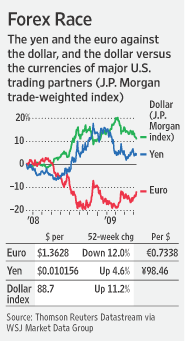
Over the last couple months, the Euro has thoroughly outperformed the Dollar, which recently fell to a five-month low on a trade-weighted basis. Over the same period, global stock and commodity prices have also risen quickly, which is not a coincidence.
Euro Rallies against DollarIn other words, investors are allocating capital on the basis of risk, rather than in accordance with (economic) fundamentals. For example, “ICE’s Dollar Index and crude oil have a correlation of minus 0.61 in the past two months, compared with minus 0.26 since the start of the year,” as rising oil prices and the declining Dollar feed back into each other.

Meanwhile, “Implied volatility on major currencies, which reflects investors’ expectations of currency swings, fell to 13.96 percent yesterday, from…17.22 percent at the end of March. A drop in volatility tends to signal less demand for options to protect investors from currency swings.” This indicator is now at its lowest level since the days preceding the Lehman Brothers bankruptcy and subsequent stock market collapse. One would normally expect a correlation between risk and return, but in this case, rising returns have been accompanied by lower risk.

Even more unbelievable is that this decline in risk is taking place against the backdrop of declining economic fundamentals. “Risk appetite in the currency market is nothing short of impressive considering the fact that the Fed reduced their growth forecasts,” said one analyst. However, “The euro-area economy will contract 4.2 percent this year, according to the International Monetary Fund, more than the projected 2.8 percent contraction in the U.S. and 4.1 percent slump in the U.K.” If investors were focusing on this divergence in economic growth, one would expect the Euro would be falling.

One hypothesis is that inflation-conscious traders are flocking to the Euro, since the ECB remains vigilant about fighting inflation, even in the face of declining prices and aggregate demand. After cutting rates to a record low 1% earlier this month, the ECB unveiled its own version of a quantitative easing plan, involving the purchase of 60 billion euros worth of low risk securities. But this is a pittance, both relative to the size of the EU economy (it represents a mere .6% of GDP) and compared to the Trillion Dollar Fed program. This led one analyst to call the ECB’s plan “chicken feed.” While all of this is noteworthy, it’s unlikely that this is having a meaningful effect on forex markets, which still remain focused on (avoiding) deflation.

If the Euro is to continue rising, it must overcome some technical obstacles. “The euro could hit a ceiling if the recent resilience of U.S. stock markets faces headwinds. ‘At some point…stronger nongovernment growth has to show up to sustain and justify these moves in equities.’ ” It’s interesting that the fear of Euro bulls is not that the EU economy won’t recover, but rather that US stock prices are overvalued. Given recent market movements, however, their concerns are reasonable, and “any disappointment [in corporate fundamentals] could provide an excuse to take profit [this] week — benefiting the dollar.”

[...]

Outlook is Positive for Australia, but Less so for Australian Dollar

0 comments

The economic outlook continues to improve for Australia. Most recently, both the government and the Central Bank released five-year growth forecasts, both of which show a modest recovery in 2010. “By 2011-12, the commodity-rich economy will again be firing on all cylinders with growth of 4.5%, well above the long-term growth rate of around 3%.”

This positive development coincided with the release of similarly upbeat economic data: “Retail sales surged 2.2 percent in March from the previous month, four times as much as economists forecast. Home-loan approvals jumped 4.9 percent, the sixth consecutive gain.” Meanwhile, unemployment shrank for the first time in months, and consumer confidence is once again rising. While the economy is forecast to shrink by .75% in the current fiscal year, this compares favorably with other industrialized countries.

The sudden turnaround can be attributed to a couple factors. First of all, the pickup in China’s economy is stimulating demand for natural resources, which had been slack for the last year. If not for simultaneously falling commodity prices, Australia might have even achieved positive economic growth for the year.

The government’s stimulus plan and spending initiatives have also played a role, although the extent cannot be measured accurately for a few months. “The government claims that measures in its budget will inject a further A$8.8 billion into the economy in 2009-10, adding to around A$50 billion in fiscal measures already announced since October 2008.”

The outlook for the Australian Dollar, meanwhile, is not so rosy. The 425 basis points in cumulative rate cuts that the Royal Bank of Australia (RBA) effected over the last year have lowered the interest rate differential with other industrialized countries. While the RBA has indicated that it will pause before cutting rates further, interest rate futures reflect the expectation that rates will be lower twelve months from now. “Economists say the RBA is open to cutting interest rates again if consumer and business confidence appear threatened, but for now it is content to let monetary and fiscal stimulus measures take hold.”

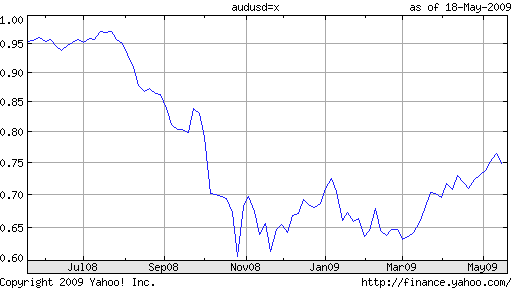
To be sure, the uptick in risk tolerance has been good for the Australian Dollar, igniting a 25% rise since March. The currency now stands at a 7-month high against the US Dollar. But the increasingly modest differential is now causing some analysts to question whether it is a reasonable risk to take, especially against the backdrop of volatility and a high correlation with global stock prices. “What’s the point of picking up a 3 percent interest-rate differential by being long Aussie and short Japan in a world where the exchange rate can move by that much in two days?” Asks One analyst rhetorically.

This same analyst is actually recommending investors to use the Australian Dollar as a funding currency, and go long on higher-yielding currencies, such as the Brazilian Real. This particular trade would have netted a respectable 5.9% return in 2009. How quickly the roles have reversed!

aud-usd-1-year

SocialTwist Tell-a-Friend
Posted by Adam Kritzer | in Australian Dollar, Economic Indicators | No Comments »

Deflation: Worst-Case Scenario or Already Here?

May. 18th 2009

In following up on last week’s post (”Inflation or Stimulus: An In-depth Look At the Fed’s Response to the Credit Crisis“) on the possibility of inflation, I want to focus today’s post on the opposite phenomenon: deflation.

As evidenced by the huge expansion of government borrowing and Fed Quantitative easing, it is deflation which is currently the paramount concern of policymakers. While falling prices would seem to represent an ideal solution to the current economic downturn, deflation is actually quite pernicious if left unchecked. To elaborate: “When prices fall across the board, businesses and consumers postpone purchases because they expect lower prices later, or worry their incomes will decline or don’t want to acquire assets that will fall in value. Shrinking demand forces sellers to cut prices further, triggering a vicious cycle.” Deflation is also detrimental to consumers with liabilities, which remain the same even as incomes are falling.

Now that we understand what deflation looks like, let’s examine its likelihood. In fact, the current economic environment represents a perfect breeding ground for deflation. For example, both consumers and businesses are using stimulus and bailout checks to pay down debt, rather to increase spending. In addition, businesses are selling out of inventory rather than ramping up production, due to uncertainty for the future. Bond yields are rising, making it more expensive - and hence less likely - for companies to borrow and invest.

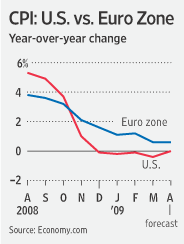
And what about the data? The Retail Price Index, “RPI - which turned negative for the first time in almost 50 years in March - is expected to fall from minus 0.4% to minus 1% in April.” The Consumer Price Index, meanwhile, “declined by 0.7 percent year-over-year in April, the largest 12-month drop since 1955.” It’s hard to take this data seriously, however, given the “seasonal adjustments” and “stripping of so-called volatile energy prices, and using the dubious ” ‘owners equivalent rent,’ OER, to measure consumer housing expenses” in order to conceal the actual decline in property values. In short, the actual decline is probably much worse, especiall given the steep drop in commodities from 2008.

At least Fed Chairman Ben Bernanke is satisfied, and was most recently quoted for his belief that “the risks of deflation were receding.” Bernanke remains committed to pumping money into the economy via its purchases of government bonds. It still has a ways to go in making good on its promise to buy more than $1 Trillion in securities.

While it’s easy to blame the Fed, it’s also hard not to begrudge it some sympathy for having to toe a very thin line between deflation and hyperinflation. In the event that its successful in forestalling a decline in prices, it will have just enough time to catch its breath before drawing all of the new money out of the economy so as to prevent inflation from taking hold and another bubble from forming in asset prices.

cpi-us-vs-euro-zone

[...]

Carry Trade Lifts Hungarian Forint

0 comments

The rally in emerging markets and accompanying revival of the carry trade can be seen clearly in the Hungarian Forint, which can now claim the distinction of being the world’s best performing currency. You’re probably scratching your head and/or rolling your eyes, but bear with me.

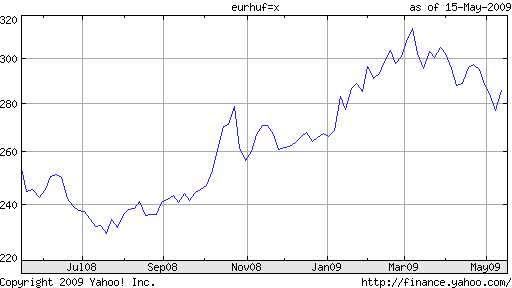
Beginning last July, shortly before the peak of the credit crisis, the Forint began to fall rapidly. It quickly lost more than half of its value against the Dollar, but then again so did a bunch of other currencies. The more relevant comparison is with the Euro, against which the Hungarian currency also fared quite poorly. Despite a 13% rally over the last two months, the Forint is still down 27% from its high last summer.

forint-chart

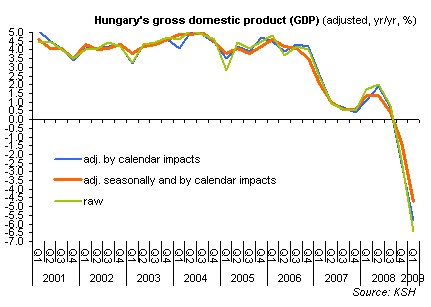
This is understandable, since Hungarian economic fundamenals are commensurately poor. “Household consumption is shrinking due to a drop in wages and narrower borrowing opportunities, while investments are hit by a lack of funds and a global economic downturn.” Factor in an 18.7% annualized decline in exports, and the result is a 6.4% decline in GDP for the most recent quarter.

hungary-2009-gdp

Hungary’s economic woes have not gone unnoticed. “The International Monetary Fund, the EU and the World Bank have pledged 20 billion euros ($27 billion) of emergency loans to support Hungary, the biggest aid package for a European nation alongside Romania.” While financial markets have stabilized, credit default swap rates indicate investors are still concerned about the possibility of default. Meanwhile, Hungary has now been officially rejected (for the second time) by the European Monetary Union, such that its doubtful that Forint will ever be absorbed into the Euro.

Why, then, is the Forint rallying? The answer is simple: high interest rates. The benchmark Hungarian interest rate is a lofty 9.5%. While other Central Banks have been busy lowering rates to try to boost economic growth, “The Monetary Council of the central bank voted unanimously on April 20 to keep rates on hold at 9.50 percent.” Given the precarious financial situation, its economic policymakers are concerned that a drop in interest rates could precipitate capital flight and a currency crisis.

An exasperated Deputy Central Bank Governor explained to reporters, “As long as Hungary is considered such a vulnerable country, our interest rates cannot be lower than South Africa’s or Turkey’s; it’s not the Czech Republic, Slovakia or Poland you should compare us to.” She has clearly been paying monitoring the forex markets and knows that now is not the time to gamble with investors’ sudden return to Hungary.

Analysts remain divided over whether the upward trend in the Forint is sustainable. For its part, “Deutsche Bank recommends investors sell the euro against the forint on bets the rate difference will help the Hungarian currency gain 10 percent to 260 per euro in two to three months from 286.55 today.” However, it will be difficult for the economy to stage a serious economy for as long as the currency is rallying, which is why a survey of analysts revealed a median forecast of a medium-term decline in the Forint.

[...]

The Sucker’s Rally and the Dollar

0 comments

“The Dow Jones Industrial Average has bounced an astounding 30% from its March 9 low of 6547. Is this the dawn of a new era? Are we off to the races again?” Asks Andy Kessler provocatively in a recent Op-Ed for the Wall Street Journal.

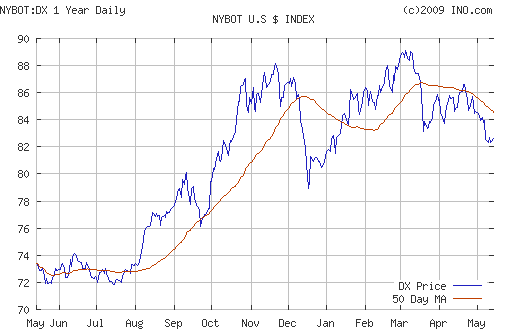
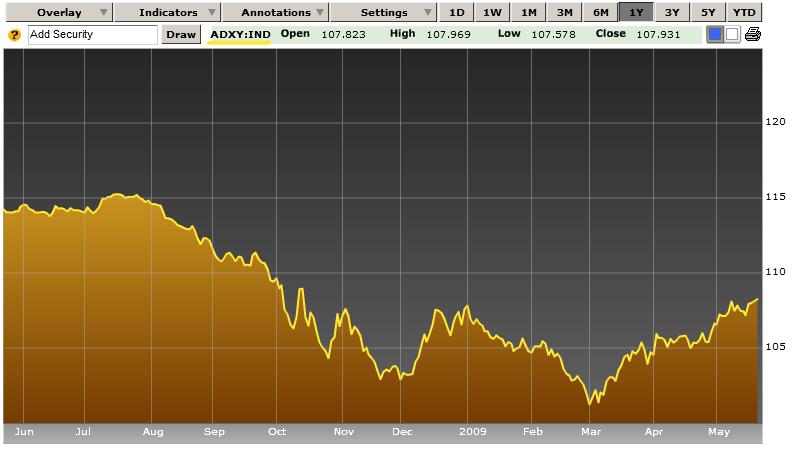
This is an important question not only for stock market investors, but also for forex traders. By no coincidence, the stock market rally has coincided with a steady decline in the Dollar, which recently broke through a key level of resistance and touched a four-month low against a basket of currencies, and is similarly nearing a four-month low against its chief rival, the Euro. ”

dollar index 1-year-performance

Experts” point to a decline in risk aversion as the chief driver of the rally; when investors become more comfortable with risk, they buy stocks, which in turn causes investors to become even more complacent with risk. Hence, a 30% rally only six months after stocks recorded their worst day and worst week ever.

In this case, however, the experts are not in complete agreement. Economic fundamentals, for example, remain relatively weak, and corporate profits are still anemic. Andy Kessler blames the Fed for distorting “asset allocation formulas” by dropping yields to zero and for its quantitative easing program, which “gets money into the economy the fastest — basically by cranking the handle of the printing press and flooding the market with dollars (in reality, with additional bank credit). Since these dollars are not going into home building, coal-fired electric plants or auto factories, they end up in the stock market.”

Sure enough, trading data suggests that in fact this rally is being driven by retail investors, as opposed to institutions. Says Lou Ritholz, ” ‘The ‘dumb’ retail money is leading the gains. ‘In this type of environment, the market is guilty until proven innocent. We have to assume this remains a bear market until we see a more normalized economy.’ ” In short, it looks like analysts have confused the chicken with egg, by emphasizing the decline in risk aversion, rather than the self-fulfilling nature of the rally.

If the rally does end, it will almost certainly be good news for the Dollar, at least in the short-term. There has emerged a strong correlation between global stock prices and emerging market currencies, for example, which virtually ensures an outflow of capital from emerging markets. One professional idiot- err investor- Jim Rogers has prognosticated an end both to the stock market rally and the Dollar rally. Credit Rogers for his long-term thinking, but he seems to have impugned a direct relationship, when recent trends suggest it is actually inverse.

I agree with Kessler, and abide by the same maxim “Only a fool predicts the stock market…” My point here is not to convince you that the market rally is unsustainable, but rather to emphasize the importance of knowing where you stand. I’m personally quite bearish on the Dollar in the long-term (food for a future post), but a damper in the stock rally would almost certainly be positive for the Dollar.

[...]

Central Bank Mulls Intervention to Hold Down Singapore Dollar

0 comments

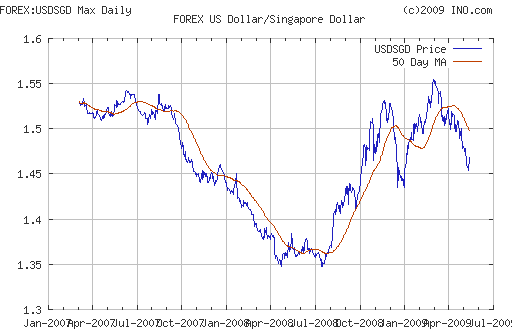
While the Singapore Dollar hasn’t been punished to the same extent as its counterparts, the currency was nonetheless dealt a strong blow by the credit crisis, falling 20% in a matter of months, after peaking in 2008. For its part, the Monetary Authority of Singapore (MAS)- which functions as the Central Bank- couldn’t have been happier. The currency had fallen just enough to almost completely offset its rise during the leadup to the crisis.
singapore-dollar-chartNow, with a global stock market rally underway and a modest economic recovery taking shape on the horizon, the Singapore Dollar has quickly erased almost half of its slide. The Central Bank naturally, is alarmed, and is threatening to intervene. While the MAS, itself, has thus far denied such a possibility, insiders suggested that “The Monetary Authority of Singapore will buy the U.S. dollar “‘f it falls below S$1.4700, around S$1.4690…’ [which] roughly equates with the strong end of the undisclosed trade-weighted band that the MAS uses to guide the Singapore currency.” Curiously enough, the Singapore Dollar beat a retreat this week, after rising all the way to $1.45.

The Singapore Dollar is generally considered a bellweather for the currencies of neighboring countries. Singapore is seen as having a model economic policy, and the Singapore Dollar is somewhat immune from the shocks that affect other currencies because its fluctuation is controlled via a loose band by the city-state’s Monetary Authority. The exchange rate is basically used in lieu of conventional monetary policy ( i.e. adjusting interest rates), although market supply/demand plays a significant role. You can think of the MAS as performing a sort of smoothing function.

In this way, the MAS is acting similarly to the Swiss National Bank, which professes to manipulate its exchange rate in order to prevent deflation- not to increase the competitiveness of exporters. According to a top MAS official, “We keep our monetary policy [based] on the medium-term inflation outlook and taking into account growth prospects. We don’t use the currency for competitiveness because it is not sustainable to align currencies just for competitiveness.” This is somewhat plausible as the MAS intervened similarly during the last downturn, in order to forestall a systemic drop in prices.

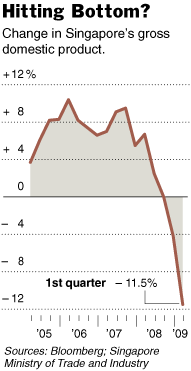
As always, the line between maintaining price stability and increasing demand is thin, since the latter is in fact used to bring about the former. This is especially true with Singapore, whose economy is largely dependent on exports to drive growth, and hence has been hit especially hard by the downturn. “In the first quarter of 2009, calculated on an annualized basis, Singapore’s economy contracted at a record rate of 11.5 percent from a year earlier, and 19.7 percent from the previous quarter.” [See Chart] As a powerful symbol of just how bad things are, the New York Times recently reported that over 700 cargo ships are docked near and around Singapore, idling as a result of slackened trade. Maybe the MAS noticed…

singapore-gdp

[...]

Inflation or Stimulus: An In-depth Look At the Fed’s Response to the Credit Crisis

0 comments

These days, The Federal Reserve Bank seems to have very few supporters. A recent poll showed that “Twenty-six percent of Americans said they were ‘a lot less’ confident in the Fed…now than five years ago.” Some people think the Fed is doing too much in responding to the economic downturn, others accuse it of doing too little, and everyone agrees the Fed is culpable for lax regulatory efforts under Alan Greenspan. One of the biggest criticisms being levied at the Fed is that its current policies are sure to generate massive inflation in the medium-term, as a result of the massive liquidity being pumped into the financial system now. In this post, I will attempt to provide some clarity on this aspect.

Sure enough, the US monetary base (represented by M1) has exploded since the inception of the credit crisis, rising more than 15% to more than $1.5 Trillion. Plus, given that there is a slight lag in the release of data, these figures don’t necessarily include the effects of the Fed’s expansion in its quantitative easing program, announced on March 18. One commentator explains that, “Of all the Fed’s moves, this ‘quantitative easing’ gets money into the economy the fastest — basically by cranking the handle of the printing press and flooding the market with dollars (in reality, with additional bank credit). Since these dollars are not going into home building, coal-fired electric plants or auto factories, they end up in the stock market.” In the short-term, then, QE has probably contributed only to asset-price inflation, rather than the more serious consumer price inflation.
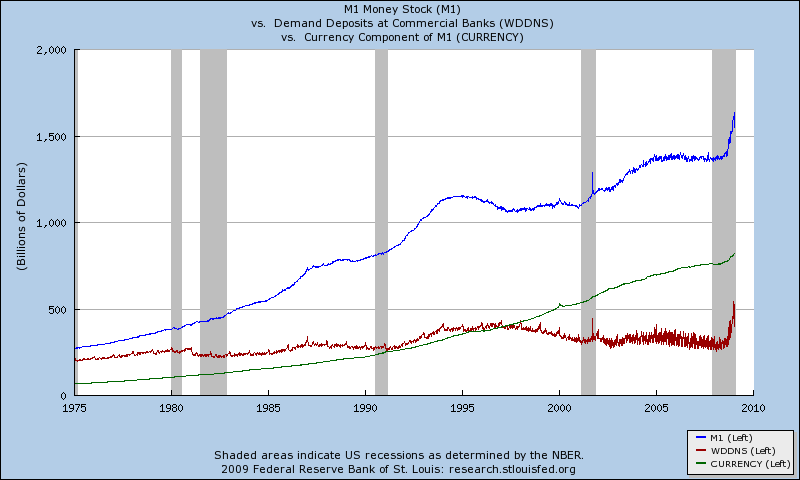
us-money-supply-jan-2009

What about the charge that the Fed is dangerously reaching its tentacles into every corner of the financial markets? As you can see from the chart below, there is certainly a huge degree of truth to this claim. Since January 2008, the Fed has “diversified” its portfolio away from relatively benign Treasury securities, into at least 20 different types of securities and loans. In the process, its balance sheet exploded from approximately $800 Billion to $2.2 Trillion, and could expand further as the next phase of quantitative easing is implemented.
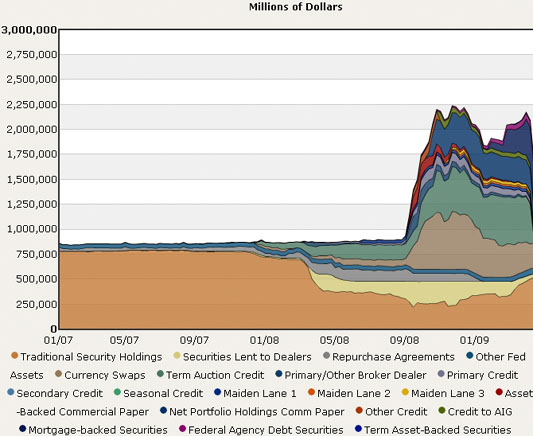
fed balance sheet

This portfolio’s makeup is indeed becoming increasingly risky. For example, “The Federal Reserve took on more than $74 billion in subprime mortgages, depreciating commercial leases and other assets after Bear Stearns Cos. and American International Group Inc. collapsed.” Despite writing down almost $10 Billion from this portion alone, however, the Fed continues to turn consistent profits. “Last year the central bank reported a whopping $43 billion in operating income. That was more or less the same level as in 2007, but meanwhile short-term interest rates had plummeted, ending the year near zero.” The assertions of conspiracy theorists, notwithstanding, the majority of this profit was transferred to the US Treasury. [Chart courtesy of The Economist].
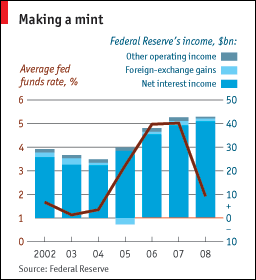
fed profits in 2008
Fortunately, most of the (non-esoteric) securities are highly liquid, and can theoretically be sold to investors if and when it becomes appropriate to do so. “The Fed, for example, is required by law to end some when the need is no longer urgent. It charges a penalty for some programmes so that borrowers will return to private markets once these have healed.” The Commercial Paper Funding Facility (CPFF) and Term Auction Facility (TAF) programs, which together account for over $650 Billion of the Fed’s portfolio, moreover, can be quickly undone. “The maturity of the outstanding [TAF] loans is 84 days at a maximum, ” while CPPF “deals in short-term money market instruments and can also be phased out, if desired, in a short period of time.”

The $400 Billion in swap lines, on the other hand, are slightly more problematic, both because of the longer time frame and because foreign banks “are now heavily dependent on the Fed for dollars.” Then there is the Term Asset-Backed Securities Loan Facility (TALF), which is not yet operational. While this program is also designed to be temporary, “the multi-year maturities of the loans and the potential size of the program—up to $1 trillion—make the impact on the monetary base more persistent than for some of the other liquidity programs.”

In short, inflation isn’t yet on the radar screen, as economists and bankers must first combat disinflation, and perhaps even deflation. Of course, there is always the (very serious) risk that the Fed either won’t be able to, or simply won’t be diligent enough in removing this cash from the money supply when the time comes. There is also a moral hazard component of the Fed’s QE, whereby “governments could come to rely on such purchases to finance budget deficits.” In my opinion, this kind of scenario would be much more likely to engender inflation, but it would be primarily the fault of the government (as opposed to the Fed), and hence beyond the scope of this post.

[...]
Pound Sterling Trends Downward as BOE Expands QE

0 comments

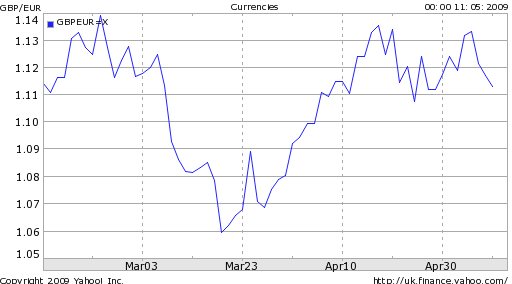
The Pound is holding its own against the USD, even touching a four-month high last week. But against other major currencies, the story is just the opposite. While managing to avoid parity against the Euro, for example, the Pound has nonetheless remained range-bound against the common currency. The Australian Dollar, meanwhile, has risen to $2 against the Pound for the first time in 13 years.
euro-rangebound-with-pound
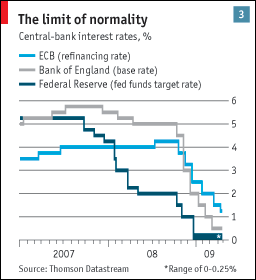
How to explain the stagnation of the Pound? It depends on which currency pair you look at. Against the Dollar, the narrative remains one of risk aversion; when stocks rise, so usually does the Pound. “The U.K. pound is joining other currencies in beating up on the dollar,” announced one analyst on a day that stocks and commodities rallied broadly. The Pound has also been able to hold its own against the Dollar because both currencies’ Central banks have embarked on similar quantitative easing plans, which could prove equally inflationary in the long run. [Chart courtesy of Economist].

eu-us-uk-interest-rates In fact, the Bank of England just announced a huge expansion in its program, increasing total debt buying (i.e. money printing) by $50 Billion. One analyst summarized the impact of this announcement on forex markets as follows: “The Bank of England’s aggressive stance with regard to quantitative easing is adding to concern about the economy and that is negative for sterling.” Not much nuance there….
In fact, this is especially bad for the Pound against the Euro, where a juxtaposition of the Central Banks’ respective approaches to the credit crisis reveals stark differences: “The weakness in the pound suggests the market is drawing a contrast between the ECB, which seems to be dragging its legs on quantitative easing, and the BOE, which is still ‘full-steam ahead.’ ” Where the ECB is providing liquidity indirectly in the form of swaps and guarantees, the BOE is printing money and injecting it right into capital markets.

“Mervyn King, governor of the Bank of England, has said the exit strategy will be dictated by the outlook for inflation and that central banks should not support markets that cannot survive on their own,” but investors remain skeptical and for good reason. “Britain will sell a record 220 billion pounds of gilts this fiscal year, 50 percent more than last year.” Based on the fact that yields have risen for four straight weeks (against the backdrop of the first “failed” auction ever for UK government bonds), there is doubt that the government can finance its deficits.

The BOE continues to be roundly smacked with criticism, for its role in fomenting the credit crisis and in not adequately responding to it: “It happens that in the early years of inflation targeting, it did produce a stable economy. But I think it’s now clear that it can’t, by itself, produce a stable economy,” argued one commentator. Unemployment rates in the UK remain at frighteningly high levels. The government’s own economists (which are more optimistic than third-party forecasts) forecast GDP at -3.5% for 2009, with a modest recovery in 2010. Of course, these forecasts should be taken with a grain of salt, as they hinge on the crucial assumption that the BOE’s interest rate cuts and quantitative easing plan will soon trickle down through the economy, proof of which has still not been observed.

As a result, I’m personally between neutral and bearish for the UK Pound. For as long as stocks continue to rally, investors will remain Adistracted. If and when the rally loses steam (I am skeptical that the rally is sustainable), they will quickly turn their attention to comparative economic and monetary conditions; suffice it to say that Pound won’t stack up well.

[...]

WisdomTree Unveils New Multi-Currency ETF

0 comments

On Wednesday, the latest addition the Wisdom Tree family of currency ETFs officially debuted, and in its first two days of trading, the Emerging Currency Fund (CEW) returned an impressive 2.2%. It’s not worth annualizing this figure, but suffice it to say that its performance is already turning heads.

According to the prospectus, CEW “is an actively managed exchange-traded fund that seeks to provide the investor with a liquid, broad-based exposure to money market rates and currency movements within emerging market countries.” Investors will gain exposure both to the currencies themselves and to their respective short-term interest rates, via “short-term U.S. money market securities and forward currency contracts and swaps of the constituent currencies…designed to create a position economically similar to a money market security denominated in each of the selected currencies.”

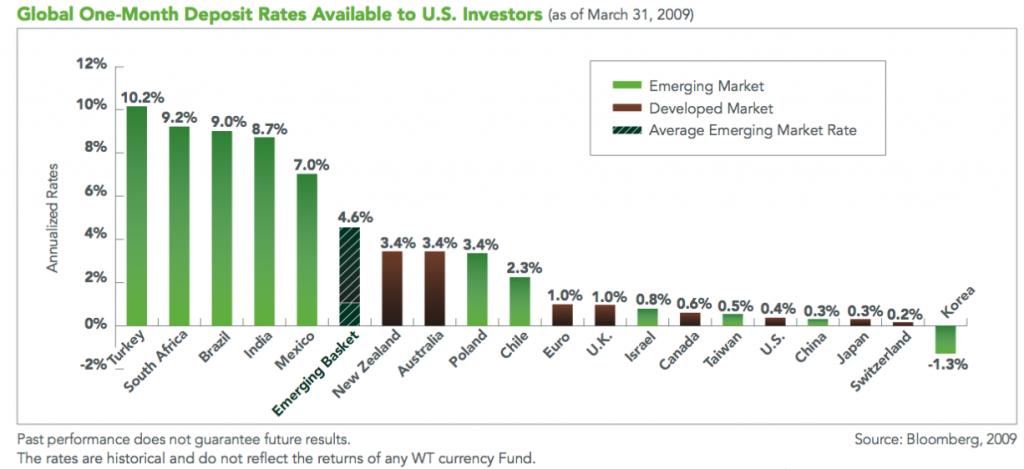
Emerging Market Interest Rates Favor Carry TradeChosen from three regions (Latin America, Africa/Europe/Middle East, and Asia), the inaugural 11 currencies are as follows: Brazilian real, Chinese yuan, Chilean peso, Indian rupee, Israeli shekel, Mexican peso, Polish zloty, South African rand, South Korean won, Taiwanese dollar and Turkish new lira. According to WisdomTree, these currencies were selected not necessarily for economic reasons, but rather because of their relatively high liquidity and low correlation with each other. In addition, “The selected currencies are equally weighted in terms of dollar value at each currency assessment date and after each quarterly re-balancing,” to reflect fluctuations in exchange rates. Naturally, WisdomTree reserves the right to rejigger the portfolio in terms of constituent makeup, but this would probably only be effected to improve overall liquidity, rather to replace an under-performing currency.
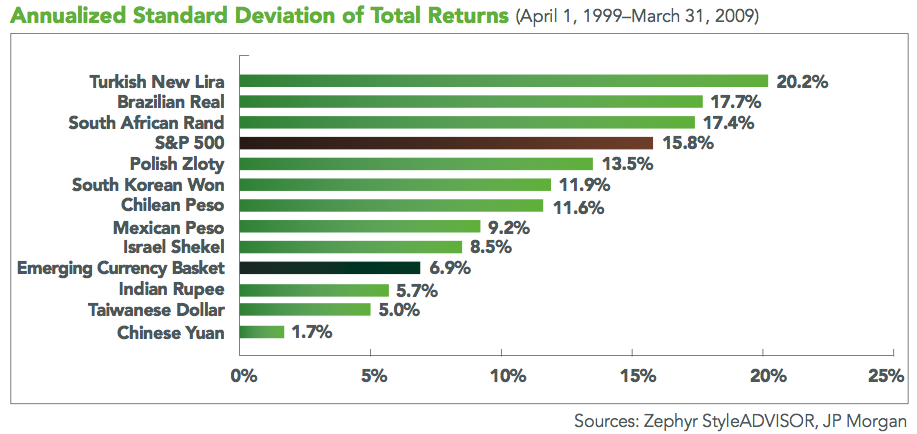
The advantage of CEW lies in its automatic diversification, such that investors gain access to a variety of currencies but only have to transact in the fund itself. WisdomTree also points out that, “Emerging market currencies often move independently of domestic stock, bond and money market investments…[and] exhibit low correlations to other alternative asset classes, such as commodities and gold.” The chart below [courtesy of CEW promotional materials] makes this point indirectly, and it probably comes as a surprise that US stocks are collectively more volatile than individual emerging market currencies. “Incorporating a 10% allocation of emerging currency into balanced portfolio mixes of the domestic stocks and domestic bonds over the last ten years…raised annual returns by an average of 0.66%, while lowering overall portfolio volatility” in a hypothetical exercise.
S&P 500 is more volatile than emerging market currencies!
“In terms of taxation, WisdomTree says normal capital gains rules will apply to the sales of fund shares. However, income from the portion of the fund invested in U.S. money market securities usually will be taxed as ordinary income, while the tax treatment of the local currency forward contracts could vary with the situation.” The fund’s expense ratio, meanwhile, is .55%.

If the preceding paragraphs read like a sales pitch, I apologize, as that was not my intention. At the same time, I’m personally quite positive about CEW (as well as ETFS in general, for that matter), since it provides quick and easy exposure to a bunch of quality currencies, eliminating the need to buy them separately. Not to mention that this fund is debuting right when both the carry trade and emerging markets (and their currencies) are coming back in vogue.

I’m not sure if the timing was deliberate, but it could certainly have been worse. It’s tough to say whether the market rally of the last two months is sustainable, but if the decline in risk aversion that ignited the rally continues to obtain, it will be good for CEW.

[...]

Swiss National Bank Renews Threat of Intervention

0 comments

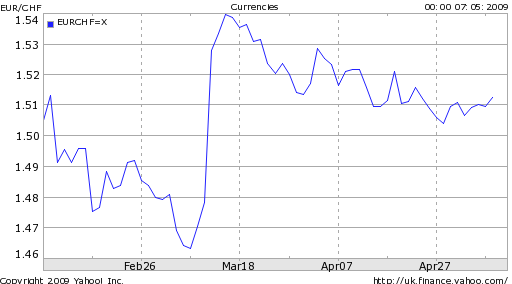
When the Swiss National Bank (SNB) announced oln March 12 that it would intervene in forex markets for the first time since 1994, the Franc immediately plummeted up to 5% against select currencies. Since then, the currency has largely clawed back some of its losses, prompting talk of round two: “Speculation about an imminent intervention in the foreign-exchange markets was rife…after the euro fell to CHF1.5031, the lowest level seen since March 12 when the SNB began selling Swiss francs against euros.”

swiss-franc-rises-despite-snb-interventionIt was unclear whether the Central Bank had chosen a magic threshold, such that a rise by the Franc above which would trigger a sale of Francs in the open market. Earlier in the week, one analyst asserted, “With the euro/franc exchange rate almost at pre-intervention levels - the euro jumped to a level above CHF1.52 after the SNB intervention in March from CHF1.4843 before the announcement - the stage is set for the SNB to either put up or shut up.”
Sure enough, both the Chairman of the SNB as well as a board member both announced yesterday that the campaign to hold down the the Franc is still in effect, and will soon enter a new phase. Thus far, the Bank has relied on various forms of quantitative easing to deflate its currency, both through direct currency transactions and purchases of bonds. The goal of such quantitative easing is only proximately to deflate the Franc; the ultimate goal is to ward off deflation. Given that the Bank had already lowered its benchmark interest rate close to zero, manipulating its currency was/is one of its few remaining options. “As long as the environment does not improve and as long as deflation risks are visible in our monetary policy concept, we will stick to this insurance strategy resolutely,” said Chairman Jean-Pierre Roth.

As the economic recession takes hold, the Swiss economy is forecast to contract 3% in 2009, but to grow in 2010. Consumer sentiment has fallen to the lowest level since 2003. Inflation, meanwhile is projected at -0.5%; deflation, in other words. Still, Switzerland maintains that its motivation is not to boost the economy, but only to increase monetary stability. National Bank governing board member Thomas Jordan “reiterated the interventions have nothing to do with a beggar-thy-neighbor policy, a strategy to weaken a country’s currency to improve the situation for domestic exporters.”

Given that forex intervention is usually doomed to failure, the SNB must rely on a combination of luck and improved fundamentals to keep the Franc down. Thus, when the next round of intervention was announced yesterday, the Franc fell by a modest .75% against the Euro, as investors largely shrugged of the news. Fortunately, the initial pledge to intervene coincided with a pickup in investor sentiment, and decline in risk aversion. This has reduced demand for the Swiss Franc, which had previously been bid up as a so-called “safe haven” currency. As long as the stock market rally continues, investors will stick to higher-yielding currencies and the Franc should be “safe.”

[...]

Australian, New Zealand Currencies Benefit from Risk Aversion

0 comments

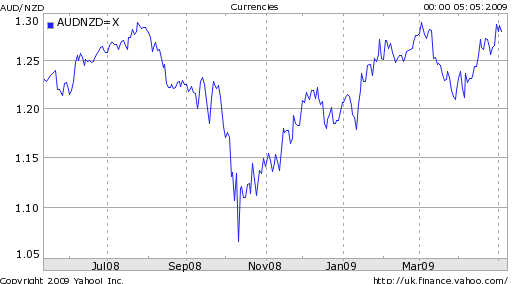
Against each other, the New Zealand Kiwi and Australian Dollar have traded in a pretty tight range for the last year (except for a “blip” in the fall of 2008). This makes sense, as both currencies rise and fall in accordance with exports and interest rates.
nzd-and-aud-trade-in-tight-range
Against other currencies, meanwhile, both have torn upwards in the last couple months. Despite steep interest rate cuts, both currencies have maintained their interest rate advantages against other industrialized currencies. This has not gone unnoticed, and the return of the carry trade has been kind. “The current improvement in sentiment is providing an underpinning of support and while that remains the case - and that may be until midyear - the New Zealand dollar is going to remain well-supported,” said one economist.

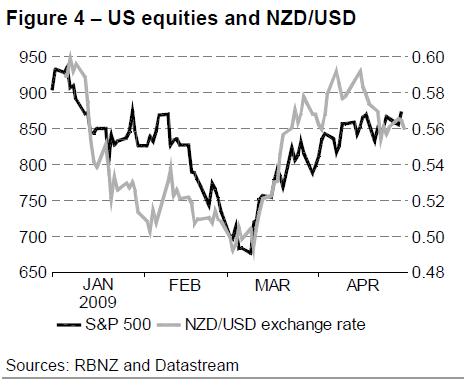
The correlation between the New Zealand Kiwi, specifically, with the US stock market has become remarkably cut-and-dried of late, which you can see from the chart below. For carry traders, therefore, it probably makes more sense to follow stock market commentary than to track New Zealand economic data. The same economist, for example, warned “that the equities rally, which has seen the broad U.S. Standard & Poor’s 500 index climb 36% from its March low after rising another 3.4% Monday to its highest since Jan. 8, may be dissipating.”
us-equities-and-nzd-usd
Besides, given the deteriorating economics in both countries, lower interest rates are probably inevitable: “We think this case for further cuts will be made in the second half of this year…we think it will be very difficult, no matter what the global economy is doing, for the RBA to ignore rapidly rising unemployment,” offered one analyst who predicted that rates would be cut to a “trough of 2%.” In such a scenario, the interest rate spread would still remain healthy, but perhaps not enough to offset the additional risk.

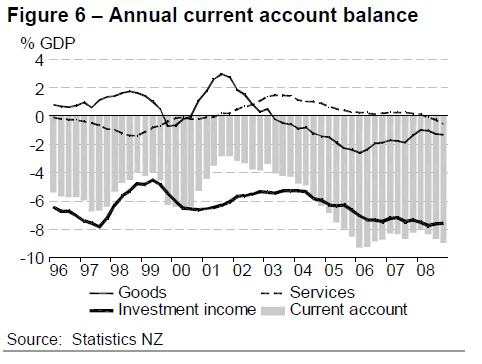
Australian home prices are falling at a rapid clip, the labor market is sagging. In New Zealand, meanwhile, a decline in sentiment and consumer spending has corresponded with a 1% contraction in GDP in the quarter ended March 31. Tourism is down, although net exports are increasing. The current account deficit continues to expand, but this is mostly a product of an investment balance - perhaps related to the carry trade.

new-zealand-2009-current-account-balance

For now, forex traders remain optimistic, albeit slightly less so than before: “The difference in the number of wagers by hedge funds and other large speculators on an advance in the Australian dollar compared with those on a drop — so-called net longs — was 16,692 on April 28, compared with net longs of 17,250 a week earlier.”

[...]

Despite “Reality,” Fed Optimistic about the Economy

0 comments

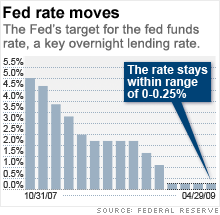
Last week, the Fed opted to maintain its benchmark Federal Funds Rate close to zero, and indicated in its press release that it “anticipates that economic conditions are likely to warrant exceptionally low levels of the federal funds rate for an extended period.” [Chart courtesy of CNN].
fed_rate_moves03Nonetheless, the Fed made a point of emphasizing that the economy seems to be stabilizing: “Information received since the Federal Open Market Committee met in March indicates that the economy has continued to contract, though the pace of contraction appears to be somewhat slower.” I suppose everything is relative, but it’s a bit perplexing as to where the Fed is getting its data from, given that “Gross domestic product, the broadest measure of economic activity, fell at an annual rate of 6.1% in the first quarter of 2009 after a 6.3% drop in the last three months of 2008.” This exceeded analysts’ expectations for a 4.7% decline, and if anything, would seem to suggest that the economy is worsening. Granted, consumer spending rose slightly and inventories declined, but the aggregate picture paints an unequivocal picture of an economy in deep recession.
Bernanke, apparently, is unconvinced. ” ‘We continue to expect economic activity to bottom out, then to turn up later this year,’ Mr. Bernanke told the congressional Joint Economic Committee.” Meanwhile, the unemployment rate is currently 8.5% and falling. Business investment is still abysmal, as companies implement hiring freezes and hold off on all non-essential capital purchases.

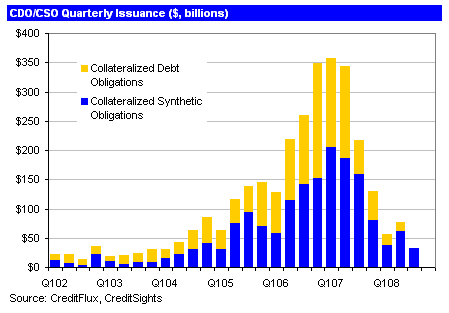
Bernanke is especially optimistic about the state of the US financial system, noting that “conditions in credit markets have revived slightly in recent weeks. Homeowners are refinancing mortgages at a rapid clip, and financial institutions have stepped up their sale of securities backed by of credit card loans, automobile debt and student loans.” However, mortgage refinancing is a red herring, and frees up very little cash for consumption. Meanwhile, debt securitization is well below 2007 levels, and some experts predict that credit card loans represent the next catastrophe. “Fitch’s Prime Credit Card Delinquency Index measures credit card debt more than 60 days late. Through January 2009 that index surged to a record 4.04 percent.”

cdo issuance declines in 2008

Bernanke also hinted that the results from the bank stress-tests, scheduled to be released today, are largely positive. As part of this program, “The government plans to divide banks into three categories, based on the adequacy of their capital reserves to absorb projected losses,” if the recession were to worsen. If Bernanke’s assertions are to be believed, then the tests will show that their capital reserves are sufficient, and they will not need additional capital infusions.

Bernanke’s testimony and the Fed Statement have been greeted positively by investors, “contributed to improving sentiment and boosted risk appetite, easing demand for then yen and greenback as safehavens.” Nonetheless, everything he says should be taken with a grain of salt. Even with the best rose-tinted glasses money can buy, it’s hard to draw such optimistic conclusions from an objective interpretation of the data. Either Bernanke is basing his assessment off of the stock market rally (which is circularly based on such economic optimism), or he is trying to deliberately distort reality in order to try to make a recovery self-fulfilling by disingenuously telling people that everything is okay. Personally, I don’t think he’s worth taking seriously.

[...]

Spike in Treasury Yields is Good News for US Dollar Bulls

0 comments

By no coincidence, the Dollar’s best day in April was a mirror image of its worst day in March. Recall what happened when the Fed initially announced its quantitative easing program: “The dollar plunged a record 3.4 percent against the euro on March 18 as traders speculated the Fed’s purchase Treasuries would debase the currency.” On April 29, meanwhile, “The dollar rose the most against the yen this month after the Federal Reserve refrained from increasing purchases of Treasuries and mortgage securities.”

The implication is that as risk aversion has dropped, investors have turned their gaze towards interest rates. Previously, this phenomenon would have worked against the Dollar, as both short-term and long-term interest rates are generally lower in the the US than they are abroad. On the short end of the curve, this is a product of a low Federal Funds Rate, as guided by the Fed. On the long end, this is a function of high demand for US Treasury securities, which keeps prices high and rates proportionately low.

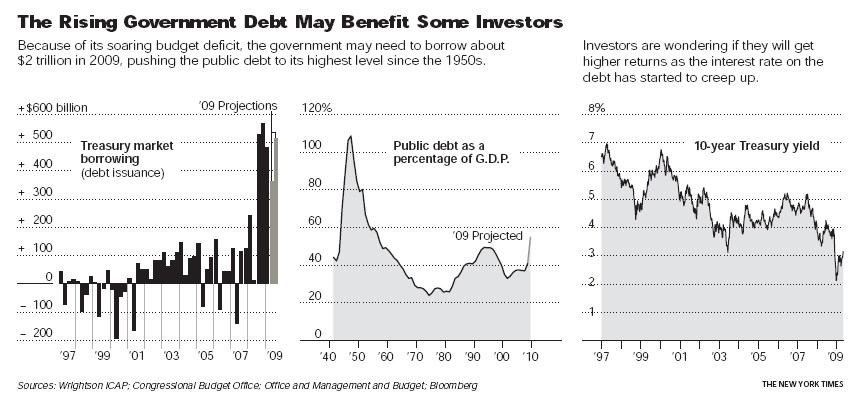
However, this trend is very quickly reversing itself. Aside from a few hiccups (including a big one on March 18!), Treasury yields have risen continuously since touching an all-time low in January. Since then, the yield on the 10-year note, for example, has risen from 2.2% to nearly 3.2%. The impetus for higher rates is coming both from a decline in risk aversion (which is leading investors to seek alternatives to Treasuries) as well as a concern that the Fed will not be as active in buying US bonds as it had initially intimated.

government-debt-is-rising

A decline in demand for Treasury securities is making some investors understandably nervous that the government will not be able to fund its deficits (projected at 10% of GDP in 2009). Writes one columnist, “We cannot take it for granted that the global bond markets will prove deep enough to fund the $6 trillion or so needed for the Obama fiscal package, US-European bank bailouts, and ballooning deficits almost everywhere.” The fear is that the government will turn to the Fed, which will stoke inflation by printing money, and induce a devaluation of the Dollar.

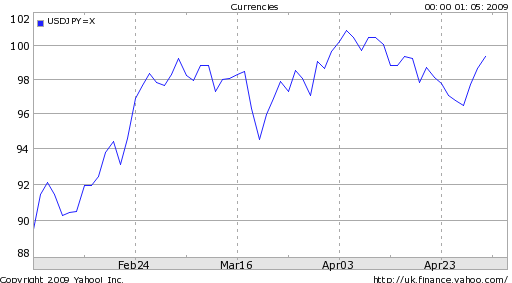
If the Fed limits its purchase of Treasuries, by extension, not only will this limit inflation, but also it will lead to higher interest rates on US government bonds, which should help prop up investor demand. One currency strategist observed that “The dollar-yen is very closely correlated with the back end of the yield spread.” In other words, as US long-term yields rise, so may the Dollar.

dollar-rises-versus-yen
Of course, the key is to strike a balance between too much demand and not enough. If investors got really spooked by the fact that “The Congressional Budget Office expects interest payments to more than quadruple in the next decade as Washington borrows and spends, to $806 billion by 2019 from $172 billion next year,” then it could lead to a skyrocketing of interest rates as investors beat a mass retreat away from Treasuries, which would certainly entail a devaluation of the Dollar. To apply Alan Greenspan’s famous analogy, has anyone coined the term “Goldilocks Treasury Yields” yet?

[...]

South Africa Hikes Rates, but Interest Rate Differential is Preserved

0 comments

Yesterday, the South African Reserve Bank (SARB) lowered its benchmark interest rate by 100 basis points to 8.5%. Since December, the Central Bank has now cut rates by 3.5%, from a high of 12%. [As an aside, the SARB uses a repo rate to conduct policy, as opposed to a discount rate. In theory, a repo rate is slightly unique in that it reflects the rate at which the Central Bank will repurchase government securities from commercial banks. The Federal Funds Rate, in contrast, "is the interest rate at which private depository institutions (mostly banks) lend balances (federal funds) at the Federal Reserve to other depository institutions." In practice, both rates function as modulators of liquidity in the financial system.]

“The outlook for domestic economic growth remains subdued, with no indications of a quick recovery,” offered the SARB as a rationale for the rate cuts. Activity in manufacturing and mining, two of the cornerstones of the South African economy, have plummeted since the inception of the credit crisis, along with exports and retail sales. As a result, “Central bank Governor Tito Mboweni said April 7 he would ‘not be surprised‘ if the nation’s economy shrank for a second consecutive quarter in the three months through March, following a 1.8 percent contraction in the fourth quarter.” Meanwhile, South Africa’s producer price index (PPI) has declined for seven consecutive months. Coupled with a moderation in food and energy prices, inflation is no longer perceived as a serious problem.

The South African Rand actually rose on the news of the rate cut, as part of a trend that has seen the currency rise nearly 40% since touching a low of 11.7 Rand/Dollar in October. In April alone, “South Africa’s rand, the laggard of 27 major world and emerging-market currencies last year, rallied 12 percent against the dollar.” This reversal of fortune is due largely to the recovery of risk appetite and consequent return of investors to the carry trade.

rand-reverses-trend-against-us-dollar

South Africa is especially poised to benefit from this trend for a couple reasons. Primarily, the Rand’s advantage lies in in interest rate differentials. Even if the SARB hews to economists’ predictions and cuts its repo rate by another 100 basis points, the differential will still be tremendous, as virtually every industrialized country has lowered rates close to zero. In addition, South Africa is perceived as a relatively safe place to invest, especially relative to interest rate levels. According to one trader, “We’re seeing a re-assessment of the rand’s relative value because of the fact that South Africa’s economy and financial system are relatively more sound than is the case in many other countries.”

As Bloomberg News summarized, you can’t stand in front of a freight train: “Emerging-market stocks are poised for their best month in 20 years as evidence the global recession is easing spurs investor demand for higher-yielding assets.”

In the end, you can’t fool the markets and carry traders ignore fundamentals at their peril. The recent election of Jacob Zuma as South African Prime Minister “hardly adds to confidence in the South African economy.” In addition, South Africa continues to maintain a sizable current account imbalance, “at 7.4 percent of gross domestic product last year.” Despite declines in February and March, the deficit touched a “record 17.380 billion rand deficit in January” and the markets are “expecting large deficits to persist this year as exports come under pressure.”

[...]
 
© 2009 | FOREX SETS | Privacy policy Forexsets.blogspot.com