Forex Markets Indifferent to Bernanke Nomination

0 comments

Earlier this week, President Obama officially nominated Ben Bernanke to a second four-year term as Chairman of the Federal Reserve Bank’s Board of Governors. The reaction was relatively muted, perhaps because most pundits had already anticipated the news. Bernanke himself probably sealed his own re-appointment with the public relations campaign he embarked on last month, ostensibly to offer a rationale for his response to the credit crisis. “In a profound departure from the central bank’s tradition as an aloof and secretive temple of economic policy, Mr. Bernanke has plunged into the public spotlight to an extent that none of his predecessors would have contemplated.”

Most of the sound-byte reactions came from politicians, and focused on whether he deserved another term, rather than the potential ramifications of his re-nomination. Heavyweights Barney Frank and Christopher Dodd both offered tepid support. Ron Paul referred to the news as irrelevant. Meanwhile, “European Central Bank President Jean-Claude Trichet on Tuesday said he was ‘extremely pleased’ by President Barack Obama’s decision.”

The reactions from investors, likewise, ranged from ambivalent to moderately supportive. Equity markets rose to a 2009 high the day after the story broke, while the Dollar fell slightly. The re-appointment was deliberately awarded five months ahead of schedule in order to help the president’s credibility with investors. Fortunately (or unfortunately, depending on how you look it), the fact that the markets didn’t react much, shows that they don’t really care. In other words, “President Obama overstated matters when he said that Mr. Bernanke had kept us out of a Great Depression” not only because “this remains to be seen,” but also because the ebbs and flows of GDP are contingent on more than just monetary policy.

Regardless of how much credit Bernanke actually deserves, he will certainly have his work cut out for him in his second term. “Bernanke’s Next Tasks Will Be Undoing His First,” encapsulated one headline. At some point, the Fed must raise interest rates, return credit markets to normal functioning, and remove hundreds of billion of dollars from the money supply.

But this is easier said than done: “If the Fed shifts too quickly from the role of savior to that of strict disciplinarian, it risks aborting the recovery and tipping the nation back into a recession, essentially repeating mistakes made in 1937 after the economy had begun to rebound. If the Fed moves too slowly, it risks the kind of intractable inflation it experienced in the 1970s and fueling another bubble.”

The consensus is that, for better or worse, he will err on the side of price stability, perhaps at the expense of economic growth. “A Fed chaired by Ben Bernanke will follow a policy uncomfortably tight as the 2012 election looms into sight. Bernanke has espoused a commitment to low inflation over his entire career,” argued one economist. Meanwhile, the markets aren’t expecting rate hikes at least until 2010, although Bernanke, himself, has conveyed a sense of optimism - and hence hawkishness - about a quick exit from recession.

What does all of this mean for the Dollar? It’s impossible to say exactly, and depends largely on whether Bernanke can unwind the easy money policy of the last year just as deftly as he deployed it.And of course, there is the wild card of the US National debt, and the potential for a loss of confidence to induce a run on the Dollar, which even Bernanke would be powerless to solve.

[...]
Carry Trade Still Popular, but Doubt is Growing

0 comments

It’s safe to say that the inverse correlation observed between the Dollar (and also the Yen) and global equities is largely a product of the carry trade. “The U.S. stock market bottomed and the U.S. Dollar Index peaked almost simultaneously in March. While U.S. stocks are up more than 50% in that time, the Dollar Index (which measures the greenback’s value against the euro, the yen, the British pound, the Canadian dollar, the Swedish kroner and the Swiss franc) is down nearly 12%,” observed one analyst.

On one level, this represents a return to 2008, prior to the explosion of the credit crisis, when carry trading was THE dominant theme in forex markets. However, there is one important difference. While the Dollar and Yen were the funding currencies then and now (due to their low interest rates), there has been a slight shift in the currencies selected for the opposing/long end of the trade.

am-af721_carryh_ns_20090417053224
Traditionally, the most popular long currencies were those of industrialized countries, rich in commodities and backed by high interest rates and often rich in commodities. To be sure, these currencies have shined in recent months, certainly due in part to speculative (carry) trading. “Strategists at Wells Fargo Bank in New York ‘believe that the gains in the dollar-bloc currencies (Australia, New Zealand, Canada) have run ahead of the gains in commodity prices.’ ” The Bank of Canada also noticed that “At the time of its last statement, oil prices were about $75 a barrel, but now they are in the $60-to-$65 range. That suggests the currency’s appreciation has outpaced the demand for its commodity exports.”

But the run-ups in the Kiwi, Aussie, and Loonie have been overshadowed by even more rapid appreciation in emerging market currencies. This shift is largely a product of changes in interest rate differentials, which are now gapingly large between developed countries and developing countries. Compare the 2.75%+ spread between the US and Australia, with the 8.5% spread between the US and Brazil or 12.75% between the US and Russia. For investors once again becoming complacent about risk, the choice is a no-brainer.

Still, some analysts are nervous about this change in dynamic: “While the new carry trade may be less leveraged, it’s an inherently riskier bet. As such, it’s more vulnerable to the kind of swift unraveling of risk appetite observed across all nations and sectors in 2008, but which occurs with far more frequency in emerging markets.” Meanwhile, emerging market stocks have behaved volatilely over the last few weeks (with Chinese stocks even entering bear market territory), and some investors are concerned that they may be temporarily peaking. There are also signs that bubbles may be forming in carry trade currencies, with bullish sentiment at high levels. Accordingly, one strategist suggests waiting out a 5% pullback in the Australian dollar, and a 10% pullback in the New Zealand dollar before going back in.

There is also the outside possibility that the Fed will raise interest rates, which would crimp the viability of the US Dollar as a funding currency. Granted, it seems unlikely that the Fed will tighten within the next six months, but investors with a longer time horizon could begin to adjust their positions now, rather than wait until the 11th hour, at which point everyone will be rushing for the exits.

[...]

Australian Dollar Rises, Remains Closely Correlated with Stocks

0 comments

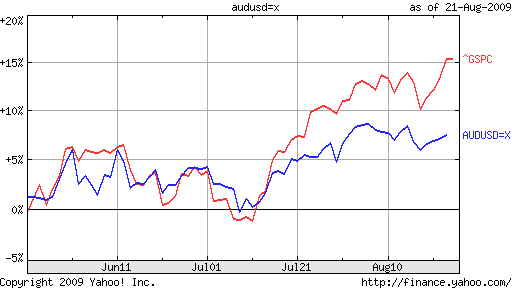
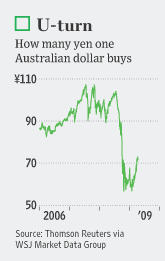
The performance of the Australian Dollar over the last six months has been nothing short of incredible: “Since the end of February, the Australian dollar has risen 29% against the U.S. currency,” and a still-impressive 18% if you backtrack to January, when the Aussie was still in free-fall.

austra

As has been the trend in forex markets of late, the currency’s rise cannot be attributed to an improvement in fundamentals. The economic picture remains nuanced (that is putting a positive spin on it), and definitive proof of recovery has yet to emerge. “We really are trawling pretty deep to try and get any snippet of information that might have some backhanded relevance as far as Australia goes,” said one analyst.

As a result, fundamental analysts have been forced to wait for a “more precise picture about the timing [of] any Reserve Bank of Australia interest rate hike.” On this front, investors are ratcheting down their expectations of a rate hike anytime soon, as “The RBA has signaled that there’s a danger of raising rates too soon.” Futures prices reflect the expectation that rates will rise by only 37 basis points from current levels before 2010, and by 161 basis points 12 months from now.

With such economic uncertainty, investors have turned their attention elsewhere. “Nomura Chief economist Stephen Roberts said in the absence of any clues about the fundamental drivers of the currency, nearly all the cues in foreign exchange markets are being taken from equities.” Some analysts have posited a close relationship with the US stock market: “The correlation between the Aussie dollar and U.S. equity market in particular has been very strong over the past few weeks, with our analysis showing a correlation as high as 95 percent.”

For other analysts, the relationship is with the Chinese stock market. This correlation makes more sense logically, since the Australian economic recovery is largely contingent on continued growth in China and the concomitant purchases of Australian commodities. “Currency markets will be watching the Shanghai share market, which has been a pretty big influence on the Aussie recently,” summarized one analyst. A reporter for the WSJ tried to spell it out even more clearly in an article entitled, “Australian Dollar Up Late, Closely Tied To Chinese Stocks.”

Unfortunately, the correlation with (Chinese) stocks runs both ways. When the Chinese stock market tanks - often for inexplicable reasons - as it has for the last three weeks, the Australian Dollar follows suit. Another analyst is more blunt: “The story for the Australian dollar and other risk- and growth-oriented currencies is similar to the share markets. They’ve had a great run and are probably due a bit of a pullback.”

[...]

Dukascopy Morning Forex Overview - Aug 28 09

0 comments

Previous session overview

The dollar and euro rose against the yen in Asia Friday as Japanese importers bought the two currencies ahead of their month-end book-closing.

Dealers said Japanese players had bought vigorously in early Asian trading, sending the dollar as high as JPY93.86 and the euro to JPY134.94.

But the two currencies shed some of their gains in the afternoon as weak Asian share markets encouraged short-term investors to buy the safe-haven yen, dealers said.

EURUSD made a brief show above USD1.4400 in the US session, topping out at USD1.4405 after seeing earlier lows at USD14222, closing the day in the USD1.4350 area. Brief lows were hit into the Asian session at USD1.4343 before momentum accounts stepped in to buy euros, pressing the pair back up to USD1.4377. Further impetus was lacking with flows described as muted, slippage in Shanghai stocks denting sentiment, with euro-dollar subsequently easing back to USD1.4350 and remaining contained ahead of the European open.

The British pound was knocked lower after both weaker than expected business investment and consumer spending provided evidence the UK is still in recession mode. Thus, UK interest rates will stay low to restore the economy.

The Australian dollar rocketed higher on Friday while shorter dated interest rate futures spun into freefall as traders ramped up expectations Australia’s central bank could tighten policy much sooner than expected, possibly by October.

Market expectation

The euro, U.K. pound and dollar are recovering just a bit against the yen on Friday as traders square up positions. Earlier, traders said Japanese importers were buying both the U.S. dollar and the euro against the yen.

European and U.S. stock markets shifted little yesterday, and if they remain stagnant Friday, the dollar could tick down to JPY93.00 and the euro to JPY133.00, dealers said.

But economists say the long-term impact on foreign-exchange markets is unclear as players watch for how the DPJ will be actually carried out its policies.

EURUSD still trading around the USD1.4350 area at writing, some stops noted through USD1.4410, with offers then noted into the August highs just ahead of USD1.4450. Barrier interest said to reside there, more into USD1.4500. Bids are at USD1.4345/40 and USD1.4300 in small, a break below there set to find little in the way of support ahead of USD1.4220.

Views, ahead of the RBA’s monthly policy meeting next week, drove a bid tone in the local currency and caused strong selling in the front end of the yield curve.

Analysts are now awaiting the statement accompanying next week’s board meeting outcome to see if an October rate hike is indeed on the cards, and will also examine second quarter gross domestic product, buildings approvals and the trade balance - all scheduled for release next week.

[...]

Day trading doesn’t have to take all day

0 comments

Hi!

I’m sure you know by now that you don’t have to trade all day to see your
account grow. Even if you consider yourself a day trader, it doesn’t
always = 8 hours of full-time trading.

After many years of trading, I’ve figured out that the key is having the
right trading rules and a system that you can trust so you’re not strapped
to your computer all day taking the wrong trades. No tricks just the right
‘evil plan.’

See how using the HVMM strategy brought in $750 per contract in just over
30 minutes:

http://www.netpicks.com/cmd.php?af=1004071&u=http://www.highvelocitymarketmaster.com/blog/

In the video the guys over at the HVMM headquarters revealed that trading
Crude Oil Futures, can be ideal in particular for those with some trading
experience. But, even if you’re not an experienced trader, the nice thing
about the HVMM is it doesn’t discriminate. You can trade any market you
desire and any timeframe.

Find out how. Make sure you’re registered for the HVMM Premier Tuesday
September 1st at 9:00am EST/12:00pm PST/ 5:00pm GMT.
I’ll be there waiting to hear your name called as the winner of their blog
contest. Oh did you catch the trade tip in this latest video? Don’t forget
to post the answer in the blog comments!

Good Trading,

P.S. You have to participate in the blog contest and ATTEND the webinar to
be in the drawing for the first copy of the HVMM before it’s even on the
market.

[...]

Dukascopy Afternoon Forex Overview

0 comments

Previous session overview

The euro is little changed Thursday against the dollar, and its ongoing intraday volatility inside this narrow range signals growing market uncertainty.

U.S. data released early Thursday has had minimal effect on exchange rates. The dollar garnered some support against the euro and yen on positive signs for growth in the U.S. second-quarter gross domestic product report and weekly jobless claims.

However, the euro remains slightly up on the day, recovering some from day earlier profit-taking and overnight anxiety tied to China’s recovery, which has become a major theme driving market direction.

The dollar’s response to morning data was the latest suggestion that the U.S. unit could begin to gain on positive U.S. data. It advanced some against the euro and yen after the GDP and jobless claims release, although the euro is still up on the day. This fundamental trading strategy, as opposed to risk-driven, is an emerging trend in currency markets, after nearly two years of flows being dictated by a flight to safety.

The yen may be finding additional support due to month-end factors and changes in Japan’s tax schedule that could encourage corporations to repatriate foreign investments back into yen.

Market expectation

EURUSD pair has been locked in a narrow trading range since early June. With the European Central Bank and the U.S. Federal Reserve both likely to maintain easy monetary policy conditions for some time to come, interest-rate expectations - often a key driver of currency market moves - are unlikely to play a major role any time soon.

EURUSD second run above USD1.4270 sees rate extend recovery to USD1.4282, the earlier reported semi official supply not around on this move, trader’s reports. Rate currently trades around earlier stall highs at USD1.4276. If rate will push higher expected meet offers placed between USD1.4285/90 ahead of USSD1.4300/10. Main support remains in place from around USD1.4220 through to USD1.4200.

Pound recovery off extended lows of USD1.6170 extends to USD1.6221, with rate remaining buoyed above USD1.6200 into early NY trade. A break and clear above USD1.6220 to allow for a move back up toward USD1.6230/35. Bids now seen placed back at USD1.6195/90, stronger toward USD1.6170.

EURGBP stretched recent gains to stg0.8819, but momentum quickly faded as move ran into willing sellers on approach to stg0.8820 (61.8% stg0.9082/0.8400). A break here may open a move on toward stg0.8830/35 (stg0.8832 1.618% swing of pullback from stg0.88075 to stg0.8769).

[...]

Dukascopy Morning Forex Overview

0 comments

Previous session overview

The euro and dollar fell against the yen in Asia Thursday as weak regional share markets prompted players to sell those currencies for the safe-haven yen.

In early afternoon trading, Japan’s benchmark Nikkei 225 Stock Average was down 1.82%, while China’s benchmark Shanghai Composite was off 0.42%. Those falls were large enough to encourage short-term investors to trim holdings of riskier assets such as the euro in favor of the yen, traders said.

The dollar stood at JPY93.70 compared to JPY94.13 late Wednesday in Tokyo. The euro traded at JPY133.47 compared to JPY134.09, having tripped stop-loss selling orders around JPY133.80 in the morning session, dealers said.

Other higher-yielding, riskier currencies also fell against the Japanese unit. The British pound was at JPY152.08 at compared to JPY152.98 late Wednesday in New York. In the morning the currency touched an intraday low of JPY151.72, its lowest level since July 14.

Though higher-yielding currencies like the euro usually benefit from strong U.S. data, the dollar gained against the euro in New York Wednesday after reports showed sales of new single-family homes in July increased by 9.6%, well above projections for a 1.6% gain.

The British pound fell sharply against the dollar as traders bet that the UK’s economic recovery will lag behind that of the 16-nation Euro zone.

Another round of China jitters and cheaper commodity prices crimped the Australian dollar Thursday before further signs of the economy’s resilience added good support in anticipation of robust growth numbers next week.

Market expectation

Foreign exchange markets are shying away from the risk-sensitive euro as the Japanese stock market weakens Thursday.

Dealers said that into next week, the yen may continue gaining against its rivals if global share markets remain sluggish.

Pound jumps from around USD1.6210 to USD1.6239 ahead of nationwide house price data. Offers noted at USD1.6240/45, a break of USD1.4250 to open a move toward USD1.6280/85.

EURUSD recovered to retest earlier highs before settling between USD1.4235/50 ahead of Europe. Further sales have squeezed rate to USD1.4230 but seen meeting willing buyers on the dip. Bids remain in place from around USD1.4220 through to USD1.4200, with stops seen placed on a break below. A break may open a deeper move toward USD1.4175/70. Offers now seen placed between USD1.4250/60.

Dealers suggest that speculative selling pressure could hit the pound across the board if the technical outlook crumbles.

[...]

GDP Revision Doesn’t Happen — EUR/USD Gains

0 comments

EUR/USD reacted with a small drop immediately after the GDP release today but then retraced and is now trading with a considerable daily gain. The Q2 2009 GDP change value was expected to be negatively revised today but since the revision didn’t happen, traders react on a positive signal for the U.S. (and global) economy. EUR/USD is currently trading near 1.4269.

U.S. real GDP decreased at an annual rate of 1.0% in the second quarter of 2009 according the latest estimate report. Previous estimate report also showed a -1.0% change. Traders expected a revision of the estimate to a drop by 1.5%. The GDP fell by 6.4% in the first quarter of 2009.

Initial jobless claims declined to 570k last week, down from 580k a week before (revised from 576k). A decline to 565k was expected from this report.

[...]

EUR/USD Down on Good U.S. News

0 comments

After posting a clear doji candlestick yesterday, EUR/USD is now falling down despite the good fundamental reports from U.S. accompanied by the stock market growth there today. It’s a rather uncommon case for the dollar to gain with the good macroeconomic reports, but it looks like the traders are interpreting these positive factors as the signals that the U.S. interest rate will be raised soon. EUR/USD is now trading near 1.4238.

Durable goods orders increased by 4.9% in July after falling by 1.3% in June. Median forecasts by the market analysts pointed at 3% gain for the report.

Seasonally adjusted annual rate of the new home sales in U.S. went up from 395k to 433k in July. A further drop to 390k was expected by the traders.

Crude oil inventories increased by 0.2 million barrels last week, which is quite a insignificant change. Total motor gasoline inventories dropped by 0.7 million barrels during the same time.

[...]

Consumer Confidence Above 50 Boosts EUR/USD Up

0 comments

The dollar is currently losing against the euro on the Forex arena after falling slightly yesterday. The European currency gains from the improved outlook for the global economy on positive consumer confidence and home price index in U.S. EUR/USD currency pair is now trading near 1.4324.

S&P/Case-Shiller home price index for 20 U.S. states reached a seasonally adjusted rate of 141.31 in June — that’s a 15.45% drop compared to June 2008 but at the same time it’s the first gain in the index in more than two years. This indicator was expected to be reported at -16.4% year-to-year change.

Richmond Fed manufacturing activity index for August was reported at the same unchanged level as in July — 14, while it was expected to grow up to 16.

Consumer confidence went up from 47.4 in July to 54.1 in August, signaling generally positive expectations of the consumers in the United States. A decline to 45 was forecasted by the economic analysts.

[...]

How Long Have You Been Trading Forex?

0 comments

I had begun to trade Forex back in August 2005 when I first heard about the company (Marketiva) that offers free $5 bonus to start trading Forex with them. It was interesting for me to try and at that time free $5 sounded like a lot to me, so I’ve opened an account. Since then I’ve been losing and wining and I have also changed my broker a lot of times but Forex trading has been a great part of my life since my first opened position. I believe that experience is one of the greatest teachers in Forex and that new traders rarely can start to win consistently without years of real on-line trading. So, in this new poll I’d like to know how long have you been in Forex.

How long have you been trading Forex?

View Results

[...]

Asia Session - August 28, 2009 1:41 AM

0 comments

The Asia session today seemed to change its recent formula, as what has become the usual wild fluctuations in the Chinese equity markets failed to illicit any serious moves in risk as it had done for most of this week. Most of today’s action in the markets could be attributed to two factors, traders squaring up positions ahead of the Japanese Lower House elections on Sunday, and some yen weakness on the back of a record high unemployment rate of 5.7%. Many reports show the opposition Democratic Party of Japan with an overwhelming lead over the ruling Liberal Democratic Party where they may take control of 300 seats which would in essence break the 50 year hold the LDP has on Japan’s reigns. Many expect a DPJ win to give a short term boost to Japanese equities. EUR/JPY pushed higher as traders sold off recent long yen positions, bringing the pair to a 134.90 high after a humble beginning near 134.10. GBP/JPY did the same, starting the day near 152.00 and topping out close to 152.90 highs on the day. USD/JPY continued higher after hitting a two month low of 93.21 earlier in NY. The Pair eventually reached 93.85 before sagging near 93.70 late in the day. Full text »

[...]

New York Session - August 27, 2009 5:15 PM

0 comments

The NY session finally brought the much awaited break in currencies. The risk trade offered little direction as equities closed about flat for the fourth consecutive day this week. US economic data was mixed with the backward looking 2Q GDP revision coming in better than expected at an unchanged -1.0%. Meanwhile, initial jobless claims were a touch worse than forecast at 570K after a 580K print the prior week. This left stocks better offered in early NY trading but they would eventually grind their way back up into the close. Full text »

[...]

Rising Yen Could Spell Trouble for the Japanese Economy

0 comments

Japanese yen in forex trading

Right now, the only major currency doing well against the U.S. dollar is the Japanese yen. This is not much of a surprise, since both are safe haven currencies and these are in demand today as risk aversion rises.

While risk aversion does play its part in the gains posted by the Japanese yen in forex trading on the currency market. It doesn’t tell the whole story. Nor does it tell the story of what could happen to the Japanese economy of the yen continues to gain strength in currency trading.

GFT’s Boris Schlossberg comments on the challenges faced due to a rising yen in FX360:

However, the biggest reason for yen’s strength tonight may have to do with an announcement by Japanese authorities that they will waive taxes on repatriated profits from April 1 to help support the economy. Under previous laws, companies had to pay a combined 40 percent tax on overseas earnings.

Although the impulse behind this gesture by the Japanese government was to stimulate domestic demand by bringing capital back home, the unintended consequences of this policy could result in further contraction of the Japanese economy in the second half of this year. A massive influx of capital back to Japan in September could drive the yen higher perhaps even targeting the 9000 level. This will occur just as China - Japan’s most important trading partner - is looking to limit its massive capital spending. A rising yen at a time when the country’s biggest customer is looking to curb demand could spell disaster for export oriented Japanese companies as their profit margins become squeezed once again as they did in Q1 of 2009.

[...]

U.S. Dollar Maintains Pace in Currency Trading

0 comments

Risk aversion sends greenback higher in forex trading

The U.S. dollar is rising in currency trading on the FX market, thanks to risk aversion. Even today’s reasonably positive jobless claims data has not been able to help risk appetite. As a result, the U.S. dollar is up against both the sterling and the euro in forex trading.

The Japanese yen is the only major currency having luck against the U.S. dollar today, and that is because the yen is the safe haven currency that others turn to as even more safe than the dollar. The dollar is considered safe because it is guaranteed by a very stable and reliable taxpayer base.

For now, the U.S. dollar is once again coupled with risk. As risk aversion grows, the greenback climbs in forex trading.

[...]

Jobless Claims Fall, But Pessimism Remains

0 comments

Risk aversion climbs in forex trading

For the first time in three weeks, jobless claims have fallen. But this news has failed to provide a kick-start for the stock market. Indeed, even with the announcement of a slightly improving job market (or at least one that isn’t getting any worse), risk aversion is on the rise.

MarketWatch reports on the reasons that the jobless claims data is not helping much this morning:

Although claims have fallen below the 600,000 level that prevailed earlier this year, economists are disappointed with the pace of improvement in the data. Many analysts, including top Federal Reserve officials, now think it is likely that the recovery will be "jobless" as businesses hold off hiring until the economic expansion is assured.

Forex trading is seeing its own results from increased risk aversion. Safe haven currencies are on the rise today, benefiting from the recent desire toward capital preservation and a drawback of risk.

[...]

London Session - August 27, 2009 7:55 AM

0 comments

More dovish China news rattled the markets overnight and the yen remained the winner in London trading. China’s announcement that they plan to slow steel and cement production has the market trading with an overall risk averse tone. European bourses have dipped down to flat for the day after some respectable gains early on. The selling was despite better economic data across the pond. UK home prices rose a better than expected 1.6% in August on the heels of a 1.4% add the prior month. Moreover, German consumer confidence printed a better than anticipated result of 3.7 for September. This was not enough to turn the market’s pessimism. Full text »

[...]

Asia Session - August 27, 2009 1:24 AM

0 comments

China once again emerges as the key focal point of currency markets in Asia as traders bought the safety of the Yen in response to news that possible cuts to Chinese production may put a damper on equities. China’s government announced that it was looking into cutting down on overcapacity in certain industries, including cement, wind generators and steel, thus pushing Asian equities lower. The Chinese CSI 300 later followed, pulling the yen crosses lower in its wake. Chinese stocks have been the prime mover of risk as of late in Asia. USD/JPY dropped from its early perch near 94.25 to sink below 93.60 lows by session end as traders sought the perceived safety of the Japanese currency. GBP/JPY’s footing was lost at opening highs of 153.18 and didn’t stop until just over the 151.70 level, posting a six week low. EUR/JPY did not fare as bad, shedding less than 120 pips on its trip lower from near 134.40 to near 133.25. Some traders felt that the moves in Yen were also attributed to the perception that the current risk rally in equities was overbought and due for a correction. The Aussie and Kiwi dollars also weakened against the yen by about 75 and 80 pips respectfully. Full text »

[...]

New York Session - August 26, 2009 4:56 PM

0 comments

It was a case of deja vu in NY trading as the price action looked eerily similar to the prior two days. Risk was better bid early on in the session on the back of more upbeat economic data. Durable goods orders jumped 4.9% in July after a -1.3% decline the prior month and this blew away market forecasts. Later on, new home sales also improved much more than anticipated to 433K units in July after an upwardly revised 395K the previous month. This sent stocks to the intraday highs of up 0.5%. The rally would fade and equities eventually closed flat on the day. The daily candles for stocks in the last three days suggest major indecision at current levels. It could very well be that the market is in the process of putting in a short-term top here. If past is prescient, any relapse in equities should help support the US dollar near-term. Full text »

[...]

Sterling Down Against Euro in Forex Trading

0 comments

U.K. pound lower in currency trading

The U.K. pound is having a difficult day in currency trading on the FX market. Indeed, the sterling is down against both the dollar and the euro in forex trading.

Right now, the U.K. pound is struggling against a lower stock market, as well as coming to the reality that the euro zone is poised to expand at a faster rate than the British economy. GFT’s Boris Schlossberg reiterates this in FX360:

As we noted earlier, “With the market already primed for a good number, today’s IFO data was not extraordinary enough to propel the pair to new yearly highs. Nevertheless, today’s IFO news does suggest that the EZ economy will expand at faster pace than UK

The German Ifo has come in, and it is doing much better than expected. And things are looking a little better for the U.S. economy as well. It is little surprise that the U.K. pound is have trouble in currency trading.

[...]

Forex Trading Forecast: Great Britain Pound

0 comments

Sterling to head lower in currency trading

The forex trading forecast for the Great Britain pound is not looking particularly good right now. Indeed, sterling is moving lower in currency trading against the U.S. dollar, and is expected to continue doing so. Action Forex looks at the technical analysis for GBP/USD, and describes the possibilities:

On a decisive cut through there the pair will head further lower towards the 1.6206 level, its weekly 50 ema followed by the 1.6034 level, its July 13′09 low and then its July 08′09 low at 1.5984. Its daily and weekly RSI remains supportive of this view. On the other hand, in case of any recovery, its Aug 13′09 high at 1.6664 will be aimed at initially with a clearance of there driving it further higher towards the 1.6742 level, its July 30′09 high before the 1.7000 level and then the 1.7041 level, its Aug 05′09 high.

However, there is still the strong likelihood for the Great Britain pound forex trading forecast that there should still be some declines. Sterling often moves with the stock market, and equities in Europe are lower right now, with the U.S. market looking at a slightly lower open.

[...]

Fibonacci Analysis and Forex Trading: A Match Made In Heaven

0 comments

I've got something a little different for you today because the article below is a guest article from John Robinson (forextraders.com). It's a detailed article about fibonacci analysis and how you can incorporate it into your forex trading. I don't discuss this subject very often on this blog so hopefully you will find it useful.


Who knew that a mathematical theory developed sometime in the 13th century would have so many applications today? Leonardo Fibonacci, the Italian mathematician for whom the Fibonacci theory is named lived between 1175 and 1250, but his theory lives on today. In fact, Fibonacci is one of the most often used technical analysis tools by traders of all asset classes, but its applications when it comes to forex analysis are especially useful.

Understanding the Fibonacci theory is easy. It states that each term in a sequence of numbers is the sum of the previous two numbers. (1,1, 2, 3, 5, 8 and so on.) The sequence isn't all that important to understanding Fibonacci for forex analysis, but the power of the so-called Golden Ratio is. The Golden Ratio is basically the quotient of the adjacent terms and that number is 1.618 or 0.618 as an inverse. How important is this number? Just type Fibonacci 1.618 into a search engine and watch how many results turn up that involve the practical application of this number.

But enough with that. How can Fibonacci be used to make a forex trading strategy more profitable? Used in forex analysis, Fibonacci's golden ratio is translated to three numbers 38.2%, 50%, and 61.8%. Five lines are drawn on a chart including these three numbers with 100% and zero percent. Obviously, 100% is the high and zero percent is the low.

The interesting thing about the Fibonacci levels on a forex chart is that they frequently act as places where prices start to rebound or as support and resistance levels. On a traditional five-line Fibonacci chart, a currency pair that has retreated from the 100% line is likely to find support at the 61.8% line. If the pair doesn't find support there, that is a signal for to sell it short. Knowing this, it's fair to say the Fibonacci theory is a useful tool for trend traders.

On the other hand, Fibonacci can also be a profitable tool for short term trading. If scalping is part of your forex trading strategy, then you should not be without Fibonacci charts on your trading platform. As we said above, Fibonacci levels often represent price areas where a forex pair starts to rebound, so using the example above of currency that has peeled back from the 100% Fibonacci line, it is likely to find support at the 61.8% line and start to move higher again. If you take a look at a long-term chart, say an hourly or daily, and draw Fibonacci lines, you're bound to see several examples of the Fibonacci lines acting as areas where a previous price trend started to reverse.

The point is that short-term traders are often getting thrown around by market movements because they don't properly identify the most important price levels in a given forex pair. Proper use of Fibonacci lines can help prevent this problem and put the odds in favor of the forex trader. And no, you won't need to draw the lines yourself by hand. Most charting packages come with a Fibonacci feature.

Smart forex traders know that trading against the trend is perilous to the health of their account and that their forex analysis regimen needs to include trend identification. Fibonacci is a superior tool for keeping a forex trading strategy on the right side of the trend.

[...]

Staking Plans - What's The Best Staking Plan To Use When Trading Forex?

0 comments

One of the best things you can do if you're serious about becoming a profitable forex trader is to learn all about money management. This is because capital preservation is just as important as the actual system you use to generate your profits. Therefore to protect your capital you need to use an effective staking plan.

Most people agree that whenever you place a trade you should never risk more than 2-3% of your capital. So if you use a staking plan of 3% per trade and have $1000 in your trading account, for example, then you would be prepared to lose no more than $30.

I'm broadly in agreement with this. I think 3% is just about right for people new to forex trading. However you should of course have a good trading system in place before you start trading with real money.

You should also try and look for trading opportunities that if successful would give you much greater returns than your initial stake. So for instance if you were risking 3% per trade then your trading system should ideally look to take profits in the region of 6% or more. In other words if you are risking 3% of your capital using a stop loss of 30 points, then your target price should be 60 points or more.

If you want to take this one step further you can do what I do and exit your position in two stages. Regular readers will know that whenever I trade my 4 hour trading strategy, I always close half the position for around 50 points before moving my stop loss up to break-even and letting the other half run for as long as possible. That way you can sometimes achieve total returns in the region of 10% or more from a single position.

Once you have every confidence in your trading system, you can start thinking about increasing your stakes slightly. For example, if I'm really confident about a particular set-up I will sometimes risk as much as 5%, however I wouldn't recommend going any higher than this.

For the most part I think 3% is just about the ideal staking plan. Your losses are contained if you suffer a few losing trades but if you develop a winning system. then your account will grow very nicely in the long run because your stakes will go up in accordance with your trading account.

[...]

Brazil Real Edging Up, Despite Efforts of Central Bank

0 comments

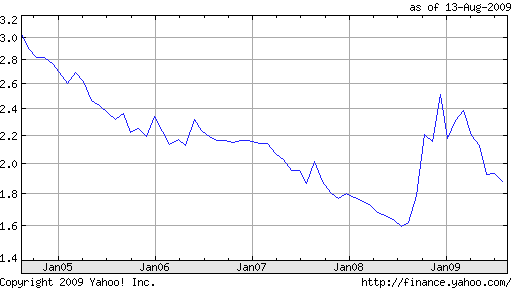
The Brazilian Real has been one of the world’s best performers in 2009, having risen by a solid 25%. The currency is now close to pre-credit crisis levels, and is even closing in on an 11-year high. When you consider that only six months ago, most analysts were painting doomsday scenarios and predicting currency devaluations and bond defaults for the entire continent, this is pretty incredible!
real-dollar

The currency’s rise has been supported by a variety of factors, few of which are grounded in fundamentals. To begin with, while Brazil has staved off depression, it’s not as if the economy is firmly back on solid footing. The economy contracted by 5% in the first quarter, and forecasts for 2009 GDP growth still vary widely, from a slight contraction to modest expansion. Meanwhile, the economy is importing more than it exports, despite the rebound in commodity prices. “The central bank said the net trade result was based on $9.89 billion in receipts for exports and $12.72 billion in import payments overseas.”

“Investment inflows, meanwhile, totaled $33.88 billion, while outflows totaled $29.78 billion.” The disparity between investment and trade data goes a long way towards explaining the Real’s rise. Thanks to a recovery in risk appetite, foreigners have poured cash into Brazil at an even faster rate than they once removed it. As a result, Brazil’s “Bovespa stock index has risen 51 percent this year, the world’s 12th-best performer among 89 measures tracked by Bloomberg, as foreign investors moved 13.7 billion reais into the market through July, the most since the exchange began tracking data in 1993. Brazilian local bonds returned 37 percent in dollar terms after falling 13.8 percent in 2008.” The country’s foreign exchange reserves also just set a new record, surging past the $200 Billion mark.

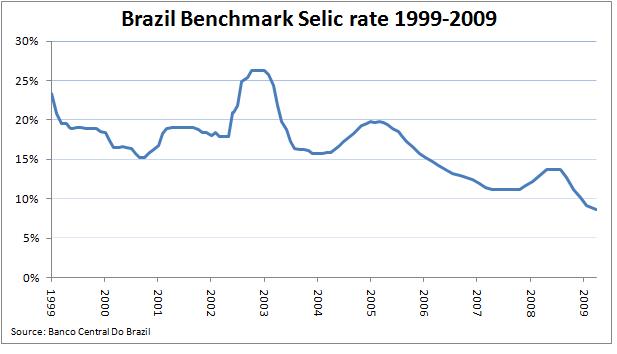
Brazilian interest rates tell the rest of the story. Despite a gradual decline over the last decade (made possible by a moderation in inflation), Brazil’s benchmark SELIC rate stands at a healthy 8.65%, which is the highest in South America, after Argentina. Unlike Argentina - and the dozen or so other economies around the world that boast equally lofty interest rates - Brazil is perceived as relatively safe place to invest. Given interest rate levels in the western world, combined with the expectation that Brazil’s currency will appreciate further, investors are more than happy to accept a little bit of risk in order to earn an out-sized return.

brazil-interest-rates-1999-2009

Just like the Bank of Korea, Bank of England (both profiled by the Forex Blog in the last week), the Bank of Brazil is not happy with the resilience in its currency. “Brazil’s central bank said on Wednesday it bought $779 million on the spot foreign exchange market this month to Aug. 7 as dollar inflows to the country surged because of growing demand for local stocks and bonds.” This brings the total intervention expenditure to $9 Billion.

Unfortunately for the Bank of Brazil, the forces in the forex market are way beyond its control. “Dollar inflows to the country totaled $2.26 billion this month to Aug. 7, compared with inflows of $1.27 billion in all of July.” Analysts are also unconvinced, and are racing to revise their Real forecasts upward. One economist, caught completely off guard, just “changed his year-end real forecast to 1.8 from 2.5 at the start of the year. ‘The resilience of the Brazilian economy to weather this crisis has been spectacular,’ ” he explained.

[...]

Korean Won Rebounds Strongly

0 comments

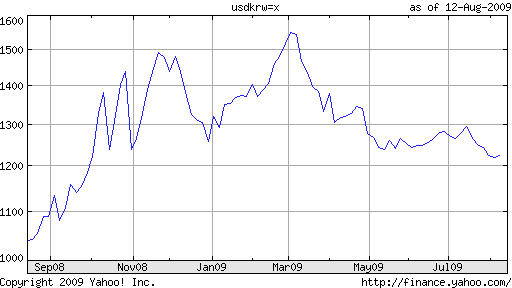
Last year the Korean Won was one of the world’s weakest currencies- and that’s saying a lot when you you consider how many currencies tanked at the onset of the credit crisis. The Won lost nearly half of its value, driven by concerns that Korean creditors would be unable to pay their foreign debts. Since March, however, the currency has rebounded by an impressive 25%, as the government took action: “To avert a crisis, South Korea forged a dollar-swap agreement with the U.S., pumped money into the banking system, boosted fiscal spending, set up funds to replenish bank capital and cut rates.”

korean-won-dollar

In the last quarter, South Korea’s economy grew 2.3%, the fastest pace in nearly six years, marking a significant turnaround from the 5% contraction recorded in the fourth quarter of 2008. Still, “South Korea’s economy will shrink 1.8 percent this year, the IMF said yesterday, revising a July prediction for a 3 percent contraction.” Exports, which account for 50% of GDP, have also recovered, and are now rising by nearly 20% on an annualized basis. Retail sales are climbing, and bank lending to households has risen for six straight months. Finally, “Stimulus measures at home and abroad are fueling South Korea’s revival. The government has pledged more than 67 trillion won ($53 billion) in extra spending, helping consumer confidence climb to the highest in almost two years in June.”

However, an inflow of speculative hot money - which has buttressed a rally in Korean stocks - threatens to undo the recovery. “With an anticipated increase in risk appetite, foreign investors may invest further in emerging-market equities, leading to more dollar supply,” said one analyst. The first half 2009 current account surplus set a record, with forecasts for the second half not far behind. Korea’s foreign exchange reserves, meanwhile, have recovered, and could touch $300 Billion within the next year.

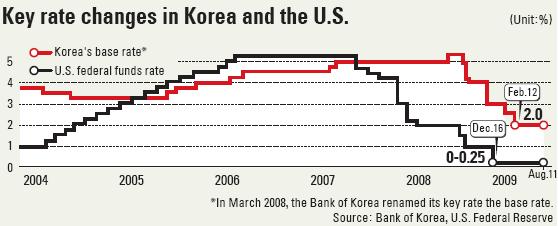
Of course, the Central bank is not simply standing by idly. It has already lowered its benchmark rate to a record low 2%, and at yesterday’s monthly monetary policy meeting, it firmly refused to consider raising it for at least six months. Commented one analyst, “There is no urgent need to raise rates. The most likely course of action is that the Bank of Korea will wait until the economy fully recovers, and in particular, they will wait until the unemployment rate stops increasing.” Still, given both that interest rates remain above levels in the west (see chart below) and that the Korean Won is considered undervalued, funds could continue to flow in.

south-korea-interest-rates-2004-2009

The Central Bank’s other tool is direct intervention in the forex markets, in order to depress the strengthening Won. But this, it is loathe to do: ” ‘It would be better to have a larger foreign exchange reserve in order to better deal with economic crises, but attempts to buy dollars to artificially boost the reserve volume could lead to accusations of currency manipulation, while excess won in the markets could stoke inflation,’ a high-ranking ministry official said.” Still, investors are growing increasingly nervous about this possibility:”A state-run bank that usually doesn’t participate much in the market bought some dollars at the day’s low, prompting speculation about a possible intervention, a local bank trader said.” Sure enough, after hitting the psychologically important level of 1,220 at the end of July, the Won dived. It has yet to bounce back.

[...]

Fed to Hold Rates for the Near Term

0 comments

Over the last week, the markets have been abuzz with chatter about how the US recession will soon come to and end, followed by a quick and healthy recovery. According to investor logic, the result would be a rise in inflation and interest rates. This optimism was partially deflated today, as the Federal Reserve bank conducted its annual monetary policy meeting.

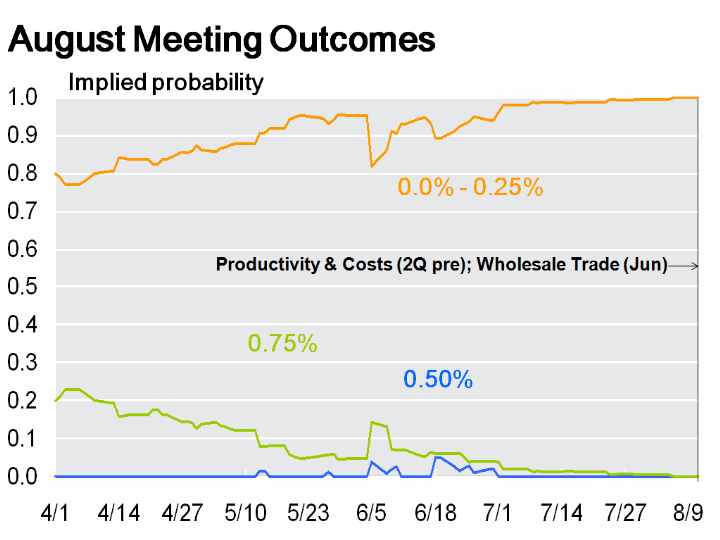
Excluding a brief uptick in June (see chart below courtesy of the Cleveland Fed), investors had long come to expect that the Fed would leave its benchmark Federal Funds rate unchanged, at 0-.25%. At the same time, there was a strong belief that the Fed would begin to hike rates at the end of 2009, and comment accordingly in the press release that accompanied its monetary policy decision. Barron’s predicted yesterday: “The statement will acknowledge some improvement in the U.S. economy, though it will imply that this nascent growth reflected in recent gross domestic product reports is fragile and will be monitored closely. This will leave open the specter that interest rates could be increased at some point in the future.”

august-ffr-interest-rate-expectations
Sure enough, the Fed left rates unchanged, and its press release conveyed a restrained sense of hope that the worst of the recession is now behind us: “Information received since the Federal Open Market Committee met in June suggests that economic activity is leveling out. Conditions in financial markets have improved further in recent weeks…Although economic activity is likely to remain weak for a time, the Committee continues to anticipate…a gradual resumption of sustainable economic growth in a context of price stability.” The Fed also announced that its Treasury buying activities would soon come to an end, although it may continue to buy mortgage securities as part of its quantitative easing program.

Perhaps the tone of the press release was slightly less positive than investors would have liked, since interest rate futures dived immediately on the news. Especially compared to last week, investors are now assuming that it will be a while before the Fed actually hike rates: “At Wednesday’s settlement price of 99.655, the February fed-funds futures contract priced in about a 38% chance for a 0.5% funds rate after the late-January meeting. That’s down sharply from about a 60% chance at Tuesday’s settlement, about a 76% chance at Monday’s settlement, and about a 96% chance at last Friday’s settlement.” Analysis of options trading activity reveals that the large brokerage houses believe similarly.

As for the Dollar, it now seems possible that last week’s rally was premature. If the Fed isn’t prepared to hike rates anytime soon, then the current interest rate differentials between the US and the rest of the world will remain intact. More importantly, the Dollar will remain a viable funding currency for carry trades, and the shift of funds into higher-yielding alternatives will probably continue for the time being.

[...]

British Pound due for Correction, Thanks to BOE

0 comments

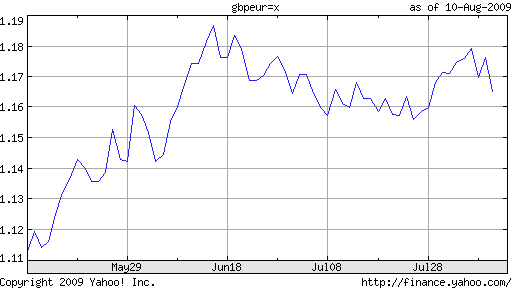
The British Pound’s rise since the beginning of March has been nothing short of spectacular: “Improving economic data have helped the pound advance 14 percent against the dollar this year and 12 percent against the euro.” Due primarily to a recovery in risk appetite and the concomitant belief that the Pound had been oversold following the onset of the credit crisis, investors began pouring hot money back into the UK. As recently as two weeks ago, one analyst intoned that, “Longer term, we are in part of an uptrend for the pound. I don’t think this is over.”

gbp-euro

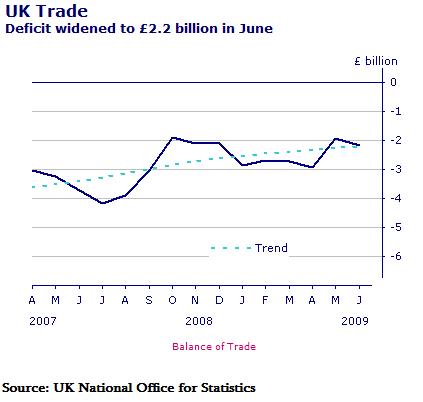
Since then, however, a series of negative developments have cast doubt on such optimism. The first was the release of economic data, which indicated an unexpected widening in Britain’s trade deficit. While exports rose, imports rose even faster, causing analysts to wonder whether it would be realistic to expect the British economic recovery would be led by exports: “We remain skeptical that the U.K. is about to become an export-driven economy any time soon. A return to sustained growth continues to look unlikely in the near term,” said one economist.
uk-balance-of-trade-june-2009

The second development was the decision by the Bank of England to expand its quantitative easing program: “The central bank spent 125 billion pounds since March as part of the asset-purchase program and had permission to use as much as 150 billion pounds, about 10 percent of Britain’s gross domestic product. Chancellor of the Exchequer Alistair Darling has now authorized an extra 25 billion pounds.” This came as a huge shock to investors, which had collectively assumed that the program had already been concluded.

Upon closer analysis, it appears that the rise of the Pound and the expanding trade deficit might have contributed to the BOE’s decision: “According to the Bank’s rule of thumb, this [the Pound's rise] is equivalent to interest rate increases of 1.5 percentage points.” However, interest rates are already close to zero. The BOE has already conveyed its intention to maintain an easy monetary policy for the near-term (March 2010 interest rate futures reflect an expectation for a 75 basis point rate hike); otherwise, there is nothing else it could do on the interest rate front. “Unless the UK is ready to deflate its production costs heavily, it can only achieve required competitiveness by reducing the value of sterling…The BoE knows this and its decision to increase its quantitative easing efforts may well have to be seen in the context of summer sterling strength.”

The final factor has been the Dollar’s sudden reversal. Previously, the Pound had been helped as much by UK optimism as by Dollar pessimism. This changed last week, when positive US economic data triggered expectations of a near-term economic recovery and consequent Fed rate hikes. In short, the Pound must now rest on its own two feet, and can no longer count on Dollar pessimism for a boost: “The current gloomy sentiment, which has chipped some 3% off sterling’s value against the dollar in the past four trading days, represents a sharp turnaround.”

The prognosis for UK economic recovery should receive some clarity tomorrow, when the Bank of England releases a report on inflation and GDP. At this point, we will have a better idea as to what to expect from the Pound going forward.

[...]

Dollar Reverses Course

0 comments

A recent WSJ headline reads, Good Economic News Threatens the Dollar, and summarizes the Dollar’s trading pattern as follows: “Demand for the U.S. currency continues to erode amid a tide of more encouraging economic data and corporate earnings that have fed a thirst for riskier assets such as stocks, commodities, and growth-sensitive currencies.”

Less than two weeks after that article was published, the Dollar rose by a healthy 2% against the Euro in only one trading session, as US labor market conditions improved slightly: “The U.S. unemployment rate fell in July for the first time in 15 months as employers cut far fewer jobs than expected, giving the clearest indication yet that the economy was turning around from a deep recession.” While technically another 250,000 jobs were lost and economists forecast that the employment rate will rise past 10% before peaking, investor sentiment is still at a high.

euro-dollar
Unsurprisingly, the news triggered a stock market rally. More noteworthy, though, is that the Dollar also rallied. Since the beginning of 2009 and especially since the beginning of March, there has been a clear negative correlation between stocks and the Dollar, as a result of risk appetite. “At one point this year, the correlation between the euro-dollar rate and the S&P 500 index hit 50 percent, according to BNP Paribas calculations. That is, the euro and S&P 500 rose or fell in tandem half the time.”

This latest development suggests that this relationship has broken down, at least temporarily. Argues one analyst, “The dollar’s going to turn. The U.S. economy is more able to withstand shocks than other economies, especially Europe.” Perhaps going forward, the markets will be driven less by risk appetite and more by comparative growth trajectories and economic fundamentals.

Not so fast, though. Much of the Dollar’s recent slide has been a product carry trading patterns, as investors borrow in low-yielding Dollars and invest in higher-yielding alternatives. An improvement in economic conditions could compel the Fed to hike rates, which would seriously dent the attractiveness of the carry trade. “Indeed, long-dated U.S. interest rates have been quietly moving in the dollar’s favor while U.S. interest rate futures on Friday started pricing in a federal funds rate of 1.25 percent by the mid-2010, the highest since June.” Based on this paradigm, then, it’s still risk appetite that’s driving the Dollar, whether up or down.

[...]

Asia Session - August 17, 2009 1:58 AM

0 comments

The Yen started off the week with a good deal of strength as investors seem to think that there are bumps ahead in the road to the much heralded global recovery. With US consumer confidence sagging and a carry-over from Wall Street on Friday pushing Asian stocks lower by over 2% in China and Japan, the Yen crosses were sold early and often in the session. Lower equities helped to cast shadows on growth and traders were eager to take profits from higher yielding risk trades. EUR/JPY was at its session high just over the 134.50 level early, but as stocks headed south, the crosses followed, with the pair touching a low near 133.60. GBP/JPY took a bigger hit as it fell from the 156.50 area to just a touch over the 155.30 level, and AUD/JPY and NZD/JPY shed 100 pips and close to 80 pips respectively on the day. USD/JPY broke the 94.85 level to the topside, but selling of dollars by Japanese exporters sent the pair below the 94.50 level. Japanese GDP data came in at 0.9%, and although lower than the 1.1% forecast, it showed that Japan has emerged from its worst recession since World War II. Although this data helped to make Japan one of the first economies to escape the recession, it was not enough to help curb the markets risk aversion. Full text »

[...]

08/16/2009 - The USD bounces back from the brink

0 comments

* Risky assets may come under increasing pressure, but…
* That’s what we’ve been waiting for
* BoE minutes due Aug 19, not much room for surprises
* German and France grow in Q2 but PMI still showing contraction
* Key data and events to watch next week

The USD finished out this past week virtually unchanged from week-ago levels against most other currencies, excluding the JPY. To be sure, there was healthy intra-week volatility in most USD pairs, but the key take-away is probably that the USD rebound following last Friday’s July NFP report was largely sustained, adding further weight to the idea that the USD has made a significant medium-term low. The other prominent result of the week is a more decisive turn lower in many of the so-called risky assets. USD/JPY most clearly surrendered all of its post NFP gains and continues to trade in near lock-step with US Treasury yields, which also gave back the bulk of their gains from last week. With the USD unchanged against most others, but down sharply against the JPY, the carry trades (JPY-crosses) have posted bearish engulfing patterns on the weekly candlestick charts, which typically warns of further losses ahead. Outside of FX, stocks continue to stall below key Fibonacci resistance at 1015/1020 in the S&P 500, while oil also looks to have more decisively given up on attempts to extend gains beyond the year’s highs around .00/50. The recent strength in gold prices also looks to be losing steam after having topped out below key technical resistance in the 5/980/oz area. Overall, though, FX and many other assets remains trapped in recent ranges… Full text »

[...]

Japanese Yen Rallies in Currency Trading

0 comments

Forex trading with the yen

The Japanese yen is rallying in currency trading on the FX market, even as the Shanghai index falls. In forex trading, the Japanese yen often moves inversely to some of the Asian stock indices. Right now the yen is gaining a bit on risk aversion as investors look for safer investments.

In addition to rallying against the U.S. dollar (which is in trouble due to the fact that equities are falling), the Japanese yen is also gaining against the Australian dollar. The yen carry trade is unwinding as China’s struggles cause problems for the Aussie in forex trading.

[...]

Aussie Tied to Chinese Demand in Forex Trading

0 comments

Australian dollar in currency trading

The Australian dollar is retreating in currency trading on the FX market on the news that the Shanghai stock market continues to slide. Indeed, because the Aussie is tied to Chinese demand when it comes to forex trading, weakness in China is a serious problem for the down under currency. GFT’s Boris Schlossberg looks at recent Aussie performance in forex trading:

The Aussie spiked to set a fresh year high of 8479 in post news reaction but has since faded back to the lower 8400s as profit taking kicked in. The AUD/USD could still make another run at the 8500 level but at this point the pair is priced for perfection and if the Shanghai slide continues, AUD/USD& relative strength could quickly turn into relative weakness and the unit could see a sharp correction in the week ahead.

China is one of the biggest importers of Australian commodities. The demand for the resources of Australia has driven the economy for quite some time. However, if China is struggling, than demand decreases and that adds weakness to Australia’s economy — and economy that has held up remarkably well throughout the recession.

[...]

London Session - August 14, 2009 5:51 AM

0 comments

Range trading has defined the European morning today. EUR/USD pushed above the 1.4300 level in Asian hours, however, the gains were reversed and a narrow 1.4255 to 1.4285 range has ensued. The JPY is moderately higher across the board on the back of speculation that Japanese investors will repatriate earnings from US treasury redemptions and coupon payments. However, the JPY is now trading off its best levels vs the USD, the EUR and the GBP. While the AUD was hit overnight by news stemming from China, some of these losses have been reversed during European hours. Full text »

[...]

Азиатская Сессия - August 14, 2009 5:28 AM

0 comments

Ранние признаки склонности к риску были раздавлены, когда акции Китая упали из-за комментария от министерства промышленности Китая, в котором было заявлено, что будет трёхлетний мораторий на одобрения на любые новые предложения которые связаны с расширением в металлургических индустриях. Во время сессии, которая, казалось бы, продолжит ослабление Доллара США, в последний момент произошёл разворот, и Доллар США и Йена оба поднялись из-за избегания риска. Full text »

[...]

Asia Session - August 14, 2009 1:50 AM

0 comments

Early signs of risk appetite were squashed as Chinese equities slid due to comments out of China’s Ministry of Industry stated that there will be a three year moratorium on approvals of any new expansion related proposals in the steel and iron industries. In a session that looked like a further extension of Dollar weakness, a late turn around and saw the both the Dollar and the Yen make gains on risk aversion. Full text »

[...]

New York Session - August 13, 2009 5:11 PM

0 comments

Disappointing US economic data cut short a rally in risky assets, sending USD/JPY and the carry trades (long JPY-crosses) lower. US July advanced retail sales disappointed expectations of a pick-up in consumer spending and posted a headline decline of-0.1% vs. a forecast gain of 0.8%. Excluding auto sales, which were boosted by the cash-for-clunkers program, the result was an even weaker -0.6% instead of the estimated +0.1% increase. Factoring out gasoline, autos and building materials, the measure used to calculate GDP, July retail sales fell -0.2%. Weekly jobless claims also tempered risk appetites, as initial jobless claims rose from 554K to 558K instead of an expected decline of similar size. The 4-week moving average of weekly claims rose for the first time since June, in another potential sign that labor markets remain extremely slack. Continuing claims did fall from 6.34 mio to 6.20 mio, but mostly due to benefits expiring rather than new jobs being found. Full text »

[...]

Trading on Momentum in Forex Trading

0 comments

Understanding the currency market

One of the things that is important in forex trading is momentum. You need to know how to use it to your advantage — and be able to exit a position when the momentum stops. The Street points this out about forex trading:

Forex traders really need to know what is going to trigger the technical setups, and therefore be prepared to ride momentum while it lasts. In the trading forex arena, there are different things to look for than in the equity and bond investment world; a week in forex is like a month’s worth of stock trade.

The Street points out that there are specific considerations for riding momentum. These suggestions include:

  • Learning about European and Nymex close.
  • S&P futures trades to get a feel for business cycle.
  • Watching for the alignment of GDP growth and equity direction.
Of course, when the economy picks up again, things are likely to change, and new conditions will have to be observed. But that is the way of forex trading. There is always change, and the chance of gains on the currency market are always balanced by the risk of possibly large losses.

[...]

Good News in Germany and France Sends the Euro Higher in Forex Trading

0 comments

Currency trading in the euro zone

The euro is heading higher in forex trading as positive news out of Europe provides a bit of a boost. In Germany and France, the GDP has turned positive. This was a bit of surprise, since things looked so horrible in Quarter 1. But the Quarter 2 numbers are in, and things are looking a bit better. At least for now.

The euro is moving higher in forex trading on the news, and the sterling has even gotten a bit of a boost. However, it is unsure how long this optimism in the euro zone will last. Questions about the sustainability of the GDP rebound are already being raise. In FX360, GFT’s Boris Schlossberg looks at the issues facing the euro zone going forward:

The question going forward however is whether government spending has created enough momentum to generate organic growth in H2 of 2009. For now all signs suggest that at the very least EZ economy has stabilized after the economic freefall of Q1 and growth should be positive for the rest of the year. Nevertheless, the key to sustainability of the recovery will depend on continued demand from China and a revival of domestic consumer spending. On both fronts there are reasons to be concerned as Chinese growth appears to have peaked in Q2 while both German and French retail sales remain moribund as consumers are still wary of economic conditions.

[...]

Is The AUD/NZD About To Move Strongly Downwards?

0 comments

The AUD/NZD pair (Aussie dollar against the New Zealand dollar) is starting to look interesting because it has just broken downwards through a tight trading range, as you can see from the chart below.

It moved strongly downwards yesterday to close at 1.2278 and could well signal the start of a strong downward breakout. It's now trading comfortably below it's 200 day exponential moving average and the fact that it's broken through an established trendline could encourage more sellers to jump on board.

To add weight to this forecast, the trade triangles provided by Marketclub have just triggered a sell signal on the monthly charts at 1.2249, which is always a strong indicator. In addition Marketclub's trend analysis currently puts the AUD/NZD on a -100 score (on a scale of -100 to +100) so it's basically in a maximum strength downward trend.

Of course all of this is no guarantee that the price will fall but my own personal view is that if the price could rebound slightly to say 1.2350 or 1.2400, a new short position could be a low-risk high reward trade.

AUDNZD15-09.png

[...]

Weekly Trading Update - 10-14 August 2009

0 comments

Well it's been a difficult and frustrating couple of weeks for me on the trading front. There was just one trade this week using my main 4 hour trading strategy. Admittedly it did bring in a small profit, but it wasn't exactly an overwhelming profit.

The trade in question was on the GBP/USD pair and took place yesterday afternoon. I was (and still am) waiting for this pair to close below 1.6425 on the daily chart in order to begin a new bearish trend, but the fact that it failed to do so, and actually moved up to create an upwards EMA crossover on the 4 hour chart, gave me confidence that I could bank maybe a few hundred points profit in the short-term.

However after entering a long position at 1.6565 the price moved up enough for me to bank my usual 50 point profit (with half the position) but after moving the stop loss up to break-even, the other half was later stopped out.

The annoying thing is that there was also an upwards EMA crossover on the EUR/USD pair but it happened overnight when I couldn't actually trade it.

If the markets continue to be this quiet I will have to start employing some of my short-term trading strategies again. Despite the fact that many of them are profitable, particularly Bill Poulos' ones, I really want to avoid doing that if I possibly can because I much prefer sitting back with my pipe and slippers and watching the 4 hour charts slowly move in my favour. It's far less stressful.

(I don't really own a pipe as I'm only 31. It's just an expression. However sadly I do own a few comfortable pairs of slippers )

Anyway have a great weekend.

(If you want to check out my main 4 hour trading strategy you can access it for free when you sign up to my newsletter. Simply fill in the short form above).

[...]

GBP/USD Analysis - Look Out For A Daily Close Below 1.6425

0 comments

After a very strong run in recent weeks the GBP/USD pair is now very close to entering a new bearish phase. The reason I say this is because the Supertrend indicator currently stands at 1.6425 so as soon as the price closes below this level, the Supertrend is going to turn red, ie bearish, for the first time since March 24th.

Therefore as a result of this, when I use my main 4 hour trading strategy (see right for details) I shall automatically be seeking out opportunities to open short positions on the 4 hour chart for this particular pair.

There are already a few signs emerging that this pair is turning bearish. For instance the CCI (20) has just crossed down through 0, the RSI has recently crossed down through the 50 level, and the Smoothed Repulse indicator (another one of my favourites) is also on the verge of turning bearish as well.

So as I say if the Supertrend turns red as well, ie closes below 1.6425, then the GBP/USD could be heading a lot lower in the coming weeks.

[...]

Fibonnaci Analysis - Why It Can Sometimes Be Completely Useless

0 comments

I personally believe that every forex trader should at least have a basic understanding of fibonacci analysis and the key levels to watch out for, which in my view are the 50% and the 61.8% levels. By plotting these two levels you can form an idea of what kind of price targets you should aim for whenever you trade any price reversals.

For example if the price has moved 1000 pips (from the low point to the high point) and is reversing back downwards quite strongly then a 50% retracement, ie 500 points, would be a good place to exit your position.

However some traders like to wait for these retracement levels to be hit before entering a new position in the direction of the initial trend. Now this is where fibonacci analysis can be a little bit hit and miss.

While you will find plenty of instances where the price has bounced nicely off of the 50% or 61.8% retracement levels and resumed it's trend, unfortunately there are just as many instances where the price has ignored these levels and just gone straight through them.

To demonstrate this point you only have to look at the recent movement of the GBP/USD pair. As you can see from the chart below the pair moved from a low point of 1.6339 all the way up to 1.7044.

It then reversed back downwards but although both the 50% and 61.8% retracement levels were both taken out (and therefore would have been good exit points), the price failed to bounce back upwards from either of these levels, so those traders who were banking on a continuation trend from either of these levels will have been left disappointed because the price didn't respond to them at all.

So the point I want to make is that although fibonacci levels are good for determining possible exit points, they are often nowhere near as reliable when you are looking for entry points for continuation trends.

GBP_USD11-09.png

[...]

Forex Technical Analysis for 08/17—08/21 Week

0 comments

EUR/USD trend: sell.
GBP/USD trend: buy.
USD/JPY trend: sell.
EUR/JPY trend: sell.

Floor Pivot Points
Pair 3rd Sup 2nd Sup 1st Sup Pivot 1st Res 2nd Res 3rd Res
EUR/USD 1.3782 1.3968 1.4075 1.4261 1.4368 1.4554 1.4662
GBP/USD 1.6150 1.6400 1.6541 1.6792 1.6933 1.7183 1.7324
USD/JPY 91.91 93.13 95.34 96.56 98.78 100.00 102.21
EUR/JPY 131.60 133.08 135.72 137.21 139.85 141.34 143.98
Woodie’s Pivot Points
Pair 2nd Sup 1st Sup Pivot 1st Res 2nd Res
EUR/USD 1.3948 1.4036 1.4241 1.4329 1.4535
GBP/USD 1.6373 1.6487 1.6764 1.6878 1.7156
USD/JPY 93.38 95.84 96.81 99.28 100.25
EUR/JPY 133.37 136.30 137.50 140.43 141.63
Camarilla Pivot Points
Pair 4th Sup 3rd Sup 2nd Sup 1st Sup 1st Res 2nd Res 3rd Res 4th Res
EUR/USD 1.4021 1.4102 1.4129 1.4156 1.4209 1.4236 1.4263 1.4344
GBP/USD 1.6467 1.6575 1.6611 1.6647 1.6718 1.6754 1.6790 1.6898
USD/JPY 95.67 96.62 96.93 97.25 97.88 98.19 98.51 99.45
EUR/JPY 136.10 137.23 137.61 137.99 138.75 139.12 139.50 140.64
Tom DeMark’s Pivot Points
Pair EUR/USD GBP/USD USD/JPY EUR/JPY
Resistance 1.4461 1.7058 97.67 138.53
Support 1.4168 1.6667 94.24 134.40
Fibonacci Retracement Levels
Pairs EUR/USD GBP/USD USD/JPY EUR/JPY
100.0% 1.4447 1.7042 97.78 138.69
61.8% 1.4335 1.6893 96.47 137.12
50.0% 1.4300 1.6847 96.06 136.63
38.2% 1.4265 1.6800 95.66 136.14
23.6% 1.4223 1.6743 95.15 135.54
0.0% 1.4153 1.6651 94.34 134.57

[...]

Dollar Down Against Euro on Zero CPI

0 comments

EUR/USD declined today for the first day since Monday, despite an increase in the industrial production and the capacity utilization, the traders were disappointed in the CPI change value and sold the euro. EUR/USD is now trading near 1.4216.

Seasonally adjusted CPI rate remained unchanged in July after increasing by 0.7% in June. The forecasts also showed 0% change for the last month.

Industrial production increased by 0.5% in July, following 0.4% decline in June. The median forecast for this indicator was at 0.4%. Industrial capacity utilization went up from 68.0% to 68.5% — up from its historical lows. A gain to about 68.3% was expected.

[...]

EUR/USD Goes to Uptrend Despite Bad Outlook from U.S.

0 comments

The dollar continued its decline against the European currency today even after the macroeconomic reports from U.S. showed a rather bad performance for the economy which is said to be the ”first out” of the crisis. The traders are probably still inspired by the positive GDP reports from Germany and France. EUR/USD is now trading near 1.4291.

Initial jobless claims rose to 558k during laster week compared to 554k reported for a week before. They were expected to go down to 540k.

U.S. import prices decreased by 0.7% in July, while export prices fell by 0.3%. In the month of June corresponding changes were at +2.6% and +1.0%.

Advance retail sales report for July showed a decline by 0.1%, following 0.8% growth in June and the same forecast for July.

Business inventories dropped by 1.1% in June after falling by 1.0% in May. The analysts forecasted a 0.9% decline.

[...]

EUR/USD Up on Trade Balance Deficit and Fed Decision Expectations

0 comments

The most popular Forex currency pair gained today, going above the highs of the previous two days, as the traders reacted to the increased U.S. trade balance deficit and the expectations of a liquidity-increasing decision from the Fed later today. EUR/USD is now trading near 1.4200.

U.S. trade balance deficit was reported at $27.0 billion for June, following $26.0 billion reported for May. Market analysts expected a growth of the deficit to $28.7 billion for that month.

Commercial crude oil inventories continued to gain in the United States last week and added 2.5 million barrels. Total motor gasoline inventories decreased by 1 million barrels during the same period.

U.S. budget deficit in July went up to $180.7 billion compared to $102.8 billion during the same month a year ago. The total yearly budget deficit is now at a new record high of $1.267 trillion.

[...]

How Many More Days EUR/USD to Decline?

0 comments

EUR/USD fell for the fourth day on the Forex market today and, although the decline is rather insignificant compared the last week’s drops, it’s still a fall that continues a technical bearish trend and has some strong fundamental reasons. The mixed economic reports coming from U.S. spur risk-awareness among the traders, giving more preference to the dollar. EUR/USD is now trading near 1.4141.

Productivity in the U.S. nonfarm business sector rose the annual seasonally adjusted rate of 6.4% in the second quarter of 2009. That’s better than 0.3% change in the first quarter and also better than the forecast for the second quarter — 5.5% growth.

Wholesale inventories surprised the global market bulls negatively today — they were down by 1.7% in June 2009, following 1.2% decline in May. Market participants expected a much lighter drop by 0.9%.

[...]

Another Windows VPS Hosting Company — Ultima Hosts

0 comments

Ultima Hosts offers VPS hosting services with a great choice of various server configurations, payment packages and operating system version (though, all of them are from the Windows family). They have a great experience in this industry — went on-line back in 2006. Unfortunately they don’t offer VPS servers with a pre-installed MetaTrader platform or expert advisors. Other important points about Ultima Hosts include:

  • $29 for a basic hosting package
  • Servers hosted in United Stats, Australia and United Kingdom
  • Payments are processed by PayPal
  • 30-day money back guarantee

[...]

Have You Ever Experienced Margin Call?

0 comments

Margin call happens when the remaining balance on the trader’s account isn’t sufficient to cover the current “paper loss” on the open positions. In Forex trading margin call is a particularly bad problem because everything is happening on-line (i.e. very fast), Forex brokers don’t like to see a negative balance (that’s their loss actually) and a high leverage can cause margin calls very often. So, when the remaining free margin in the account balance isn’t enough to cover the current loss on all trader’s position and a margin call appears, all positions are usually automatically closed out. Or only all positions with a loss are closed out, while the profitable ones remain open, that depends on a specific broker’s conditions. Forex brokers also prefer to set the margin call level to about 10%, which means that if your free margin falls below 10% of the loss on the open positions you’ll get a margin call. Brokers try to secure themselves from losses during the fast market moves, preventing trader’s balance from going below zero.

I’ve experienced margin call quite a few times during my early attempts to master a Forex trading. But during last few years I haven’t received a single margin call because I always use stop-loss levels. And what about you?

Have you ever experienced a margin call?

View Results

[...]

FX Trading — Forex Broker with a Right Name

1 comments

The newest Forex broker on my site currently is FX Trading — a rather cool name to have for a broker, in my opinion. They are on-line since 2003 but I can’t say that they are very popular, because they serve as an IB for other (more “wholesale”) broker. They are based in United States and offer Forex trading services via MetaTrader platform. This broker also has the following features:

  • 2 pip spread on EUR/USD
  • Gold and silver trading
  • Islamic accounts with no applied overnight interest
  • Payments via PayPal and credit cards
  • $500 to start trading on the mini-accounts

[...]

USD/CHF Chart Pattern on Weekly Timeframe

0 comments

A rather awkward version of a descending triangle pattern has formed on the USD/CHF weekly chart. It begins with a huge fall in October 2008 (when the global financial crisis began) and is currently coming close to its end with the range of a price change narrowing down from above. This is probably a continuation pattern that will result in a bearish breakout. Click on the image to get a larger picture:

USD/CHF, Weekly, Descending Triangle, 2009-08-08

[...]

Forex Technical Analysis for 08/10—08/14 Week

0 comments

EUR/USD trend: sell.
GBP/USD trend: hold.
USD/JPY trend: sell.
EUR/JPY trend: sell.

Floor Pivot Points
Pair 3rd Sup 2nd Sup 1st Sup Pivot 1st Res 2nd Res 3rd Res
EUR/USD 1.3777 1.3892 1.4074 1.4189 1.4371 1.4486 1.4668
GBP/USD 1.6060 1.6199 1.6455 1.6593 1.6849 1.6988 1.7243
USD/JPY 91.95 92.98 93.82 94.85 95.70 96.73 97.57
EUR/JPY 129.84 131.31 133.14 134.61 136.44 137.91 139.74
Woodie’s Pivot Points
Pair 2nd Sup 1st Sup Pivot 1st Res 2nd Res
EUR/USD 1.3908 1.4107 1.4205 1.4404 1.4503
GBP/USD 1.6228 1.6513 1.6622 1.6907 1.7017
USD/JPY 92.93 93.73 94.81 95.61 96.68
EUR/JPY 131.40 133.32 134.70 136.61 138.00
Camarilla Pivot Points
Pair 4th Sup 3rd Sup 2nd Sup 1st Sup 1st Res 2nd Res 3rd Res 4th Res
EUR/USD 1.4092 1.4174 1.4201 1.4229 1.4283 1.4310 1.4338 1.4419
GBP/USD 1.6493 1.6601 1.6638 1.6674 1.6746 1.6782 1.6818 1.6927
USD/JPY 93.64 94.15 94.33 94.50 94.84 95.01 95.18 95.70
EUR/JPY 133.15 134.06 134.36 134.66 135.27 135.57 135.87 136.78
Tom DeMark’s Pivot Points
Pair EUR/USD GBP/USD USD/JPY EUR/JPY
Resistance 1.4280 1.6721 95.28 135.52
Support 1.3983 1.6327 93.40 132.22
Fibonacci Retracement Levels
Pairs EUR/USD GBP/USD USD/JPY EUR/JPY
100.0% 1.4304 1.6732 95.88 136.08
61.8% 1.4190 1.6582 95.17 134.82
50.0% 1.4155 1.6535 94.94 134.43
38.2% 1.4120 1.6488 94.72 134.04
23.6% 1.4077 1.6431 94.45 133.56
0.0% 1.4007 1.6338 94.01 132.78

[...]
 
© 2009 | FOREX SETS | Privacy policy Forexsets.blogspot.com