Thinking of Forex Investing? – Learn Forex Trading

0 comments

The stock markets are dropping like flies and your 401k is in the red. All you see around the internet is how forex investing is making a killing for those who are in it. The tales are all there to see. “I make 100 pips a day in my underwear!” Before you jump into this bandwagon, think and learn forex trading.

There is no shortcut in forex trading. When we discussed the qualities of a successful forex trader, we noted that we need to take forex trading as a business like any other. The cardinal rule in any business is “do what you know best”. It does not change with forex trading.


Mini Forex Accounts in Forex Investing


The beauty of the forex market is that you can learn forex trading as you trade. Most forex brokers allow you to open an account and trade with little capital. These accounts are normally called mini forex accounts. Unlike stock trading where you need a significant amount, you can start most mini forex accounts with only $100.


I am in favour of opening mini forex accounts rather than free demo forex accounts since you learn best when you have some money on the line. One of the best mini forex accounts is with Oanda. I have a few of these accounts open with them and test out any new forex trading strategy with them. Use these account


Forex Online Software Trading and Managed Forex Accounts


The forex market is not immune to technological changes. From automatic forex trading software to free forex trading signals, you can have technology do the trading for you as you learn how to trade the forex market. However you have to know how to choose the best automatic forex trading software otherwise you can lose a lot of your trading capital.


There are a number of reasons why you should thing about managed forex accounts. The main one of course is to allow you to learn how to trade the forex market. There are some forex managed account providers who also offer the opportunity to teach their methods. These are few but in my humble opinion, it is best to learn from someone who is actually making a profit rather than some fake forex trading signals.


Things You Need to Learn for Commodity Online Forex Trading


Over time you will learn that commodity online forex trading involves a lot of reading. I was very disappointed with that but as long as I was making money, I did not complain. Some of the things that you are going to learn in your forex journey include and are certainly not limited to:


  • Enter forex Orders
  • Read Forex Charts
  • Use Technical Analysis
  • Manage Trading Risk
  • Manage your emotions,
  • Write Forex Systems,
  • Trade off forex news,
  • Make a trading Plan,
  • Know when to trade,
  • Test forex systems, and
  • Many more

Ahh, now you are afraid. You do not be. You will find that the forex market is one of the most challenging businesses in the world. The early years may be a bit tough but you will surely become better and enjoy making an honest online income through forex trading.

[...]

Learn Trading Forex Moving Averages

0 comments

Are forex moving averages profitable to the forex trader? The short answer is YES! There has been a concerted effort by many automatic forex trading software sellers to ridicule the effectiveness of moving averages. In fact some go to great lengths to prove that forex moving averages do not work. Doing that unfortunately is not a very good idea.

When you are looking for high probability commodity forex online trading you must find the trend of the forex market. Granted the forex market trends for only a limited time, but using trend following forex indicators will keep you in the right direction most of the time. Even if you are a forex scalper, you should know where the market is trending so that you can know where to enter or exit a trade.

Some of the best forex trading systems whether automated or not are based on the KISS principle. “Keep it Simple, Stupid”. There is no simpler forex indicator than moving averages.

What do Forex Moving Averages Do?

Moving averages in their simplest forms tell you where the forex market trend is and the strength of the trend. If the moving average is going up, the trend is up, if the moving average is going down, the trend is down. It is that simple.

The major complaint is that moving averages are lagging indicators. That is true; they are not a crystal ball. This lagging factor can cause a trader to miss the start of a major move or the end of a long trend. However, their purpose is to tell you the direction of the higher probability forex trades.

Prices tend to remain in the direction of the major trend. As long as the market stays above the moving averages, then you are in an uptrend and should be buying the currency you are trading and vice versa if prices are below the moving average.

Types of Forex Moving Averages

There are eight popular types of forex moving averages:

  • Simple Moving Averages
  • Exponential Moving Averages,
  • Time Series Moving Averages,
  • Weighted Moving Averages,
  • Variable Moving Averages,
  • Triangular Moving Averages,
  • Volume Adjusted Moving Averages, and
  • Moving Average of a Moving Average (this is becoming a popular forex indicator)

You can learn more about these and other forex indicators at the forex dictionary.

The only significant difference between these moving averages is the weight that is assigned for to the most recent forex data. For example, simple moving averages (SMA) assign equal weight to the prices, while exponential moving averages (EMA) assigns more weight to the most recent prices.

Interpreting Forex Moving Averages

Whichever types of forex moving average you choose to trade with the basic interpretation of a moving average trade is to compare the relationship between the moving average and the price of the commodity forex security you are trading.

Buy the currency when the currency rises above the moving average. Sell the Currency when the price falls below the moving average.

[...]

Choosing and Trading Forex Moving Averages

0 comments

For forex traders who are interested in trading only high probability trades, there is nothing more important than knowing the direction of the market. Unlike most other commodities, the forex market is moves very fast. Finding the trend is not easy. One of the tools we use to find the trend is forex moving averages.

Forex Moving averages are your friend. The best forex traders know that the best way to make money from trading forex is to be on the right side of the trend. In fact, you will spend the largest time in your forex trading career looking for the trend.

That is the reason every day, you will be told of new forex trading indicators and systems that will help you determine the trend.

Moving averages are simple to use and you do not have to reinvent the wheel while trading. It is best to spend your time to learn forex moving averages than buying new automated forex trading software every week. I believe moving averages are just the ultimate trend following forex indicators.

Please take the time to read a short introduction on how to learn forex moving averages.

The untold secret in the automated forex systems market is that very many of them rely on simple indicators such as moving averages. Of course, no one is about to tell you that their super system is a simple moving average crossover system.


How to Choose your Forex Moving Average

Deciding to learn or trade moving averages is the first step to forex trading success. The next step is to choose the moving averages (MA) to use.

You should understand that there are as many moving average trading systems as there are moving averages. The problem in finding the trend is not finding the perfect system, but FINDING THE MOVING AVERAGE THAT WORKS FOR YOU!

The basic rule in trading moving averages is that you should buy when currency commodity prices are higher than the moving average and sell when prices are below the currency price.

However, different period moving averages hug or follow prices in different ways.

Shorter moving averages will follow the price closer than longer moving averages. You will choose the moving averages to use depending on your trading goals and even your mental attitude.

Shorter moving averages will get you in and out of the forex market faster and more frequently than the longer moving averages. You are likely to enter into a new trend early when using a short moving average, but you are also likely to be whipsawed if the market is not trending.

The longer moving average keeps you longer in a trend but at the same time, you may exit a trade late or enter the new market late.

Trading with Multiple Forex Moving Averages

In order to try to avoid the shortcomings of trading using only one moving average, forex traders have adopted using multiple moving averages to make their trades.

Rather than buying or selling a currency based on whether price is above or below a moving average, most traders prefer to take their forex trading signals based on the cross between a number of short and long-term moving averages.

Trading multiple forex moving averages not only gives you entry signals to the market, but also confirms the validity and strength of the forex trend. If the trend is strong, the prices will stay above or below the multiple moving averages.

Let us take an example of one of the more profitable forex moving average crossover systems. It is the 10/20/100 EMA system. Try it, you may find that it works just great for you.

Anatomy of a Forex Moving Average System - 10/20/100 EMA Forex System

The basis of all trend following forex trading systems is to trade only trending markets and avoiding choppy markets. To do this forex traders will tend to use at least three moving averages to make their trading decisions.

Let us take an example of a forex trader who chooses to use three exponential moving averages. These are the 10 EMA, 20 EMA, and the 100 EMA on a 5 minute chart. The 10 EMA acts as the short term moving average, 20 EMA is the mid term moving average and the 100 EMA is the long term moving average.

Trade entry signals will occur when the 10 EMA crosses the 20 EMA. However to avoid too many trades and being whipsawed, both the 10 EMA and the 20 EMA must be in the same direction as the 100 EMA which acts as the main trend indicator.

Therefore, in the chart below, we have programmed a very simple moving average trend following system. The rules are simple

[...]

Dollar Down, Gold Up

0 comments

As an unintentional extension to an earlier post (Dollar Down, Everything Else Up), I want to use this post to highlight the appreciation of gold in particular, against the Dollar. After a brief decline following the credit crisis, Gold has resumed its upward path. It has appreciated 15% year-over-year, and recently cracked $1,000/oz for the only the fourth time in history.

The general factors behind the price of gold are too broad and numerous to be captured in this post. In addition, many of these factors have little to do with currencies (including the Dollar), and thus don’t warrant much space on a blog devoted to forex. At the same time, conspiracy theorists, doomsday predictors, and even some mainstream economists have long argued in support of gold as a hedge against inflation (otherwise understood as currency devaluation). In fact, I am only posting about gold now is because that notion has become much more popular over the last few years, to the point where pundits have come to see the current appreciation almost solely in terms of the decline in the Dollar.

That’s because many of the more conventional factors – the same ones that affect prices for other commodities – suggest that gold prices should be declining. Non-speculative demand (i.e. jewelry, industry) remains subdued as a result of the economic recession. Speaking of which; while there is now some evidence of recovery, it is nowhere near robust enough to support a return to bubble prices. In addition, the International Monetary Fund (IMF) just approved a massive sale of its gold reserves, equivalent to 15% of the world’s annual gold production.

Yet the price of gold remains not only stable, but positively buoyant. According to analysts, this is because of an increasing sense of anxiety about the viability of the Dollar as the world’s reserve currency. Euro Pacific Capital’s Peter Schiff, an effusive source of commentary on the markets, believes the price of gold will skyrocket to $5,000 per ounce. “Schiff’s forecast is based on his view the U.S. dollar is going to collapse under the weight of our massive deficit and reckless policies of the Obama administration, which he compares to the massive spending programs of the 1960s, which paved the way for gold’s ascent in the 1970s.”

Other analysts take Schiff’s view one step further by arguing that a shortage of viable alternative reserve currencies (Euro, Yen, Pound, Yuan, etc are plagued by similar fundamental flaws as the Dollar) makes gold the best candidate to replace the Dollar. Some people even hold the extreme view that the entire fiat monetary system will collapse, with the result being a barter system centered around gold. In any event, people are nervous: “That means a growing number of investors, traders — and, most troublingly, foreign governments — don’t believe in the strength of the U.S. dollar, analysts warn. People buy gold when there’s fear.”

On the other hand, it seems reasonable that gold is appreciating for the same reason that everything else is. In this sense, rising gold prices are hardly remarkable. Silver and platinum, for instance, have risen nearly 50% year-after-year, despite similarly weak fundamentals. There is a danger in connecting the Dollar’s decline too closely with the rise in gold, since the former is largely a function of short-term factors such as low interest rates and increasing risk appetite. “With the Fed confirming that interest rates could be steady for a long time, the dollar may continue to be dumped in favor of higher yielding currencies, which may favor the yellow metal.”

While there’s reason to be alarmed or even angry about deficit spending, quantitative easing, money printing, and unsustainable debt, there’s very little to support the notion that inflation is taking hold. In fact, based on both Treasury bonds and inflation securities, inflation is the last thing on the minds of investors. In addition, while gold represents a conceptual reserve commodity, it’s not very practical. It has very little utility (especially compared to other commodities), and its supply can be easily manipulated by producers and central banks. One analyst explains, “Even a rather wobbly reserve currency is better than gold. Gold is far less liquid than U.S. Treasury securities, costly to store and insure, and above all more volatile in price.”

Still, perception is reality in financial markets. If investors want to see a connection between a weak Dollar and strong gold, they will simply contrive one. But if the Fed raises interest rates and/or the Dollar stabilizes, you can expect gold prices to follow suit. If this happens, it won’t imply that confidence in the Dollar has been restored. Instead, it will only imply that investors can earn a higher return investing in Dollar-denominated assets and no longer need to speculate in gold.

[...]

09/20/2009 - Increasing signs the risk rally is stalling

0 comments

* Increasing signs the risk rally is stalling
* Mixed signals from Japan’s MOF
* Still a troubling trend in US economic data
* GBP gets thumped by the BOE
* Key data and events to watch next week

The greenback remains under pressure as the global risk rally continues. Concerns over the US fiscal deficit, the status of the US dollar as the primary global reserve currency, and near zero US interest rates all provide background noise to encourage USD selling, but the real source of USD weakness is the ongoing improvement in risk appetites globally. While we strongly believe that current risk asset market gains are overdone and ripe for a correction, solid indications of a pullback are tenuous at the moment. However, we would note that the ratio of the S&P 500 to its 200-day moving average is at historic extremes last seen in May of 1983, which was followed by a 2.5% decline in the following week. Full text »

[...]

09/27/2009 - Increasing signs the risk rally is stalling

0 comments

Increasing signs the risk rally is stalling
Mixed signals from Japan’s MOF
Still a troubling trend in US economic data
GBP gets thumped by the BOE
Key data and events to watch next week

Following last week’s preliminary signals that risk assets may be stalling, this past week saw stock markets lose ground, key commodities reverse gains, and the USD bounce after testing key support levels. To be sure volatility remained high during the week, with new risk highs being made, but weekly closing indications increasingly suggest a peak in key risk markets has been seen. There were a number of data disappointments (see below) that worked to soften risk appetites, but attempts to extend the rally ultimately failed out of exhaustion. This was most evident following the FOMC’s largely as expected statement, which noted that economic activity ‘picked up’ and that the Fed would maintain extremely low rate levels for an extended period. Those comments should have and did lead to a rally in risky assets, but, importantly, those gains could not be sustained and most finished down on the day. Full text »

[...]

London Session - September 25, 2009 4:46 AM

0 comments

Sterling has taken another hammering with the break through the USD1.6110 technical support yesterday focusing the market’s attention on the 1.550 area. That said some support has been seen this morning with cable clawing its way back above the 1.600 level and EUR/GBP finding sellers ahead of the 0.9190. There release of UK business investment data (-21.8% y/y) this morning has served to highlight the poor economic backdrop, but the pound continues to reel from yesterday’s comments from Governor King that suggested he is unconcerned about sterling weakness. Pressure is also stemming from the horrible budget deficit and continued speculation that the BoE may yet loosen monetary policy further. While the BoE has left the door open for further easing there are some signs that the tone may be altering. Remarks from the BoE’s Chief economist Dale that pumping too much money into the system could create an asset bubble hint that the BoE may becoming more conscience of inflation potential. The minutes of the Sep MPC also make note that the risk that CPI will fall below 1% had fallen from the publication of the Aug Inflation Report. Sterling would find support from a change in tone from the BoE. However, for now it seems likely that sterling will remain under pressure in the run up to the Oct MPC.

Full text »

[...]

Asia Session - September 25, 2009 1:58 AM

0 comments

The chain of events that would lead to the rebound of the US Dollar began with worse than expected existing home sales in NY earlier today and continued with a softer equity markets and uncertainty as to what comments may come from this weekends G-20 meeting. Today in Asia we saw a follow through of this dollar move, most specifically in the British Pound which was in an early free fall that was the centerpiece of the day’s events. Full text »

[...]

Forex Trading Forecast: U.S. Dollar

0 comments

Will the G-20 summit help the greenback in currency trading?

Right now, the forex trading forecast for the U.S. dollar appears a bit grim. The greenback is slated to head lower in currency trading, thanks to its new popularity as the world’s funding currency of choice for the carry trade.

Additionally, an improving economic picture could mean that the forex trading forecast for the U.S. dollar means long-term weakness as the greenback has become tied to risk appetite.

But in the short term, the dollar may see a rally. GFT’s Boris Schlossberg explains in FX360 how the G-20 summit may help the greenback in currency trading:

This new dynamic makes the dollar even more correlated to risk appetite and the greenback now only rallies when equities decline as was evident on the close of yesterday’s US session. That’s why the upcoming G-20 summit may spark a rally in the beaten down buck as traders steel themselves for possible fresh round of regulation for the financial services sector.

[...]

Looking for the Fed to Raise Interest Rates

0 comments

When with the Fed raise rates?

One of the questions many are asking right now is when the Fed will raise rates. This is an important issue, since it will signal an end to loose monetary policy needed for economic stimulus, and be an indication that the FOMC thinks that the economy is well on its way to recovery.

However, this change in interest rate policy is not likely to happen until next year. GFT’s Kathy Lien reports in FX360 on what needs to happen before the Fed will start raising rates:

In order for the Federal Reserve to start raising interest rates, they will first have to remove their excess policy accommodation and unwind some of their aggressive asset purchase programs. We expect them to do so gradually over the next few months and for traders to start thinking about a rate hike in 2010.

In the meantime, the U.S. dollar is likely to remain tied tightly to risk in forex trading. Which means that, for now, as things seem to improve a bit, the greenback is a bit lower. At least it is against the euro in forex trading.

[...]

Weekly Trading Update - 21-25 September 2009

0 comments

Well this week could have been a spectacular one but it was sadly a case of missed opportunities. I've been talking about the GBP/USD entering a new downward trend for a few weeks now but when it did finally break downwards this week, it left me behind. I was waiting for a slight pull-back yesterday morning after the initial breakout so I could get a good entry point, but sadly there wasn't one. It was a similar story on the EUR/GBP and GBP/JPY pairs as well, so in the end I only ended up trading two positions.

The first trade was on the EUR/USD pair early Tuesday morning. The daily Supertrend was green, ie bullish, so I was still looking for long positions on the 4 hour chart, and I went long after an upwards EMA crossover at 1.4710. I then closed half the position for 50 points and let the other half run, moving my stop loss to break-even. Sadly my target price of 1.4850 didn't quite get triggered, and worse still the price then fell back to take me out at break-even.

(There was another upwards EMA crossover on this pair but I didn't trade this one as I thought the upward trend was starting to run out of momentum).

The second trade was slightly more profitable. It was on the USD/JPY later that day. I went short after a downwards EMA crossover at 91.41 and then closed half the position for 40 points and the second half of the position for a further 40 points at 90.61.

So it was still a profitable week but as I say it could have been a hugely profitable week if I could have got a few good entry points on some of the big movers.

(If you would like to find out more about my main 4 hour trading strategy, you can access it for free when you subscribe to my newsletter. Simply fill in the short form above).

[...]

Free Forex Trading Video - How To Get Rich Slowly

0 comments

Many people enter the world of forex trading with the aim of making as much money as possible. However the assumption that most people make is that they need to be trading lots of positions in order to generate these big profits.

This is not necessarily the case though because it can be just as profitable (and it most cases a lot more profitable) to trade the longer term charts. I myself use the daily charts to determine the overall trend and the 4 hour charts for my entry and exit points.

However as Adam Hewison points out in his latest trading video, you can generate some serious profits by lengthening the time frame even further and trading the monthly price charts.

For example in this video you will learn how you could have successfully generated a clear profit of 6383 pips over the years just by trading the monthly chart of the EUR/USD pair. Plus because of the fact that currencies often trend for very long periods, you should see similar results when trading the other currency pairs as well.

Anyway if you would like to watch this video you can do so by clicking here.

[...]

A Milestone

0 comments

Macro Man hopes that readers will pardon a brief diversion from your regularly-scheduled macro commentary as he notes a milestone in the history of this blog.

Today, at 1.04 pm London time, this space received its one millionth visitor (from Ponte-Claire, Quebec, if you're interested) since its inception on 13 September 2006. A lot has changed since then, both in the market and in this space.

Thanks to all readers for stopping by, and especially those who contribute to what is usually a high-quality discussion of the issues and markets of the day. Cheers!

And now, back to your regularly-scheduled commentary....

[...]

Ursus Minor

0 comments

Is it time for the bears to come out from the woods? Apparently so, judging by the last 48 hours' price action and the general tone of comments in this space.

To be sure, yesterday's price action was pretty dreadful. Equities and other risk assets tried to rally, and had a modcium of an excuse to do so in the claims and house price data, but fell back to earth with a resounding thud.

What's interesting is that Macro Man's proprietary measure of risk appetite, while well below the highs reached earlier this year, remains at levels consistent with, dare we say, irrational exuberance by the standards of the pre-crisis era.

As for the whys and wherefores of the sell-off, there are two plausible explanations for yesterday's price action. The first, more prosaic, rationale was the disappointing existing home sales data, which fits the sort of brown-shoots scenario described yesterday. The alternative, sexier explanation was the Fed's announcement that it is reducing the size of the TALF/TAF programs, and the simulataneous releases from the ECB/BOE/SNB that they will be winding down some of their special USD repo facilities.

Now, all of these programs have been under-utilized in recent months, so their withdrawal should not have a particularly pernicious effect, especially as the authorities have retained flexibility to re-establish them. But one might reasonably posit that winding down unused facilities is a necessary (if not sufficient) precursor to implementing an exit strategy; while their elimination does not suggest an exodus is imminent, while they were in place one could reasonably discount the chances of a policy tightening for the tradeable future. Now, who knows, especially as the timing of the announcement in the run-up to G20 is probably not a coincidence.

That, at least, appears to have been the reaction of equity and currency markets. Today's WSJ op-ed from Kevin Warsh underscores that markets will need to contemplate the timeline of policy tightening before too long.

Interestingly, fixed income markets didn't take the same message....if anything, quite the opposite. The eurodollar curve flattened reasonably yesterday, continuing the trend of the past couple of months (proxied below by the March/Sep 2010 spread.) A eurodollar flattening implies "lower for longer"....not exactly what you'd expect from a market worried about having to contemplate tightening!
Alas, logical consistency appears to be too much to ask from this market, as currency punters know all too well. Consider the table below, which lists four countries and some relevant macro variables, and then four six-month currency moves. See if you can match which currency move goes with which country...and no cheating!
While Macro Man retains considerable sympathy for the bear case, and has enacted trades to that effect this week, he finds it difficult to fully commit to any thematic view when so many markets exhibit logical inconsistency.

So while it's tempting to have a real go from the short side and shoot for the stars, Macro Man will need to see more than two days of price action to convince him that this is the "big 'un." For now, therefore, he's happy to just aim for Ursus Minor.

[...]

What Now?

0 comments

So what now?

Last night's Fed statement was, to Macro Man's eye (and, he suspects, those of most macro guys) about as dovish as it could have been. And for the first hour of trade, the asset market reaction was predictable...short end screams higher, equities rally, and the dollar takes it on the chin.

But at some point, some time around 7.30 pm London time, it all sort of ran out of steam. First EUR/USD ran into corporate offers in the mid 1.48's, which then chased it lower, settting off stops. Then equities started trickling lower, which eventually morphed into a mini-torrent.

What happened? It's hard to suggest that the market had taken the adjustement to the MBS purchase schedule as a sign of imminent tightening when the short end a) flattened on the day, and b) closed pretty much on its highs.

Could it be- and Macro Man is ashamed to admit that this never occurred to him- that equity guys actually thought that there was a chance that the Fed would announce more QE? The very suggestion seems ludicrous to a macro observer, which is why your author never contemplated it. But it would certainly serve as the simplest explanation for the generally disappointing performance of stocks in the wake of seemed to be a very benign, reflationary statement.

Regardless, the stars may be aligning towards a somewhat less favourable environment for risk assets. Oil was a notable laggard in the entire orgy of reflation that's dominated the past few months, and in the wake of a huge composite inventory build crashed below the support level highlighted in this space the other day.

Sterling, meanwhile, has come under the cosh this morning after Merve the Swerve noted that a) it's a bit silly to get excited about a little growth after a huge recession, b) a year ago, a couple of UK banks were within hours of going bust, and c) that sterling weakness is welcome, in that it helps rebalance the UK economy.

The last comment in particular helped propel EUR/GBP to new highs for the move, putting the kibosh on a recent high-profile "buy sterling" call from a well-connected institution. Perhaps they need to get Merve on the payroll....
In any event, the issue of rebelancing is of particular relevance, particularly with the Pittsburgh G20 meeting rapidly approaching. One would like to think that global imbalances would be up for discussion; as Macro Man has said on numerous occasions, if China et. al. want a seat at the big boys' table, they need to bring something to the table, other than a set of demands. Y'know, like currency flexibility and/or convertibility, an issue which not only the US but also, increasingly, Europe are likely to highlight.

It's a particularly relevant time to address the global imbalances issue, as the beanstalk-like proliferation of green shoots may be about to slow. Economic surprise indices in both the G10 and Asia have quit going up and, if anything, look like rolling over. It's interesting to note that a number of leading indicator data points have disappointed consensus recently.
So if the second derivative/green shoot trend encounters a drought, 'twill be somewhat more challenging to avoid the siren song of protectionist, beggar-thy-neighbour policies that are already emerging in the dark corners of the global economy.

And if protectionism is allowed to flourish, green shoots-style, it won't just be Macro Man and other punters asking "what now?"

[...]

Headaches

0 comments

Well, the big day is finally here, and it's not begun terribly auspiciously. Macro Man is desperately trying to fend off a headache, as the brackets supporting his six computer screens have completely packed in this morning. The rather cubist array of monitor angles is eerily reminiscent of a Picasso painting; while that's fine for the Museu Picasso, Prado, or some other repository of the artist's work, it's not really what you want when you're attempting to track the progress of hundreds of small, flashing numbers.

The larger question, of course, is whether this evening's Fed announcement will generate headaches of an altogether more substantive sort. For choice, Macro Man suspects not; while there is some talk of the Fed starting to look at using reverse repos to drain liquidity from the system, this appears to be laying the groundwork for such a development next year rather than a sign of imminent draining. After all, there'd be little point in draining the SFB roll-off in the next couple of months when the MBS purchase program will be simultaneously increasing bank reserves.

That having been said, the FOMC will be looking at a headache of its own before too long. The deflationary impact of commodity prices, particularly energy, is already waning; by the end of the year, unchanged oil prices will generate a similar magnitude of yearly gains that a) lured the ECB into its ill-fated July 2008 policy tightening, and b) immediately preceded last autumn's global meltdown.
While it's certainly not axiomatic that a similar outcome will ensue, particularly in the absence of further marginal oil price rises, the impact of base effects on reported CPI and PPI inflation should be fairly substantial. Those Fed voters who interact with actual businesses who pay actual energy bills may eventually prove to be a headache for the more academically-inclined Fed governors who tend to rely on output gap models and measures of "core" inflation.

And that could prove to be a headache for those managers reliant on short-vol or coupon-clipping strategies. To be fair, "risk on" and carry trades have been the nonpareil money-spinners of the past few months. Anecdotally, Macro Man's sense is that just about every macro manager out there has some of the latter, even if they have disbelieved or attempted to fade the former.

For what it's worth, however, the HFR macro index has registered a pretty poor performance thus far this month. While Macro Man has certainly scuffled, there's been enough juice in the carry trades, some of his long-risk equity trades, and the dollar to avoid a shocker. He'd have thought others were in a similar boat, but on the evidence of the chart below, perhaps not.

Macro Man has long thought that the last few months of the year would prove volatile and topsy-turvy as the risk rally comes under the threat of its own success (via the implied policy tightening that it would produce.) Thus far, it's been fairly plain sailing. And while Macro Man is still positioned for the good times to continue, he's started to rein in his horns a little so as to avoid the mother of all migraines if the Fed does change its tune.

[...]

A Little Too Close

0 comments

Sometimes you can get a little too close to the market. If someone (say, a friendly punter/blogger with a tasteful double initial) had told you that there was a potentially significant event on Wednesday, but little news of consequence scheduled for release before then, what would be your a priori expectation of price action for the first half of the week?

Chances are, you'd say something like "well, there'll probably be some profit-taking, and maybe the sharks will run some stops. I guess it'll be pretty noisy." Makes sense, right? And if you run a "directional medium-term macro strategy", you'd think it would be nothing to get worked up over.

And yet, if you're there watching the screens, it's incredibly easy to get sucked into doing something stupid when you see stops being run and/or a price correction. Such as yesterday's dip down to 1.4611 in EUR/USD....which you're kicking yourself if you sold, given that we've soared to new highs...and that's before Lauren Cooper Axel Weber said "I ain't bovvered" about the level of the euro exchange rate.
Not that FX is alone in its ability to suck in the unsuspecting punter, only to spit him out with a damaged P/L. Equities looked offered-only at this time yesterday.....and now they don't.
Treasuries caught a tasty bid.....until it went away.
Perhaps the most interesting price action was in the energy complex, where oil caught a proper bollocking...CLZ9 shed $3 at one point, and appeared on the verge of breaking a rather significant trendline. Needless to say, pre-emptive selling of the break was rewarded with a nice $1 bounce and a hole in one's P/L.
Sometimes, it's useful to take a step back and recognize that for the short-term, the noise to signal ratio is likely to be close to infinite. On yesterday's evidence, you can save yourself money by not watching things too closely. So while Macro Man is ostensibly taking Mrs. Macro out to lunch for her birthday (and our wedding anniversary!) today, he may well find that it's quite a profitable idea as well.

[...]

Big Week

0 comments

It's a bit of an important week this week, and for a reason largely absent from the market calculus of the past few months. Wednesday sees the Federal Reserve announce its policy decision; while no one expects any change in actual policy, the statement will be parsed even more closely than usual for signs that the policy winds may be shifting.

That Big Ben essentially declared the recession to be over recently, in advance of the official data release, may simply have been an acknowledgement of the obvious- current quarter GDP will deliver a positive print when released towards the end of next month. Yet there may be some concerns that the Fed may start to guide the market's gaze towards its exit strategy; having been excoriated in some circles for its "free money giveaway", some Fed voters-particularly the regional presidents-may wish to signal that they do not intend to repeat Easy Al's mistake of taking forever and a day to withdraw stimulus.

The jitters caused by the "paid advisory report" last week suggest that the patient will not enjoy coming off the methadone. That equities have stumbled out of the gate so far this week does not suggest a willingness to look past a possible exit strategy, either.

That having been said, it does seem as if markets are pricing at least some degree of risk premium as to the development of an exit strategy. Using the front two eurodollar contracts, we can develop a "constant maturity" estimate of where 3 month LIBOR will be, say, three months into the future.

As the chart below indicates, markets have priced 3 month forward LIBOR higher than the spot fixing rate for the past several months after pricing it at or under the spot fixing for most of the first half of the year.
If we look at the gap, it's at the high end of the 2009 range; the peak just shy of 30 bps came on June 5, when "strong" payrolls were released and front ends went into free-fall.
What does it all mean? Frankly, Macro Man isn't positive. The rise in the forward-LIBOR risk premium suggests that the market is a touch nervous about what the Fed might come up with; as of Friday, this hadn't meaningfully impacted either equities or the dollar, though today they have reversed recent price action.

By the same token, the opening up of this little risk premium suggests that if the Fed delivers an unchanged message, a relief rally could ensue- particularly in the front eurdollar contract, where positioning is admittedly heavy but there's a bit more "juice" than in the EUR or GBP equivalents.

From Macro Man's perch, it's probably a bit early to be publicly discussing exit strategies- sure, markets have priced in a bit of reflation, but the SPX is still down 15% y/y and the dollar's largely unched over the same horizon. From the Fed's perspective, they are still at the point of adopting a "minimax" strategy- i.e., trying to minimize the losses in a worst-case scenario.

If, after a quarter or two, private demand looks resilient (and bear in mind, Macro Man is highly sceptical on this count), then the Fed will feel comfortable. But to Macro Man's mind, that's a 2010 story, not a 4Q09 one. Of course, he could be wrong...in which case it could be a big week, but not in the way that he might like.

[...]

Nervous

0 comments

A short post today, as Macro Man is tied up with various errands this morning. Suffice to say that markets feel nervous in a way that's been largely absent during the past couple of weeks' rally.

Maybe it's the volatility that always lurks on triple-witching days. Maybe it's the late-session swoon taken by Shanghai- though contrary to Macro Man's expectations of a few weeks ago, developed markets seem to have shrugged off eyeing Chinese stocks for short-term guidance. Maybe it's negative headlines on Lloyd's...it seems like the first time in a while that we've seen negative news on banks get serious airplay. Or maybe it's next week's autumn equinox, which is getting some attention as a possible source of hocus-pocus to derail the risk asset rally. (Paging the sky dog....)

In any event, after such a sharp rally in recent days/weeks/months, the market feels overdue for another look at the downside...even such a look once again fails.


So really...Macro Man can't blame markets (or himself) for feeling just a little bit nervous...

[...]

Bedtime Stories

0 comments

Macro trading is often a thankless and frustrating endeavour, not least because when things go wrong (as they often do), it is difficult to explain to a layman (or woman, or child.) Macro Man generally tries to leave his frustrations, as well as his victories, at the office; in a sense, he tries conduct his real life separately from his "Macro Man" alter ego.

Still, there are inevitable leakages. Take yesterday, when what was shaping up as a rare stellar day this month was derailed by a "paid advisory service" report suggesting that some Fed voters would already like to push for rate hikes, and that the committee generally senses that the output gap has narrowed quite dramatically. Although the report was evidently denied (perhaps after an angry phone call from the Eccles Building?), some of Macro Man's positions took a nasty dent, and his overall portfolio performance wasn't helped by a spot of execrable short term trading.

So last night, when it came time to tell the Macro Boys a bedtime story, Macro Man intended to tell them the story of The Boy Who Cried Wolf. Somehow, the nature of the story changed in the telling, however. Last night's story revolved around a paid advisory service that used to have good contacts in policy circles, oh, about fifteen years ago. Ever since then, however, this service has been consistently wrong. They issue a "ground-breaking report" which moves the market....only to be proven dead wrong. Eventually (though sadly not yet), they lose all their subscribers....so if and when they finally do get one right again, nobody listens and they go out of business.

Sadly, this wasn't the first time that Macro Man's day job has intruded on the evening ritual. Consider these other (macro) bedtime stories:

The Three Little Pigs: Three little piggies each built a house: one of straw, one of sticks, and one of stone. Unfortunately, each took out an ARM with a 1% teaser that reset after two years to LIBOR + 800. When this happened, they defaulted on their mortgages. This in turn bankrupted the big, bad, wolf, who received a hefty government bailout and a stern warning not to lend to little piggies ever again.

Jack and the Beanstalk: Jack was a young man who managed his mother's retirement finances. He put them all into structured credit vehicles which blew up, leaving Jack and his mother with nothing but three magic beans. Jack's mother was so irate that she kicked Jack out of the house and threw the beans out of the window. With nothing better to do, Jack pledged the beans as collateral to the government in their PPIP program. Eventually, the beans sprouted into mighty green shoots; Jack climbed up and paid himself a big fat bonus with the pot of gold he found at the top.

The Five Chinese Brothers: Once upon a time, there were five Chinese brothers. The first brother owned a toy factory in the Pearl River delta, but it went bankrupt when labour costs rose and Western consumers quit buying so many toys. The second brother applied for a loan to speculate on the price of copper. The third brother applied for a loan to speculate on equities. The fourth brother applied or a loan to set up a joint venture with a foreign electronics manufacturer, so that he could reverse engineer the products and eventually set up his own factory to make cheap replicas. The fifth brother was in charge of the local disbursement of central government stimulus funding; he fast-tracked all the loans, and the entire family became fabulously wealthy.

Dr. Strangelove, or how I learned to stop worrying and love the stock market: It's not really suitable for children, and in any case the story is still being told. Macro Man'll let you know how it ends....

[...]

USD/CAD - Trendline Breakout after Double-Bottom

0 comments

USD/CAD Daily ChartAfter forming the potential beginnings of a double-bottom pattern, price action on USD/CAD, a daily chart of which is shown, has risen to make a tentative breakout above a key downtrend resistance line extending from the 1.3060 long-term high reached in March. Currently, a key upside resistance level to watch for is the 1.1120 price region, which represents the rough peak of the potential double-bottom formation. For more technical analysis on this currency pair, please click here for Friday’s (9/25/2009) Chart of the Day.

[...]

English Forex Broker Rich in Trading Instruments

0 comments

Azurite Markets is a latest addition to the list of the Forex brokers on my site. It’s a company registered in England and Wales and regulated by the Financial Service Authority (FSA). The most notable feature of this broker is that it offers a large variety of the trading instruments, including but not limited to: common Forex pairs, CFD, soft and grain commodities, energy commodities (including oil and gas), metals (including gold and silver), indexes, and Forex futures (like the Dollar Index). The trading for all these instruments is performed from one account, which is very convenient. Other important features of Azurite Markets are:

  • $100 effective minimum account size to start trading
  • Advanced Forex trading platform
  • Web Trader to trade directly from browser
  • Muslim-friendly accounts on request
  • Mini Forex trading lots
  • Deposit/withdrawal only via the wire transfer

[...]

Forex Technical Analysis for 09/28—10/02 Week

0 comments

EUR/USD trend: sell.
GBP/USD trend: hold.
USD/JPY trend: buy.
EUR/JPY trend: buy.

Floor Pivot Points
Pair 3rd Sup 2nd Sup 1st Sup Pivot 1st Res 2nd Res 3rd Res
EUR/USD 1.4309 1.4412 1.4561 1.4664 1.4813 1.4916 1.5065
GBP/USD 1.5649 1.5939 1.6104 1.6394 1.6559 1.6849 1.7014
USD/JPY 88.87 89.49 90.39 91.01 91.91 92.53 93.43
EUR/JPY 128.65 129.97 132.13 133.45 135.62 136.93 139.10
Woodie’s Pivot Points
Pair 2nd Sup 1st Sup Pivot 1st Res 2nd Res
EUR/USD 1.4424 1.4584 1.4676 1.4836 1.4927
GBP/USD 1.5908 1.6041 1.6363 1.6496 1.6818
USD/JPY 89.56 90.53 91.08 92.05 92.60
EUR/JPY 130.18 132.56 133.66 136.04 137.14
Camarilla Pivot Points
Pair 4th Sup 3rd Sup 2nd Sup 1st Sup 1st Res 2nd Res 3rd Res 4th Res
EUR/USD 1.4572 1.4641 1.4664 1.4687 1.4733 1.4757 1.4780 1.4849
GBP/USD 1.6019 1.6144 1.6185 1.6227 1.6311 1.6352 1.6394 1.6519
USD/JPY 90.45 90.87 91.01 91.15 91.43 91.57 91.71 92.12
EUR/JPY 132.38 133.34 133.66 133.98 134.62 134.94 135.25 136.21
Tom DeMark’s Pivot Points
Pair EUR/USD GBP/USD USD/JPY EUR/JPY
Resistance 1.4865 1.6704 91.46 134.53
Support 1.4613 1.6249 89.94 131.05
Fibonacci Retracement Levels
Pairs EUR/USD GBP/USD USD/JPY EUR/JPY
100.0% 1.4767 1.6684 91.64 134.77
61.8% 1.4670 1.6510 91.05 133.44
50.0% 1.4641 1.6457 90.88 133.03
38.2% 1.4611 1.6403 90.70 132.62
23.6% 1.4574 1.6337 90.47 132.11
0.0% 1.4515 1.6229 90.12 131.29

[...]

EUR/USD Grows on Consumer Sentiment, Ignores Housing

0 comments

EUR/USD went up slightly at the Forex market today as the traders are unsure whether it’s a good idea to go for a full-scale correction after months of growth. The currency pair was in a consolidation during the early trading session but then went into a green zone after the traders began to react on the positive consumer sentiment report, ignoring the worse than expected data on new home sales in United States. EUR/USD is now trading near 1.4705.

Durable goods orders unexpectedly decreased by 2.4% in August after rising by 4.8% in July. The forecast change for this indicator was positive at 0.1%.

Michigan University consumer sentiment index rose from 65.7 to 73.5 in September — the highest level since early 2008. The expected value was at 70.2 for this index.

The new home sales report continued the cause started by the yesterday disappointing existing home sales report. The seasonally adjusted annual rate of the new home sales was at 429k in August — up from 426k in July (revised down from 433k) but below the average forecast of 440k.

[...]

FOMC: Business as Usual

0 comments

As anticipated, the Fed kept the federal funds rate within their 0.25% target and made no adjustments in the amount of their asset purchases. Team Bernanke noted that economic activity has picked up its pace while conditions in the financial markets continue to improve. They echoed most of their comments from the August meeting and said that they will continue to employ a wide range of tools to promote economic recovery and price stability. None of this surprised me - it's not like we haven't heard this before!

According to them, inflation would remain subdued for the meantime since they believe that the output gap should keep a lid on price hikes. This is accompanied by their typical note of caution; saying that ongoing job losses, sluggish income growth, and tight credit would constrain the nation's economic recovery. They pointed out that businesses are still cutting back on investment and hiring, though, at a slower pace this time.

The Fed will continue its $1.25 trillion plan to purchase asset-backed securities, but they mentioned that they would be extending the pace of these purchases from December to March. Some experts believe that the extension of the asset purchase would smoothen out the injection of money to the economy.

Is the Fed correct in their claims that the economy is headed towards recovery? With the Fed phasing out their stimulus measures, could this mean that a return to normal market conditions is in order? Let's take a look at some recent data...

The ISM manufacturing PMI, an indicator of how the manufacturing industry is faring, finally busted out of its rut and posted a reading of 52.9. A reading above 50 means the manufacturing industry is expanding. This was the first reported expansion since June 2007.

Retail sales also grew unexpectedly in August. The core report, which excludes the price of volatile items such as automobiles, almost tripled forecasts. It showed a whopping 1.1% gain instead of the 0.4% consensus. Looking beneath the headline figure, the gains primarily came from the increased purchases of general merchandise and clothing.

These positive data seem to indicate that the Fed's programs to unfreeze tight credit markets, such as the cash-for-clunkers and asset buy-back program, have finally worked their magic. Still, there are two very important issues are really weighing down on recovery - employment and housing.

Let's start with the labor market. Weekly initial jobless claims have been showing improvements as of late. This past week showed an unexpected drop to 530,000, down from 550,000 the previous week. This brought claims down to its lowest level in two months. In addition, the most recent NFP employment change report showed that firms only slashed about 216,000 workers, better than the 276,000 jobs lost in the previous month.

What's interesting here, however, are the negative revisions in all the previous results. And despite the "improvements" in the mentioned accounts, the jobless rate in the US still rose to 9.7% from 9.4%.

A more daunting number is reflected in the so called under-employment rate. This rate includes part-time workers who prefer a full-time position but cannot find one and people who want work but are already discouraged to keep searching. As it is, the figure stands at a whopping 16.8%!

As for the housing market, data released last Thursday indicated that sustainable recovery might take a while, as there was a surprise drop in existing home sales in August. The annualized number of home sales unexpectedly slid by 2.7% from 5.25 million in July to 5.10 million this past August. This marked the first drop in 5 months.

Digging deeper, about 30% of the total home sales in July and August were from first-time buyers. And in case you didn't know, an $8,000 tax credit was given to first-time home buyers in an effort by the government to boost residential property sales. Note that the Fed's mortgage-backed securities purchase program accounts for about 80% of the market.

Without tax credits and a longer asset-purchase allocation, how will the housing market fare?

Okay, now let's get to the good stuff, the stuff all you forex freaks have been waiting for: What does all this mean for the dollar?

Just this past week, we've seen the dollar hit some lows against higher yielding currencies. The EUR, CHF, AUD, CAD and NZD have staged stellar rallies as they took advantage of USD weakness. But after the Fed announcement, the USD finally fought back.

After the lackluster Fed meeting, is it possible that currency traders have realized, once again, that they have overextended themselves? I don't know but with the earnings reports coming up soon, we could see some drastic changes in risk sentiment!

Forex News
Forex Reviews
Forex Trading Journal
Forex Answers

[...]

Daily Economic Roundup - September 25, 2009

0 comments

United States

"Dolla dolla bill yo!" was buzzing through my head yesterday as dollar buying blazed through the markets yesterday. The USD gained against most major currencies, after it had been hitting yearly lows. Is the dollar back on track... or could this merely be a retracement? More...

Euro zone

Just like my good friend Big Pippin said in his daily chart art, the euro took another hit from the dollar yesterday as it fell more than 150 pips during the US afternoon session. Whether the move a major bearish correction or the start of a new trend remains a question needing an answer. More...

United Kingdom

The Pound got blitzed several times by the Green Back-ers at yesterday's Rose Bowl. They were simply out muscled, outsmarted, and outclassed. The result? A 325 pip touchdown! More...

Japan

The JPY hit the jackpot in yesterday's trading as it ended the session positively over all the other major currencies. Its biggest score was against the pound when it closed at 146.53 from a high of 149.38. More...

Canada

The USDCAD broke free from consolidation mode and sprinted towards the 1.0900 mark yesterday. While the USD staged a strong rally, the CAD and its comdoll allies were unable to draw strength from gold and oil prices. More...

Australia

Ouch! The AUDUSD got bruised and battered as the USD trampled upon higher-yielding currencies yesterday. The surge in Australia's new home sales was not enough to prop up the AUD, which was pummeled by risk aversion ahead of the release of the G20's final statement. Commodity prices were unable to provide support for the comdolls as oil prices fell by more than 4% while gold sank below 1000 USD per barrel. More...

New Zealand

The NZD traded in a U-shaped manner against the USD yesterday. It was able to gain early in Asia as the Westpac consumer sentiment survey printed stellar results but fell sharply when risk aversion took hold of the markets when the US session came rolling along. More...

Switzerland

The Swissy got sliced up a little bit, as it lost out against the US dollar like most majors. The USDCHF pair closed yesterday at 1.0301, marking the second consecutive day it rose. More...

[...]

Daily Economic Roundup - September 24, 2009

0 comments

United States

The USD was taken for a wild ride yesterday as the Fed said left benchmark interest rates steady at 0.25% and maintained the size of its asset buying programs. Investors sold the dollar after the announcement but the currency found support quickly when the initial selling frenzy ended. More...

Euro zone

The EUR came in to disappoint yesterday as it slumped against both the greenback and the yen. The EURUSD actually hit a new high at 1.4843, before the USD rallied late in the US session, causing the pair to close significantly lower at 1.4742. More...

United Kingdom

The pound let out a sigh of relief as the monetary policy committee voted unanimously to leave rates and their quantitative easing measures at their current levels. The optimistic US FOMC statement also pushed the GBPUSD to trade above the 1.6400 level. However, the GBPUSD erased some of its gains when the USD reversed its course at the end of the US session. More...

Japan

The JPY stumbled across the charts as it traded mixed against the USD, GBP, and AUD. The US FOMC statement sparked a bit of risk tolerance, forcing the JPY to give way to other major currencies. It's a good thing Japan's trade balance came in better than expected, otherwise the JPY wouldn't have been able to recover some of its losses. More...

Canada

Lots of up and down movement on the Loonie yesterday, although ranges pretty much held. The USDCAD closed higher at 1.0753, as we saw oil prices fall below $69 per barrel. More...

Australia

The AUDUSD rose sharply yesterday and was poised to break through the .8800 handle, before it came crashing down as the USD benefitted during the aftermath of the Fed's FOMC report. While the pair set a new yearly high, it ended on a sour note for the day, closing lower at .8704. More...

New Zealand

It was a crazy day for the Kiwi yesterday as it swung wildly on both sides. It started the day with a blast when it zoomed against the JPY and the USD during the early part of the Asia session. Its gains, however, was short lived and was completely reversed upon the release of the FOMC statement. More...

Switzerland

The USDCHF just bounced around a 75 pip range yesterday as traders ponder where to take the pair next. The pair has been consistently making new lows and if this keeps up 1.0000 seems like a very plausible target for CHF bulls. More...

[...]

Dollar Down, Everything Else Up

0 comments

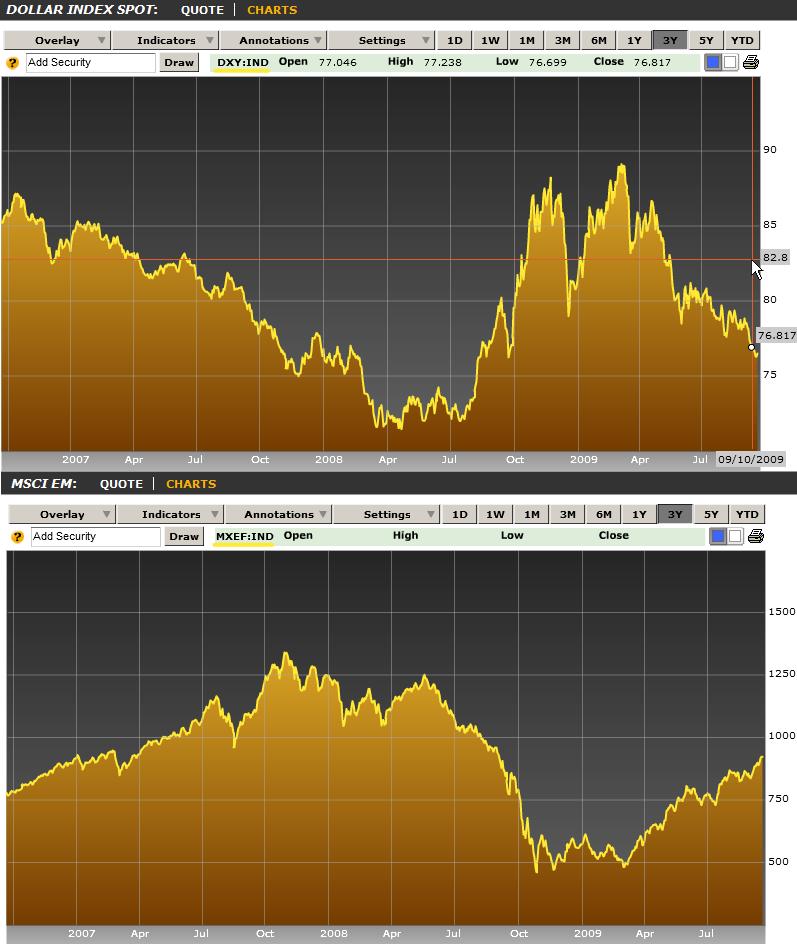
Since March, the financial markets have been characterized by several generalizable trends, which can pretty accurately be distilled into the title of this post: Dollar Down, Everything Else Up. To illustrate just how intertwined these two trends are, consider that on the same day, “U.S. stocks rose, sending the Standard & Poor’s 500 Index to an 11-month high,” and “The dollar slid to an almost one-year low.” Two perfect to be a coincidence. Look at the charts below, which show the performance of the US Dollar and Emerging Market Stocks, respectively. Subtract out the stochastic fluctuations, and you’re left with two mirror images!

charts

In this case, connecting the dots is not difficult. In fact, I don’t know of any analyst that has argued against an airtight inverse correlation between the Dollar and virtually every other commodity/security/currency. A solid explanation can be found in an earlier Forex Blog post “Dollar Under Pressure on All Fronts,” which detailed both the short-term and long-term drags on the Dollar, but I’ll summarize and expand upon it below for those of you who didn’t read the first iteration.

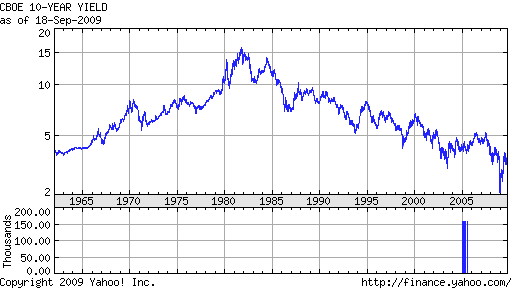
In the short-term, the Fed’s easy monetary policy is one of the most salient factors. It has injected more than $2 Trillion in US capital markets since the start of the credit crisis, and lowered interest rates close to 0%. In fact, the Dollar is now the cheapest funding currency in the world, recently eclipsing Japan, the perennial home of cheap capital. Moreover, US rates are expected to remain low for the near future. According to one analyst, “Congressional elections in November 2010 represent a strong incentive for the Fed to stand pat. That is because going into an election, there often is political pressure to keep rates low and give a boost to the economy.” This belief is reflected clear in US Treasury rates, which remain relatively close to the all-time lows touched in 2008.

_tnx
In other words, it’s a classic carry trade scenario, with the US footing the bill. Of course, there’s a twist, namely that there’s so much cash floating around the system, that all of it can’t be invested abroad. Hence, the whopping 58% rise in the S&P 500, from trough to present, as well as the recovery in gold, oil, and other commodity prices. You will find plenty of analysts who point to impressive graphs and quote equally impressive statistics to explain these seemingly distinct instances of appreciation. But from where I’m standing, the fact that everything is under the sun (except for real estate, but that’s another story) is rising would lead the proverbial alien watching from outer space to conclude that investors have adopted a bubble mentality, and are once again chasing returns wherever they can be found.

The strongest support for this explanation can be seen in the fact that signs of US recovery have not been accompanied by Dollar strength. By most estimations, the US economy is now stronger (despite the employment picture) than the UK and the EU, at the very least. Yet the Euro and British Pound have far outpaced the Dollar over the last few months, picking up steam once again over the last few weeks.

You don’t need me to tell you that this is a product of risk aversion; that, ironically, signs that the US economy is strengthening/stabilizing causes investors to move capital out of the US economy. If investors were betting on fundamentals, as stock market bulls would have you believe, this would be plain irrational. But the fact is, US economic growth makes investors more confident in global growth, and causes them to turn towards more speculative investments to achieve yield.

In analyzing whether this phenomenon is sustainable, then, it doesn’t make sense to look at the different markets, in isolation. Rather, you must be holistic in your approach, basically by examining whether investors are justified in their overall complacency. If ever it was the case, it certainly is now: perception is reality.

[...]

Bank of Canada Versus the Loonie

0 comments

I toyed with the title of this post for a while, and ultimately settled on the current iteration, because it reflects the battle that is being waged between the Bank of Canada and the forex markets. Simply, the Loonie is moving in one direction (up!), while the BOC would prefer that it moves in the opposite direction.

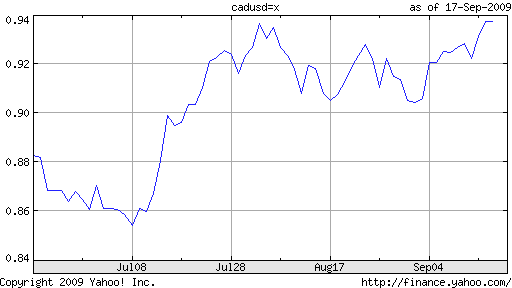
Let’s start with some context: the Canadian Dollar’s performance this year has been impressive, to say the least. 2009 is far from over, and yet the Loonie has already risen 14% against the Dollar, almost completely undoing the record 18% slide in 2008. Analysts are quick to point to the nascent Canadian economy, fading risk aversion, and the ongoing boom in commodities prices as behind the currency’s rise.

While all of these reasons are certainly valid, they hardly tell the whole story. Consider that Canadian growth remains tepid, deflation is now a reality, its currency is outpacing commodity prices, and its budget deficit will probably set a record this year. Regardless of what the future holds for the Canadian economy, the present remains nebulous. Thus, it seems the best explanation for Loonie strength is not to be found in Canada, but across the border in the US. Specifically, it is US Dollar weakness, and momentum-driven speculation based on the expectation of further weakness, that is driving the Canadian Dollar.

From the Bank of Canada’s standpoint then, the Loonie’s move back towards parity has nothing to do with fundamentals, which is why the BOC maintains that the currency represents a threat to both recovery and price stability. He has a point on the second front, since inflation is currently running at an annualized rate of -.8%, marking three consecutive months of deflation. “The [inflation information] has proved the Bank of Canada’s concerns are justified,” confirmed one analyst.

The Million Dollar Question then, is how far the BOC is willing to go to halt the Loonie’s ascent. Bank of Canada Governor Mark Carnet has already intervened vocally, by repeatedly signaling his displeasure with recent developments in forex markets, and suggesting that all options remain on the table. But rhetoric only goes so far, and after a brief pause, the Canadian Dollar has resumed its rally. “We think [rumors of intervention] it’s 100 percent untrue. I don’t think the bank has the ammunition or the desire to intervene. This is a story about U.S. dollar weakness across the board,” said one trader.

cad
The Bank has already exhausted most of the tools in its monetary arsenal. It recently voted to maintain its benchmark interest rate at the current record low level of .25%, and beyond extending the period of time during which it maintains low rates, there isn’t much more it can do on this front. Besides, conveying an intention to hold rates at .25% beyond June 2010 might not influence investors, who don’t seem too concerned about low yields offered by the Loonie. Moreover, it remains loath to copy the quantitative easing implemented by the Fed and Bank of England, because of the tremendous amount of work required to mop up“that increase in liquidity when the time comes.

In other words, the only thing the BOC can do at this point is to actually intervene, probably by buying US Dollars on the spot market. A couple obstacles are the fact that the BOC hasn’t intervened for over 10 years, and that Prime Minister Stephen Harper is simultaneously trumpeting the importance of “flexible exchange rates” in speeches intended to denigrate China.

In fact, the BOC may not have to get involved, since the consensus among analysts is that the Loonie will trade sideways for the next year. “According to…52 strategists polled by Reuters…In three, six and 12 months, the median estimate of those polled had the domestic currency steady at $1.100 to the U.S. dollar, or 90.91 U.S. cents.” Moreover, polled analysts based their forecasts on a mere 17.5% of intervention, which means that irrespective of the BOC, most forecasters think that the Loonie has reached its potential…for now.

Of course, if the Loonie fulfills estimates at the high end of the poll – especially in the short-term, and if inflation remains negative, the BOC could find itself with no other choice. But for now, investors aren’t holding their breath.

[...]
 
© 2009 | FOREX SETS | Privacy policy Forexsets.blogspot.com